
Illustrated · 1 min
By Gabi Slizewska

+1 contributors
Contributors


Image source: By Gabi Slizewska
Illustrated · 1 min
Image source: By Gabi Slizewska
Illustrated · 1 min
First up in photosynthesis are the light-dependent reactions. They occur in the chloroplast's thylakoid membranes. Thylakoids are the little pancake structures inside the chloroplast, and they are the reaction centers for this process. They form stacks called grana.
In the light-dependent reactions, sunlight is absorbed by chlorophyll molecules.
Water and light are used to produce oxygen () that leaves the plant through little holes called stomata (singular: stoma). Stomata are found on plant stems and leaves.

Image source: By Photohound [Public domain], via Wikimedia Commons Image source: By AioftheStorm CC0, via Wikimedia Commons Image source: By domdomegg CC BY 4.0, via Wikimedia Commons
In addition to oxygen gas, the light reactions produce ATP and an electron carrier called NADPH.
NADPH has pretty much the same job as NADH in cellular respiration: carry electrons from one reaction to another. (To keep NADPH and NADH straight, let the "P" in NADPH remind you of "photosynthesis".)
Here's a summary of the reactions:

This picture shows what goes into the light-dependent reactions and what is produced. Note that chloroplasts are full of many stacks of thylakoids, but I've just included one here to keep it simple. Image source: By Hannah Bonville
Illustrated · 2 min
The light reactions are a factory for producing ATP and NADPH, which are essential molecules to be used later in the production of glucose. Much like the mitochondrion, the chloroplast uses proteins to create an electrochemical gradient.

Image source: By Kelvinsong CC BY 3.0, via Wikimedia Commons
These reactions occur inside of chloroplasts, across the membrane of the thylakoids. The reactions are an electron transport chain that builds up a high concentration of hydrogen ions inside the lumen of the thylakoid and a low concentration of hydrogen ions inside the stroma of the chloroplast.
It all begins with a photon of light striking a pigment molecule, like chlorophyll, inside of photosystem II.
Photosystem II is a big protein complex that spans the phospholipid bilayer of the thylakoid. When the light hits the pigment, the protein becomes excited and releases an electron. Once two electrons have been excited and released, they are transferred to the mobile electron carrier plastoquinone. Plastoquinone picks up two hydrogen atoms from the stroma, in addition to those two electrons. This starts the formation of the electrochemical gradient.
The two electrons that have been removed from photosystem II by plastoquinone are replaced by splitting a water molecule. When the water is split, the two hydrogen atoms are displaced into the lumen, further building the gradient. The oxygen from the water is released as a by-product.

Image source: By BlueRidgeKitties CC BY 2.0, via flickr.com
Plastoquinone, which is now carrying two electrons and two hydrogens, drops the electrons off at the cytochrome B6f complex. This protein transfers the two hydrogens into the lumen and passes the electrons off to another protein carrier, plastocyanin. Transferring the two electrons allows the cytochrome B6f protein to pump another two hydrogens, for a total of four, into the lumen.
The electrons are carried by plastocyanin to photosystem I, where they are again excited by some incoming photons. The now re-energized electrons are transferred to FNR, a protein that binds electron acceptor NADP with a hydrogen, creating NADPH which will be used in the Calvin cycle.
The hydrogen atoms that have been pumped into the lumen at this point are in a really high concentration and want to diffuse back to equilibrium. Because the phospholipid bilayer is both polar and nonpolar, they have to leave the lumen and go into the stroma through a protein called ATP synthase. As the hydrogens pass through ATP synthase, they generate enough energy to add an additional phosphate group onto ADP, making ATP.
Interactive · 1 question
Photosynthesis involves two sets of reactions: the light-dependent and the light-independent reactions.
The light-dependent reaction requires sunlight and pigments; that's why it's called the light reaction. Light-dependent reactions use solar energy to convert ADP and NADH to ATP and NADPH, while also producing oxygen. These reactions take place in the thylakoids of the chloroplast, which are small disk-like sacs that contain chlorophyll and proteins called photosystems.
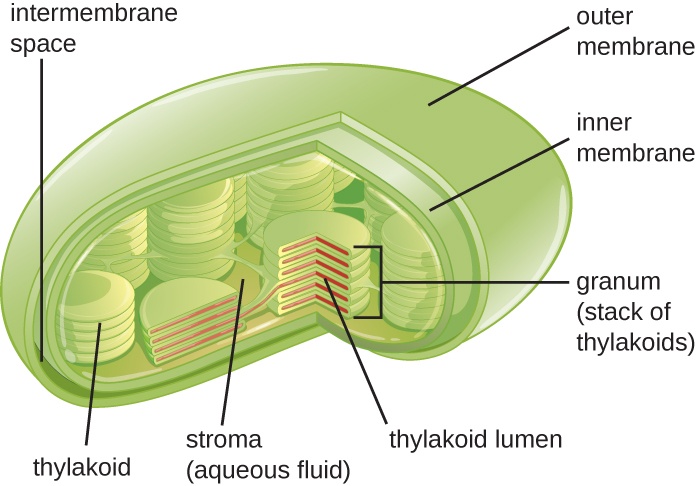
Image source: By CNX OpenStax CC BY 4.0, via Wikimedia Commons
The light-dependent reaction has four separate steps: photosystem II, electron transport, photosystem I, and hydrogen ion movement and ATP formation.

Image source: By Daniel Mayer; Vector version by Yerpo CC BY-SA 4.0, via Wikimedia Commons
The first step is photosystem II, where light energy is captured by pigments. Absorption of a photon of light causes the pigments' electrons to have a higher energy. The high-energy electrons are then passed to the electron transport chain. This process happens as long as there is light available. The transport proteins continue to move the high-energy electrons through the transport chain.
The system never runs out of electrons because part of the thylakoid membrane is able to replenish electrons in the chlorophyll. It does this by tearing apart water molecules into two hydrogen ions, two electrons, and an oxygen atom. The oxygen atom is released as a waste product while the hydrogen ions are used within the thylakoid.
Next, as high-energy electrons are moved down the electron transport chain, their energy is stripped by proteins along the chain. The stripped energy is used to allow hydrogen ions (H) to pass from the stroma to the thylakoid space. They then become a part of photosystem I.
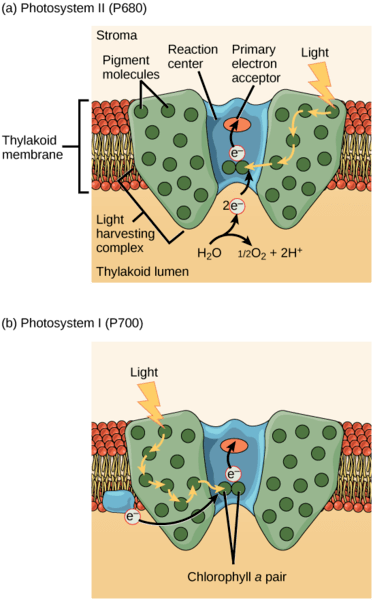
Image source: By CNX OpenStax CC BY 4.0, via Wikimedia Commons
By the time the electrons reach photosystem I, they have lost a fair amount of energy from pumping hydrogen ions into the thylakoid space. The electrons are re-energized by energy gathered from the pigments in photosystem I. The newly energized electrons are sent to another, thankfully shorter, electron transport chain leading to the stroma. NADP molecules pick up these high-energy electrons and hydrogen ions from photosystem II in the thylakoid space to become NADPH.
The last part of the light-dependent portion of photosynthesis is ATP formation and the movement of hydrogen ions (H). The hydrogen ions collecting in the thylakoid space create a gradient, or an uneven distribution, between the thylakoid space and the stroma. The gradient causes an enzyme called ATP synthase to spin around, attaching phosphate groups to ADP to create ATP.
Why are the light-dependent reactions named this way?
: The process of capturing solar energy to produce chemical energy
: A molecule that stores energy in its bonds. The cell is able to break these bonds to release energy
: Light-dependant reactions use solar energy to convert ADP and NAD to ATP and NADPH, while also producing oxygen
: This is how ATP and NADPH from the light reactions are used by the cell to create sugars
Video
by ndsuvirtualcell

Watch this video for a great visual representation of how ATP, NADPH, and oxygen are produced during photosynthesis.
Video
by RicochetScience
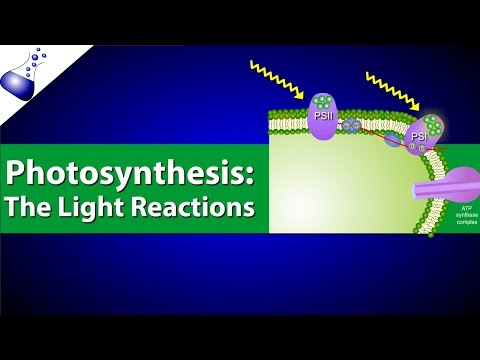
How exactly do plants create ATP and NADPH? Check out this video to see the electron transport chain in action.




