Limiting Reagent — Definition & Examples

Interactive · 1 question

Reagents in a Chemical Reaction

The limit on the amount of product formed is caused by a limiting reagent/reactant. A limiting reagent is used by a reaction and determines the amount of product made.

In a chemical reaction, two or more reactants/reagents cause changes in each other to create new materials or products.

Reaction 1: A+B→ABA + B \rightarrow AB

In Reaction 1, reactants A and B react to form a single product with A and B combined to form a new product. This is similar to combining equal parts rain and sunlight to form a single rainbow (Reaction 2).

Reaction 2:

Image Description: Sun plus rain equals a rainbow

By: Cassie Gates

Reagents can Limit Products formed!

Not all reactions occur with reactants combining equally. Let’s consider a sandwich! To make a basic sandwich with bread and cheese, we need two slices of bread and one slice of cheese (Reaction 3).

Reaction 3: 2 Bread Slices+1 Cheese Slice→1 Sandwich2\ Bread\ Slices + 1\ Cheese\ Slice \rightarrow 1\ Sandwich

Now let’s consider two different scenarios:

Reaction 4: 5 Bread Slices+5 Cheese Slice→2 Sandwiches5\ Bread\ Slices + 5\ Cheese\ Slice\rightarrow 2\ Sandwiches $$

  • 1\ Bread\ Slice + 3\ Cheese\ Slices $$

Reaction 5: 6 Bread Slices+2 Cheese Slice→2 Sandwiches+2 Bread Slices6\ Bread\ Slices + 2\ Cheese\ Slice\rightarrow 2\ Sandwiches + 2\ Bread\ Slices

In each “reaction” we create two sandwiches, but have left over ingredients. In Reaction 4, the number of bread slices limits the number of sandwiches made. While there is one bread slice left, there is not enough to create another sandwich. In Reaction 5, the cheese limits how many sandwiches we can make. There is enough bread to make a sandwich, but all the cheese has been used.

In our sandwich reactions, our limiting reagents were Bread Slices in Reaction 4 and Cheese Slices in Reaction 5.

Using Calculations to Determine Limiting Reagent

The best way to determine which reactant will limit your products is to do stoichiometry calculations. The general way to do this is to take the measured amount of each reactant, convert it to moles of reactants, then use a mole-to-mole ratio to convert it to moles of product. The reactant that produces the lowest amount of product is the limiting reagent.

General Limiting Reagent Calculation

mass of reactant(g)×1 mole reactant(mol)reactant molecular weight(g) ×moles product(mol)moles reactant(mol)=moles of product(g)mass\, of\, reactant (g) \times \frac{1\, mole\, reactant (mol)}{reactant\, molecular\, weight(g)}\, \times \frac{moles\, product (mol)}{moles\, reactant (mol)} = moles\, of\, product (g)

This calculation is repeated for the other reactant(s), the one which produces the lowest moles of product is the limiting reagent. Keep in mind that of the reactant is measured by volume, the density or concentration can be used in this caluclation.

Example Calculation

2.00 g of NaOH (molar mass= 40.0 g/mol) is reacted with 1.55 mL of HCl (molar mass= 36.5 g/mol, density= 1.18 g/mL). Determine which reactant is the limiting reagent for the production of NaCl (molar mass= 58.4 g/mol).

NaOH(s)+HCl(l)→NaCl(s)+H2O(l)NaOH (s) + HCl (l) \rightarrow NaCl (s) + H_{2}O (l)

Calculation:

2.00 g NaOH×1 mol NaOH40.0 g NaOH×1 NaCl mol1 NaOH mol=0.050 mol NaCl2.00\, g\, NaOH\times \frac{1\, mol\, NaOH}{40.0\, g\, NaOH} \times \frac{1\, NaCl\, mol}{1\, NaOH\, mol} = 0.050\, mol\, NaCl

1.55 mL HCl×1.18 g HCl1 mL HCl×1 mol HCl46.5 g HCl×1NaCl mol1HCl mol=0.039 mol NaCl1.55\, mL\, HCl \times \frac{1.18\, g\, HCl}{1\, mL\, HCl} \times \frac{1\, mol\, HCl}{46.5\, g\, HCl}\times \frac{1NaCl\, mol}{1HCl\, mol} = 0.039\, mol\, NaCl

Which reactant is the limiting reagent?

Choose one answer

Illustrated · 1 min

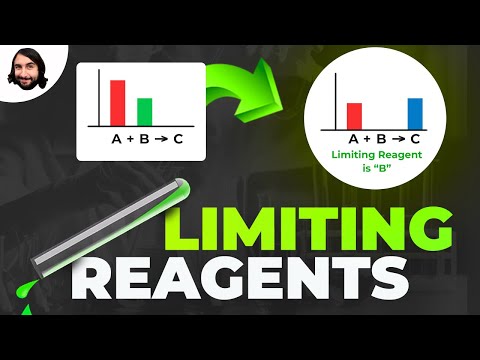
The photo shows a reaction of A+B->C where B is the limiting reactant.

Image By: Erica Burnham

Video

(video) Limiting Reagent

By Professor Dave Explains

In this video, professor Dave explains when two reagents react, one will be the limiting reagent, and the other will be in excess. The limiting reagent runs out first in a reaction. When it runs out, the reaction stops. Professor Dave then uses examples of making sandwiches to explain how to determine the limiting reagent.

Read · 3 min

We've been studying stoichiometry. It's the connection between different quantities of reactants and products. Its basis is dimensional analysis. So, we convert from one unit to another. So far, we've done mass-to-mass, mole-to-mole, volume-to-volume, and density-based stoichiometry problems. At the heart of each of these is the mole ratio. It tells us the relationship between the number of moles of each reactant and product.

Let's consider the acid-base neutralization between sodium hydroxide and hydrochloric acid. The balanced chemical equation is NaOH(aq)+HCl(aq)→H2O(l)+NaClaqNaOH_{(aq)} + HCl_{(aq)} \rightarrow H_{2}O_{(l)} + NaCl_{aq}. Our mole ratio is 1:1:1:1. Let's assume our concentrations are equal. We react one mole of sodium hydroxide with one mole of hydrochloric acid. What's the result? We produce one mole of water and one mole of sodium chloride. But sometimes, we don't have perfectly balanced quantities. For example, we might have one mole of sodium hydroxide but half a mole of hydrochloric acid. In that scenario, we would use up all hydrochloric acid. But we would still have half a mole of sodium hydroxide. Sodium hydroxide was in excess. Hydrochloric acid would be our limiting reagent.

What is a Limiting Reagent

In chemical reactions, the excess reagents react with the limiting reagent, which is the reactant that gets completely consumed. We use the term "limiting" because it determines the theoretical yield. As our chemical reaction proceeds, it depletes the limiting reagent. Our chemical reaction stops once the limiting reagent gets used up. What's remaining? A mixture of the products and any excess reactants. Determining which reactant is the limiting reagent is crucial for solving stoichiometry problems. There are two possible methods. Let's take a look at each one. You can decide which is easier for you.

Identifying the Limiting Reagent: Method 1

The first method is to compare the moles of each reactant. We choose one of the reactants. Then, we multiply the moles of that reactant by the mole ratio. That tells us how many moles of the other reactant we would need for a perfect match. We compare the "perfect match" versus our actual amount. So, we'll know if it's in excess or is limiting.

For example, let's consider the combustion of propane gas (C3H8(g)C_{3}H_{8(g)}). The balanced chemical equation is C3H8(g)+5O2(g)→3CO2(g)+4H2O(l)C_{3}H_{8(g)} + 5O_{2(g)} \rightarrow 3CO_{2(g)} + 4H_{2}O_{(l)}. So, the mole ratio of propane to oxygen is 1:5.

Let's say we react 17.00 moles of propane and 2.34 moles of oxygen. Which reactant will be the limiting reagent?

  • To solve this problem, we choose one of our reactants. We can use either propane or oxygen. Let's pick propane.

  • Now, we multiply our 17.00 moles of propane by the 1:5 mole ratio.

17.00molspropane×5molsoxygen1molpropane=3.4molsoxygen17.00 mols_{propane}\times \frac{5 mols_{oxygen}}{1 mol_{propane}}=3.4mols_{oxygen}

  • To completely combust 17.00 moles of propane, we would need 3.4 moles of oxygen. We only have 2.34 moles! So, oxygen is our limiting reagent.

This method works very well if you only have two reactants. With three or more reactants, it becomes too complicated.

Identifying the Limiting Reagent: Method 2

Now let's look at the second method for determining the limiting reagent. For this method, our goal is to calculate the amount of one product. But we do it for each reactant. The reactant that generates the smallest amount of product is the limiting reagent.

For this example, let's look at a synthesis reaction. We'll study the formation of ammonia from hydrogen and nitrogen gas. The balanced chemical equation is 3H2(g)+N2(g)→2NH3(g)3H_{2(g)} + N_{2(g)} \rightarrow 2NH_{3(g)}.

Let's say we react 27.4 liters of hydrogen with 13.4 liters of nitrogen. Which reactant is the limiting reagent? Assume that we are at STP.

  • We always want to work in moles. The problem gave us gas volumes. So, we should convert volume to moles. We are working with gases at STP. So we can use the conversion factor 22.4Lmol\frac{22.4L}{mol}.

13.4LN222.4Lmol=0.6molsN2\frac{13.4L_{N_{2}}}{\frac{22.4L}{mol}}=0.6 mols_{N_{2}}

27.4LH222.4Lmol=1.2molsH2\frac{27.4L_{H_{2}}}{\frac{22.4L}{mol}}=1.2 mols_{H_{2}}

  • Now, we can use the mole ratios. They allow us to determine how much ammonia each reactant could produce. In each case, we pretend that the other reactant is in excess. Why? We want to know the theoretical maximum for each reactant.

0.6molsN2×2molsNH31molsN2=1.2molsNH30.6mols_{N_{2}} \times \frac{2mols_{NH_{3}}}{1 mols_{N_{2}}}= 1.2 mols_{NH_{3}}

1.2molsH2×2molsNH33molsH2=0.8molsNH31.2mols_{H_{2}} \times \frac{2mols_{NH_{3}}}{3 mols_{H_{2}}}= 0.8 mols_{NH_{3}}

  • Finally, we compare the amount of product produced by each reactant.

1.2mols>0.8mols1.2mols>0.8mols. So, hydrogen gas is our limiting reagent.

Type a concept, like “slope” or “photosynthesis”.

↑ ↓ to choose · Enter to openSearch explanations and problems