Illustrated · 1 min
By Sylvia Freeman

+2 contributors
Contributors


What Is a Lysosome?

Image source: By Sylvia Freeman
Illustrated · 1 min
Image source: By Sylvia Freeman
Illustrated · 1 min
Lysosomes are organelles found in some eukaryotic cells (mostly animal cells) that are responsible for degrading (breaking down) the cell's waste products.
Most older textbooks will tell you that plant cells don't have this organelle, but current evidence actually suggests that some plant cells do.
Think of this organelle as an itty-bitty garbage disposal in the cell. It takes in trash, grinds it up, and gets rid of it.

Image source: By unknown author CC0, via http://maxpixel.freegreatpicture.com
Lysosomes are involved in the breakdown of pretty much anything: proteins, DNA, lipids (fats), carbohydrates, pieces of bacteria and viruses, and broken down pieces of the cell itself. They even have a function in cell death.
Sometimes other organelles go out of date. They just kind of get old and worn down. What does the cell do with these aging organelles? Send them into the lysosome, of course. Inside, the old organelles are broken down and their parts can be reused.

Image source: By Fran Barreto CC0, via pixabay.com Image source: By lumoreno CC BY-SA 3.0, via Wikimedia Commons
So, how exactly do these little guys break down all the trash the cell produces? They use digestive enzymes called hydrolases. Recall that enzyme names usually end in -ase, like this one does.
Enzymes are a special type of protein that speeds up chemical reactions.
The breakdown process is also facilitated by a pretty acidic environment. This low pH is necessary for lysosome function.
Video
by Revisify
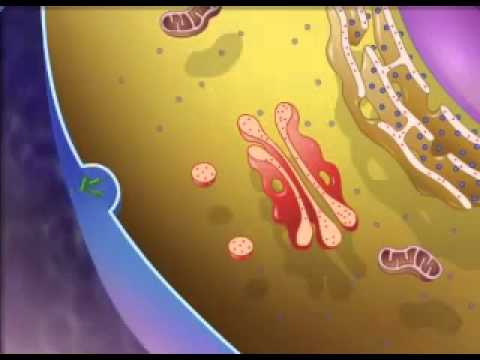
Lysosomes are membrane-bound blobs of hydrolytic enzymes just floating freely in animal cells. They might seem dangerous, but they play a key role in the cell.
Hydrolytic enzymes (also called acid hydrolases) are formed in the endoplasmic reticulum. They are then transported to the Golgi complex, where they are turned into lysosomes.
When invaders like viruses or bacteria enter a cell, the lysosomal membrane fuses with them, releases its enzymes, and destroys the intruder. This same process can also be used with old organelles to destroy and recycle their parts.
Interactive · 1 question

Image source: By LadyofHats [Public domain], via Wikimedia Commons
Lysosomes act as the clean-up crew of the cell. They are filled with enzymes that break down macromolecules into smaller molecules, which are then used to nourish the cell. They can digest peptides, nucleic acids, carbohydrates, and lipids. This is how cells recycle materials like amino acids and glucose.
They're also responsible for removing cellular clutter and breaking down unwanted molecules in the cytoplasm. Also on their list of jobs is to break down organelles that have reached the end of their life, and to help fight off invading bacteria.

Image source: By CNX OpenStax CC BY 4.0, via Wikimedia Commons
Lysosomes break down ____ .
: Uses enzymes to break down old organelles and macromolecules. Clean-up crew of the cell
Video
by Mahalo

This is a quick video which explains the functions of lysosomes.