Magnitude and Unit Vectors

Before this, knowWriting and Visualizing Vectors

Illustrated · 1 min

Previously, we learned about visualizing vectors. This lesson will cover how to find the unit vector.

What are Unit Vectors?

If you think back to pre-algebra, you will remember the concept of unit rates. Unit rates are when we compare the single (11) unit of one quantity to some rate of a second quantity. The most common real-world example of unit rates is when we look at unit pricing for produce in the grocery store. If we buy 55 bananas for $0.95\$0.95, we can assume the unit price, or cost per banana, is $0.19\$0.19.

We can extend this concept into vectors! Typically, vectors can be of any magnitude or direction. Unit vectors can also be of any direction, but they have a very specific magnitude, 11. We can examine this idea on a coordinate plane.
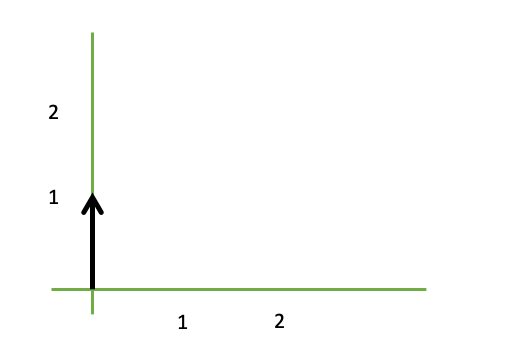
Black arrow going from the origin to (0,1) on a green coordinate plane

Image source: by Anusha Rahman

On the coordinate plane, the arrow is drawn from the origin to the point (0,1)(0,1). The distance, or magnitude, of this arrow is 11. Because this arrow has both a magnitude, of 11, and a direction, up, we can call this arrow a vector. All vectors that have a magnitude of 11 are called unit vectors, which we denote as,

a^\hat{a}

, which we verbally say as "a hat". The "hat", ^\hat{ \\\\} , denotes a unit vector. There is no unit vector formula because we use this designation.

Video · + 1 min read

(Video) What is a Unit Vector?

by Brian McLogan

This lesson by Brian McLogan talks about how to find a unit vector.

Summary

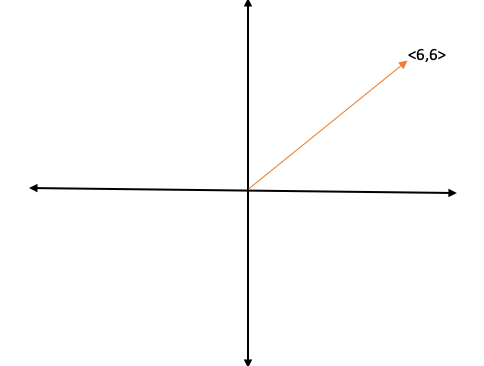
A vector is going to have an initial point, a direction, and a magnitude. Say we have our initial point at (0,0)(0,0), at the origin. If we were to draw a vector into the first quadrant, we can find the magnitude by looking at the final point of the vector.

Vector <6,6> on coordinate plane

Image source: by Anusha Rahman

To find the distance,

∣∣v∣∣=(v1)2+(v2)2=62+62=72||v|| = \sqrt{(v_1)^2 + (v_2)^2} = \sqrt{6^2 + 6^2} = \sqrt{72}

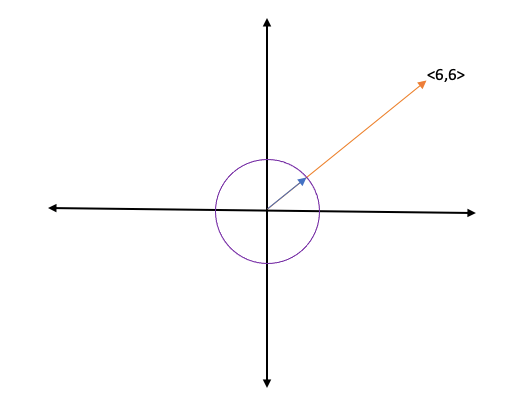
If we go back to the unit circle, you'll remember that there were one reason why we were able to easily find angles: the distance between the origin and any point on the unit circle is 11. So, what we're doing is creating right angles with a hypotenuse of 11.

Let's draw a unit circle on our existing vector.

Previous graph, now with unit vector

Image source: by Anusha Rahman

So, the unit vector has the same direction as the original vector, it just has a magnitude of 11, which we can see from the unit circle on the graph.

Video

(Video) Magnitude of a Vector

by Mario's Math Tutoring

This video by Mario's Math Tutoring talks about how to find the magnitude of a vector.

Summary

The magnitude of a vector is how long it is, which represents how much force the vector has. The larger the vector, the more force it has.

To find the magnitude, ||v||, we use the following formula for a vector, <x,y><x,y>,

x2+y2\sqrt{x^2 + y^2}

This formula is derived from the Pythagorean Theorem!

Read · 1 min

Magnitude of a Vector

A vector has two main components: a magnitude and a direction. The magnitude is the distance of a vector, or how long the vector is. We've mentioned the distance of lines before using the distance formula. We're going to use a similar idea when looking at the magnitude of a vector, except this formula was derived from the Pythagorean Theorem. We can designate magnitude of a vector, v⃗\vec{v}, with the double bars: ∣∣v⃗∣∣||\vec{v}||. You may also see magnitude designated with the single bar, ∣v⃗∣|\vec{v}|.

To find the magnitude, we find the square root of the sum of the components of the vector. For vector v⃗\vec{v}, <a,b><a,b>, the magnitude would be:

∣∣v⃗∣∣=a2+b2||\vec{v}|| = \sqrt{a^2 + b^2}

Example: Say we had the vector a⃗\vec{a}, <3,4><3,4>. What is the magnitude of a⃗\vec{a}?

Solution: We can plug in the components of vector a⃗\vec{a} in the formula to solve for magnitude!

∣∣a⃗∣∣=(3)2+(4)2=9+16=25=5\begin{align} ||\vec{a}|| &= \sqrt{(3)^2 + (4)^2} \\ &= \sqrt{9 + 16} \\ &= \sqrt{25} \\ &= 5 \\ \end{align}

So, the magnitude of this vector is 55!

Illustrated · 1 min

Magnitude of a Vector

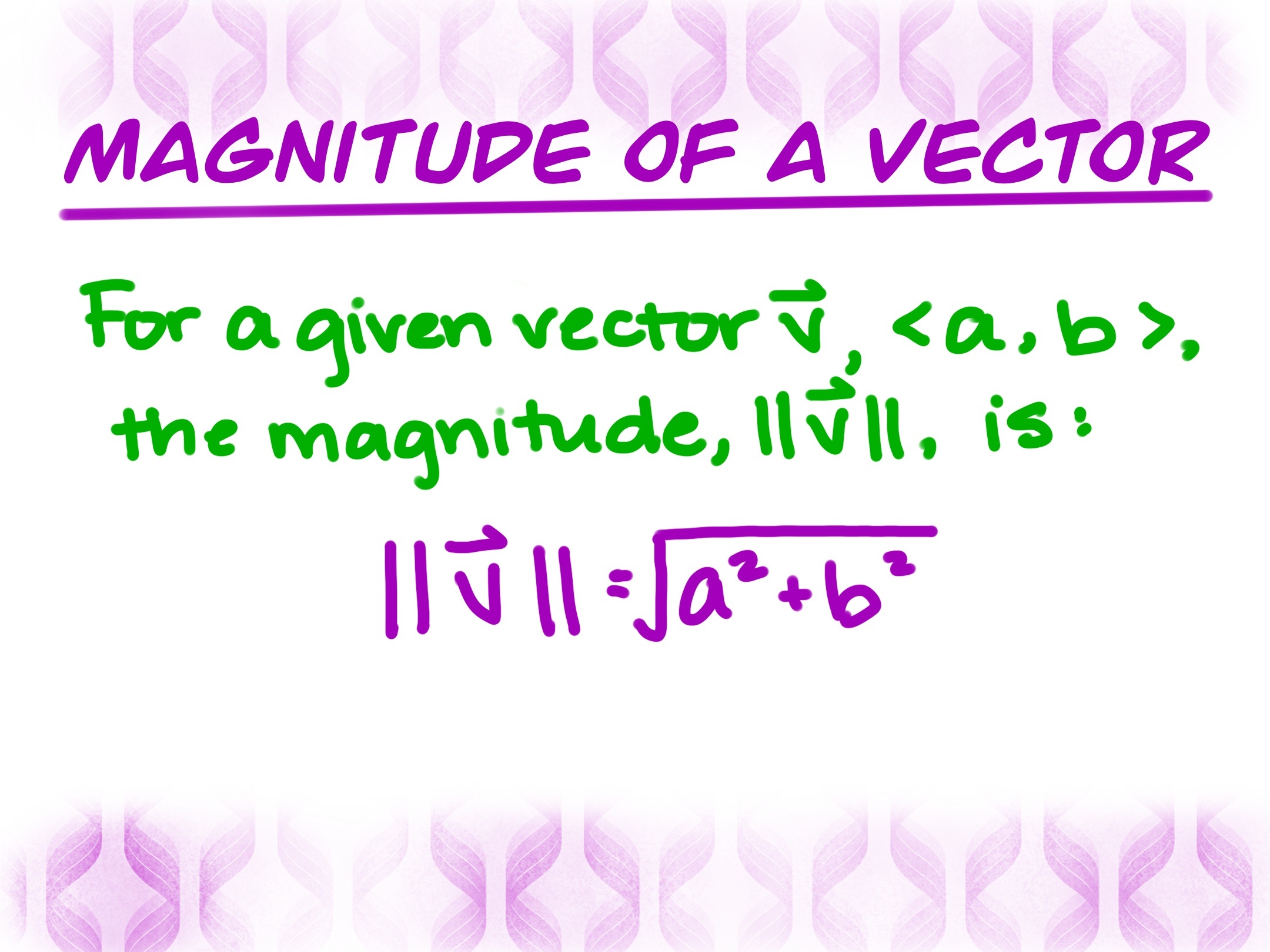
We know that a vector has both magnitude and direction. We can calculate the magnitude, or length, or a vector by using a formula.

Magnitude of a Vector
For a given vector, <a,b>, the magnitude ||v||, is sqrt(a^2 + b ^2)

Image source: by Anusha Rahman

A vector is a vector - so it will always give you a magnitude and a direction.

Example

Find the magnitude of the vector, d⃗\vec{d}, where d⃗=<3,4>\vec{d} = <3,4>.

To solve this problem, we will plug in our values into the formula we learned above.

∣∣d⃗∣∣=32+42∣∣d⃗∣∣=9+16∣∣d⃗∣∣=25∣∣d⃗∣∣=5\begin{align} ||\vec{d}|| &= \sqrt{3^2 + 4^2} \\ ||\vec{d}|| &= \sqrt{9 + 16} \\ ||\vec{d}|| &= \sqrt{25} \\ ||\vec{d}|| &= 5 \\ \end{align}

So, the magnitude, or length, of vector d⃗\vec{d} is 55!

Other Topics with Vectors

Get ready to be a master of vectors! You can learn about the dot products, vector operations, the cross product, and vector projections.

Type a concept, like “slope” or “photosynthesis”.

↑ ↓ to choose · Enter to openSearch explanations and problems