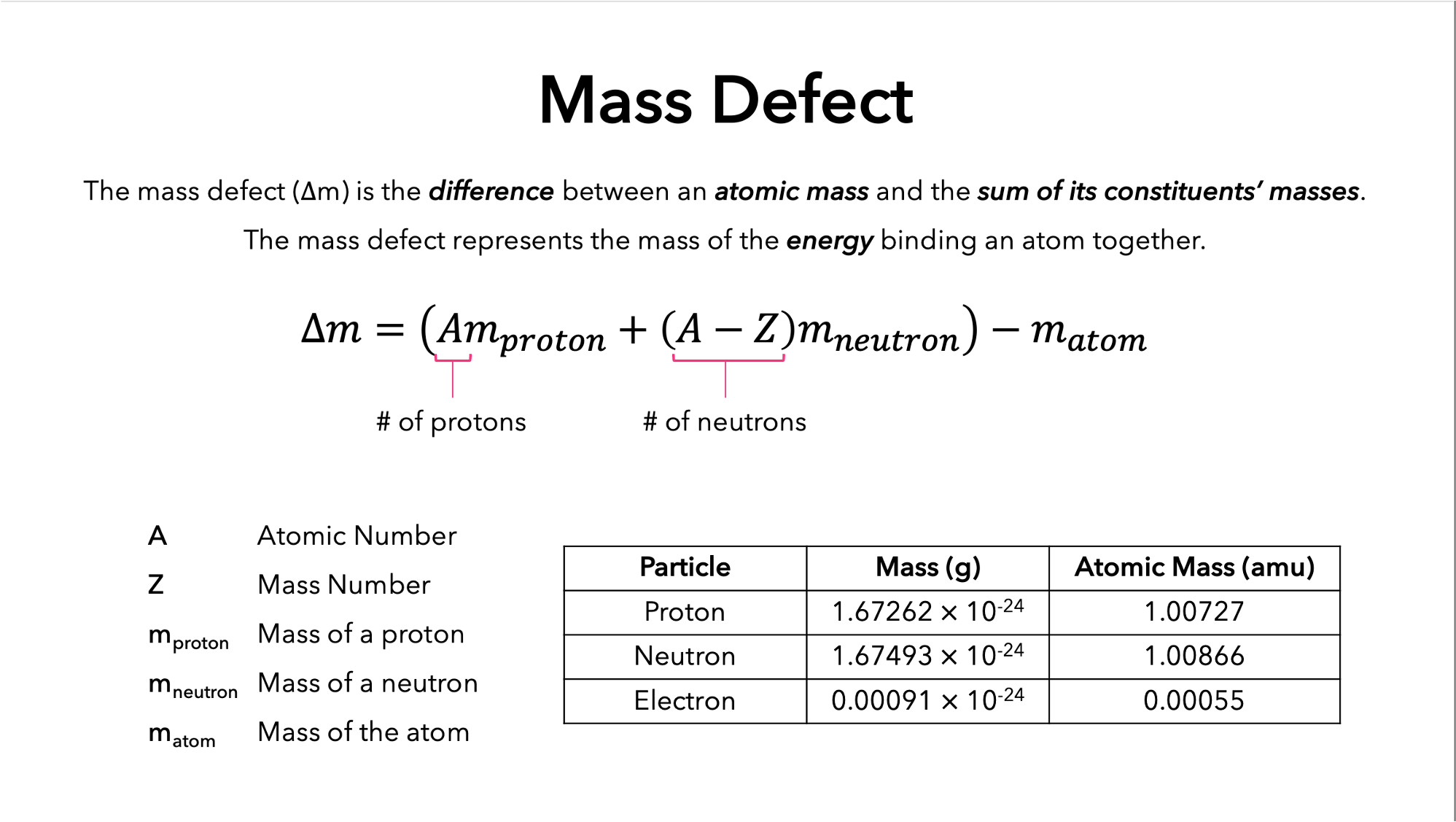
I want you to imagine yourself holding an atom in your hand. Let's say it's oxygen-18. That's a very rare isotope of oxygen. As a side note, oxygen-16 has a natural abundance of about 99.7. On the periodic table, oxygen's atomic number is eight. So we know oxygen-18 has eight protons, eight electrons, and ten neutrons. Now, let's pretend you have a scale that can measure an atom's mass. So, you place oxygen on the scale, and it reads 17.999160amu. That's so many decimal places! Your atomic scale is crazy precise! As a reminder, its values are in atomic mass units (amu).
Now imagine you could remove the protons, neutrons, and electrons, one by one. What's the mass of each subatomic particle. An electron is minuscule! It's 0.000548579909amu. What about a proton? They are 1.00727647amu. And neutrons? Neutrons are the most massive. They are 1.008665amu. What happens when you sum the masses for the individual protons, neutrons, and electrons? You get a larger number!
Mass Defect
Let's do the math!
me−=0.000548579909amu×8=0.00438863927amu
mp+=1.00727647amu×8=8.05821176amu
mn=1.008665amu×10=10.08665amu
mn+mp++me−=10.08665amu+8.05821176amu+0.00438863927amu=18.1492503993amu
So, what's the difference between the expected mass and the experimental value?
18.1492503993amu−17.999160amu=0.1500090amu
What's causing the difference between the calculated and experimental masses? At first, we may think the cause is various experimental errors. That's a good guess. But, look how many decimals places we have in our measurement! We seem to have high accuracy and precision. So, what's the answer? It turns out the difference is due to special relativity. That's Einstien's famous equation, E=m×c2. Subatomic particles are moving near the speed of light. Remember, quantum mechanics taught us that physics changes at such massive velocities. Einstein discovered that mass and energy are interchangeable.
What happened when we pretended to pull apart oxygen-18? We applied energy! We did work to extract each subatomic particle. How do we separate nucleons? We have to overpower the strong nuclear force. How much energy did we have to apply? That's the nuclear binding energy! Do you remember how we separate electrons from the nucleus? We overcome the ionization energies! But, it turns out that ionization energies don't contribute to mass. Why? Because they're the result of electrostatic interactions. They are way weaker than the strong force. So, their contribution is negligible.
So, what conclusions can we draw?
-
There will always be a difference between an atom's experimental and theoretical masses. We call this difference the mass defect.
-
We use the mass defect to calculate the binding energy. How? We use the equation BE=Δm×c2. Sometimes binding energy is written at ϵ.
How Did Chemists Find the Masses of Proton, Neutrons, and Electrons?
The History of the Electron, Proton, and Neutron
Let's start with the mass of the electron. Do you remember J.J. Thompson? He's the discoverer of the electron. He did his famous cathode ray experiment in 1897! Do you remember what a cathode ray is? It's just a beam of electrons. But scientists didn't know that at the time! In different experiments, he applied electric and magnetic fields to the electrons. They caused the electron beam to curve. Based on the curvature, he calculated the mass to charge ratio. Then, Robert Millikan conducted his famous oil-drop experiment. It found the charge of the electron. So, he used Thompson's ratio to calculate an electron's mass.
Remember, we didn't discover the nucleus until 1911. That's when Earnst Rutherford did his gold foil experiment. That's how we developed the nuclear model. So, we knew atoms had a positively charged center. But, we still had to isolate a proton. How did he do it? He shot alpha particles (helium nuclei) into nitrogen gas. What happened? The alpha particle combined with nitrogen's nucleus via a nuclear fusion reaction. Nitrogen converted to oxygen-17 plus a proton!
We can use a similar experimental setup for the proton's mass. We call a beam of protons an anode ray. So, an anode ray can also be curved using electric and magnetic fields. They also recognized the proton's charge was equal but opposite the electron's. So, calculating the mass was easier.
Scientists didn't discover the neutron until 1930. James Chadwick was experimenting with radioactive elements. He found that when polonium's alpha decay hit beryllium, it produced a new type of radiation. As he investigated the new radiation, he realized it was an uncharged particle! It also had the same mass as a proton!
Modern Methods of Measuring the Masses
How do we calculate the masses of subatomic particles today? Scientists use mass spectrometry. The experimental setup is like the cathode and anode ray experiments. But, our modern instruments offer greater precision and accuracy. We use a unique type of detector called a Penning Trap. It uses both electric and magnetic fields to trap charged particles. They cause particles to move in an eight-leaf clover pattern. The computer measures the movement's frequency and calculates a mass to charge ratio.