Mass Number — Definition & Overview

Interactive · 2 questions

Mass Number vs. Atomic Mass

The mass number is the number of protons plus the number of neutrons. So, the mass number is basically the number of things in the nucleus. In the section on elements we discussed the atomic numbe, which is the number of protons only.
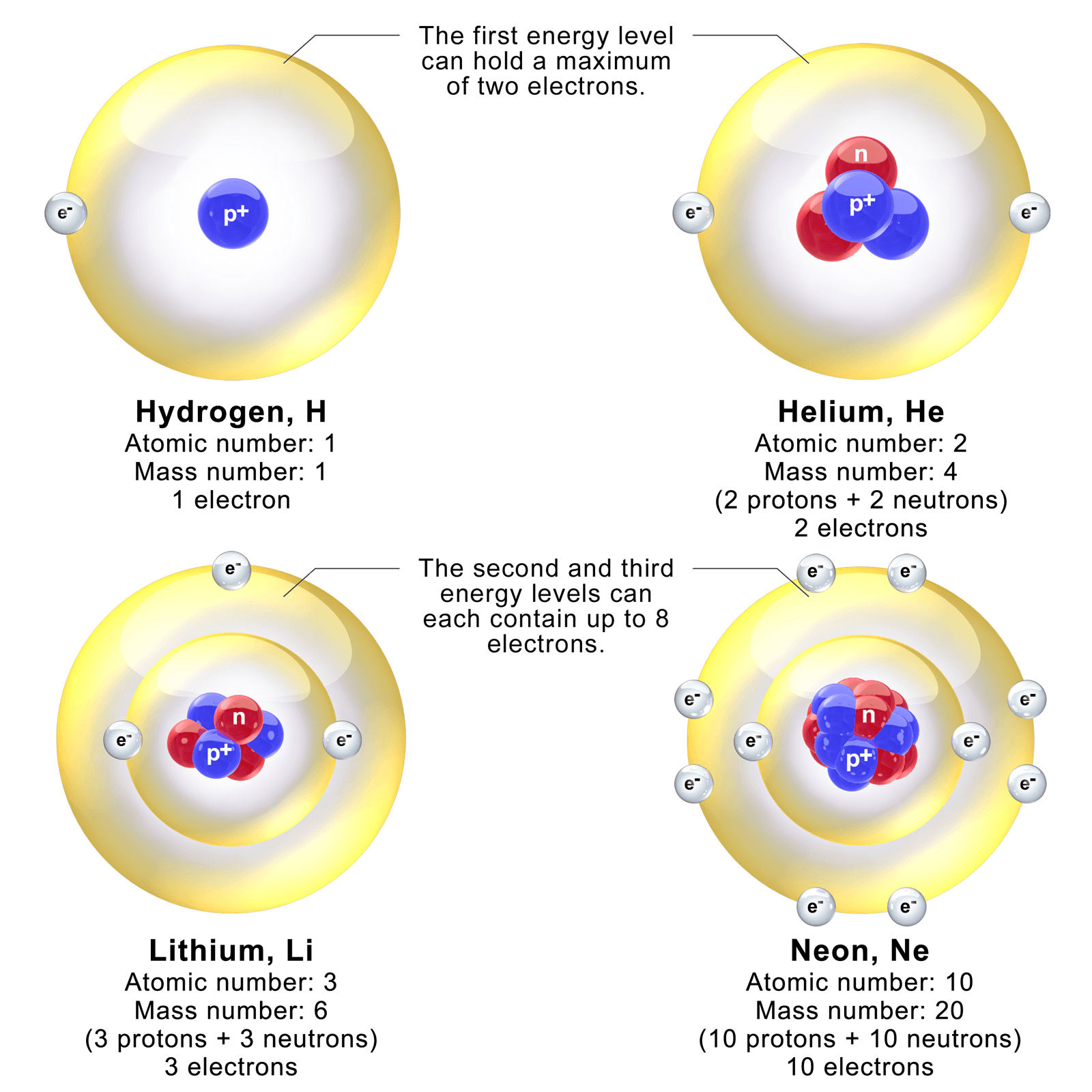
Image showing the number of protons and neutrons in the nuclei of various atoms. For example, helium has a mass number of four, so the helium atom has two protons and two neutrons.

Image source: By BruceBlaus CC BY 3.0, via Wikimedia Commons

Remember how we said that the number of neutrons doesn't impact which element it is? The mass number is when this becomes important. It allows us to be able to tell the difference between elements with a different number of neutrons, called isotopes.

The mass number is also related to the atomic mass, or amu, which is the weighted average of all isotopes for an element. The atomic mass is listed under the chemical symbol of each element on the periodic table. Because the atomic mass is an average, it is not a whole number. Rounding the atomic mass to the nearest whole number will give an excellent idea of the mass number.

The atomic mass of Neon is 20.18.

Image source: By me CC BY-SA 2.5, via Wikimedia Commons

What is the atomic mass of a neon atom?

Choose one answer

Interactive · 2 questions

What Is a Mass Number?

The mass number (AA) is used for atoms. The AA value is found by adding the number of protons (ZZ) and neutrons (NN) in an atom together.

A = Z + NA\ =\ Z\ +\ N

All atoms except hydrogen will usually have the same number of protons as neutrons. Hydrogen has one proton and no neutrons, so AHA_H= 1. Carbon has 6 protons and 6 neutrons, so ACA_C=12. However, some atoms can have different numbers of neutrons. For example, a carbon atom can have 7 neutrons and ACA_C=13. This is called C13C^{13} and is an isotope of carbon. Isotopes varying the number of neutrons, but the protons remain the same. So Isotopes will have different mass number. Typically atoms can be written with the element symbol and a superscript of the AA value, like 12C^{12}C or 13C^{13}C. Sometimes the atomic number (ZZ) is written as a subscript with this notation, like 612C^{12}_{6}C or 613C^{13}_{6}C. Notice that the number of neutrons can be found by subtracting the atomic number/number of protons from the mass number.

What is the atomic mass of a typical sodium atom?

Choose one answer

Illustrated · 1 min

Mass Number

What is the Mass Number of an Atom?

  • The mass number of an atom indicates the total number of protons and neutrons in the atom.

  • The mass number of an atom is a whole number (because you cannot have half of a neutron/proton in an atom)

  • Mass number helps determine the number of protons or neutrons in the atom (if either are unknown!)

Mass Number definition and calculation (Mass number = protons + neutrons)

Image source: Caroline Monahan

Mass Number Calculations

  • Mass number is usually used to help determine the number of neutrons in an atom

  • In order to determine the number of neutrons in an atom simply subtract the atomic number from the mass number (Mass number - atomic number = number of neutrons). This is because the atomic number is the number of protons in an atom.

Image showing the different ways to find the number of neutrons in an atom (from the periodic table, and from other notations)

Image source: Caroline Monahan

Mass Number and Isotopes

  • The same element can have different isotopes which results in the atom having a the same number of protons but different number of neutrons, thus resulting in a different mass number
Image showing how an element can have different isotopes which causes it to have a different number of neutrons (thus different mass numbers) but the same number of protons

Image source: Caroline Monahan

Illustrated · 1 min

Explaining the Mass Number

An element's mass number is the number of protons plus the number of neutrons found in an atom of that element. The mass number usually has a decimal point, is larger than the atomic number, and is located underneath the element's chemical symbol in the periodic table.

This number is used to figure out the mass of an element or the mass of compounds containing multiple elements.

The mass number of an element is usually located at the bottom, underneath the chemical symbol.

Image source: By CNX OpenStax CC BY 4.0, via Wikimedia Commons

Calculations Using the Mass Number

Let's look at an example. If we know an element's mass number, we can calculate the number of protons and neutrons in an atom's nucleus.

We already know that the mass number is the sum of the numbers of protons and neutrons (P+N). The atomic number is equal to the number of protons (P).

Using this information, what can we figure out? Carbon's atomic number is 6. This means there are 6 protons (P=6) in the nucleus.

Carbon's atomic mass is normally 12, so: 12 (the atomic number) −- 6 (the number of protons) == 6 (the number of neutrons). Therefore, there are 6 neutrons in the nucleus of a carbon atom.

Similarly, all chlorine atoms have 17 protons because chlorine's atomic number is 17. If its atomic mass is 35.5, that means it must have (on average) 18.5 neutrons per atom. (35.5 −- 17 == 18.5)

Atomic Mass Units

So, where does an atom's mass come from? Well, recall that atoms are made of protons, neutrons, and electrons. Electrons have almost zero mass. But, protons and neutrons have approximately one unit of mass each.

The units for atomic mass are called... wait for it... atomic mass units (amu). So, for example, carbon has an atomic mass of 12 amu (6 amu from the protons and 6 amu from the neutrons).

Illustrated · 2 min

What Is a Mass Number?

A mass number is the total number of protons and neutrons present in an atom’s nucleus.

Mass Number = Number of Protons + Number of Neutrons\boxed{\text{Mass Number = Number of Protons + Number of Neutrons}}
Mass Number = Protons in the nucleus + Neutrons in the nucleus

Image source: By Valeri Natole using image source: By Indolences, Rainer Klute CC BY-SA 3.0, via Wikimedia Commons

How Is It Different from Atomic Mass and Atomic Weight?

These terms are pretty easy to confuse.

Mass number is a count. Finding the mass number is the first step in determining an atom's atomic mass. The unit for atomic mass is amu. Amu stands for atomic mass units. The mass of a proton is 1.007 amu. The mass of a neutron is 1.008 amu. The mass of an electron is 0.0005 amu. The mass of an electron is so small that we ignore it. If we round the masses of protons and neutrons to 1.0 amu, then the mass number is equal to the atomic mass.

The atomic weight is an average. More specifically, it is the weighted average mass of the atoms of all of that element’s isotopes. Sometimes you will see it called average atomic mass. Remember, isotopes are different versions of an element. Different isotopes have the same number of protons but different numbers of neutrons. So, different isotopes have different mass numbers. The atomic weight and atomic mass are equal when an element only has one isotope. You can find an element's atomic weight, on the periodic table.

How Are Mass Number and Atomic Mass Related?

We have seen that protons and neutrons have very similar masses. But, different isotopes have different masses since they have different numbers of neutrons. In other words, having a different mass number means having a different mass. You can figure out an isotope's mass using its mass number.

So, how do you calculate an element's atomic weight when it is made up of a bunch of different isotopes with different masses and mass numbers? Like we said before, atomic weight is the weighted average mass of the atoms of all an element's isotopes: The formula for atomic weight is...

Ar=(% of Isotope 1×mass of Isotope 1)+...+(% of Isotope n×mass of Isotope n)100\boxed{A_r = \frac{(\%\text{ of Isotope }1 \times \text{mass of Isotope 1})+...+(\%\text{ of Isotope }n \times \text{mass of Isotope }n)}{100}}

Video

(Video) Atomic Number and Mass Number of an Atom - Science

by Elearnin

Mass number is equal to the number of protons plus the number of neutrons. This video will explain this concept further and also teach you how it compares to atomic number. Finally, you'll have a chance to practice what you've learned at the end of the video.

Type a concept, like “slope” or “photosynthesis”.

↑ ↓ to choose · Enter to openSearch explanations and problems

