Read · 1 min
+1 contributors

Background
Previously, we've seen how to rotate, and reflect a figure using matrices. This next lesson in this series will cover the final matrix transformation, matrix dilation.
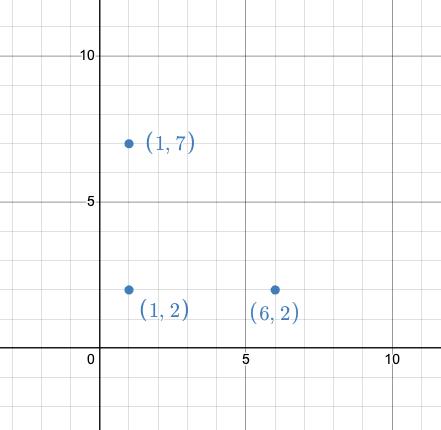
Before we continue, it's important that we review how to represent a function with a matrix. We put the ordered pair vertically in the matrix. Say we're given the points, , , and . We would represent these points in matrix form like so:
As we can see, the coordinate points are vertically paired in the matrix.
Matrix Dilation
A matrix dilation is when we make a figure bigger or smaller. We've talked about dilations before when we've seen function transformations, specifically vertically or horizontally stretching or compressing a function.
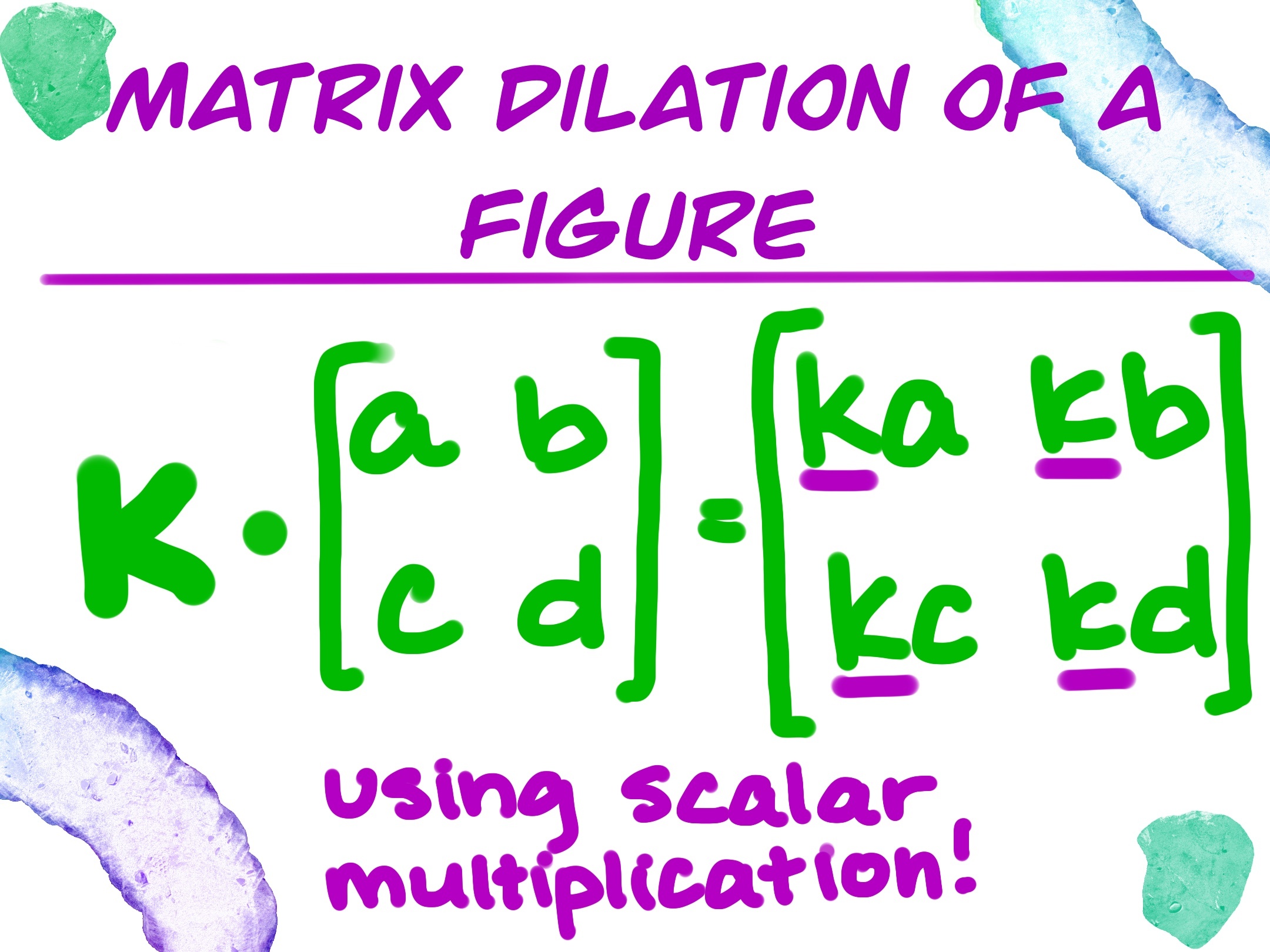
The transformation matrix, specifically the dilation matrix, is given by
If is a vector, then the matrix transforms into , which is the vector multiplied by a constant , which is a dilation or a scale factor.
This is useful because we now have another method of transforming functions. Remember that to represent a function with a matrix, we put the ordered pair vertically in the matrix. Say we're given the points, , , and . We would represent these points in matrix form like so:
As we can see, the coordinate points are vertically paired in the matrix.