Illustrated · 1 min

Background
Previously, we've seen how to rotate, reflect, and dilate a figure using matrices. This last lesson in this series will cover the final matrix transformation, matrix translation.
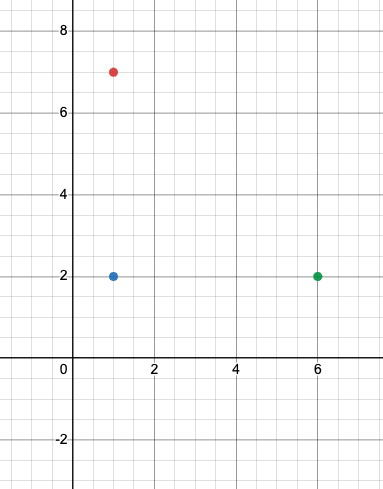
Before we continue, it's important that we review how to represent a function with a matrix. We put the ordered pair vertically in the matrix. Say we're given the points, , , and . We would represent these points in matrix form like so:
As we can see, the coordinate points are vertically paired in the matrix.
Matrix Translation
A translation is when we move a figure on a graph from one place to another. We can also call a translation a "shift", because we are shifting the function over by a given number of units. The important part about translations is that the size and orientation of the function don't change, only its location on the graph.
To translate a function use matrices, we add or subtract the amount of units that we want to move a function to each component in the matrix. If we have a triangle with coordinates , , and , and we want to shift the triangle unit down and units to the left, our matrices would look like:
Let's look at an example!
Example
Use matrices to shift the square with points , , , and left by units.
Solution
The matrix for the given square looks like:
It doesn't really matter what order the pairs are in, as long as the respective and coordinates are paired together!
The points of our squared are graphed,
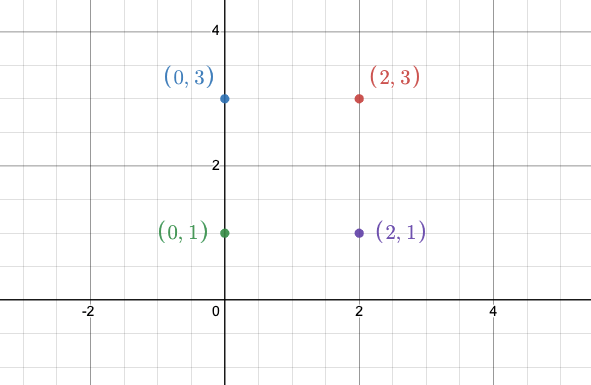
Made using Desmos
Now, we'll shift the values left by units.
This new matrix tells us that the points for our new translated square are: , , , and . Graphed, this new square looks like:
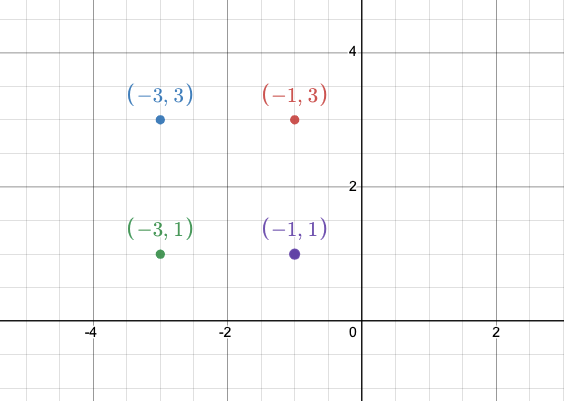
Made using Desmos