
Interactive · 4 questions

+2 contributors


Imagine we cut a carrot in half. Now, imagine that we cut one of those pieces in half. We keep dividing the halves until, eventually, we cannot split the piece anymore. All we are left with is a pile of chemical substances.

Image source: By OpenClipart-Vectors CC0, via pixabay.com
Our strange little experiment shows us that everything is made up of small, subatomic particles. Everything that has a mass and volume (takes up space), everything that can be seen, touched, or even tasted is made of chemicals. Those chemicals are matter.
What are the two things needed for something to be considered matter?
Select all that apply.
How Are Mass and Volume Represented?
Mass and volume can both be measured. Scientists use the metric system for measurements, not the imperial system (feet, pounds, etc).
The unit of mass is the gram, while the unit of volume is the liter. This is complementary to the imperial units of feet and cups/pints/gallons.
What is the metric unit of mass?
What Forms Can Matter Take?
Now, back to the matter at hand. Ha.
Matter exists in four different states: solid, liquid, gas, and plasma. States of matter are also commonly known as phases of matter.
- Solids have a fixed volume and shape.
- Liquids have a fixed volume but can take the shape of their container.
- Gasses have neither a fixed shape nor a fixed volume.
- Plasmas have similar properties to gasses.
How are solids and liquids the same?
Matter can switch between phases, as shown in the picture below. You've probably heard of some of these phase changes before, like freezing or melting. There are quite a few different kinds, though.
For example, solids can turn directly into a gas without ever being a liquid. Super strange, right? This is called sublimation and is very cool to watch.
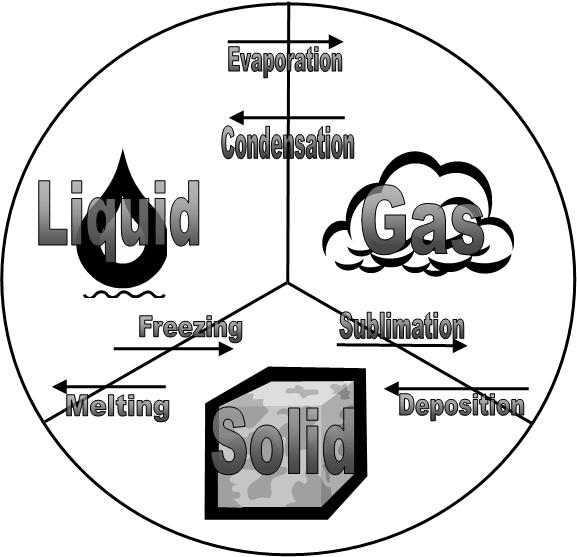
Image source: By M.manary at en.wikibooks [Public domain], via Wikimedia Commons
Try to commit the picture above to memory. It shows all of the phase changes possible.
What is the process of a liquid becoming a gas called?
: Matter is anything that takes up space and has a mass
: The phases of matter are a way to classify different properties of matter


