Metallic Bond — Formation & Compounds

Illustrated · 1 min

What Is A Metallic Bond?

A metallic bond is what holds together the atoms of a metal substance. Metallic bonds are found in pure metals, alloys, and metalloids. In a metal substance, the atoms are packed closely together. So, they form crystalline metallic solids. How? Metal atoms have valence electrons. The valence electrons from one atom are able to move away from the atom. These electrons are called delocalized. Delocalized electrons are found between the metal atoms and are able to move freely. So, they interact with all the nuclei. The electrostatic interactions with the nuclei's protons lower the electrons' energy. So, they are more stable. This creates a cloud of negative charge with positive metal ions distributed throughout. So, they form a metallic bond.
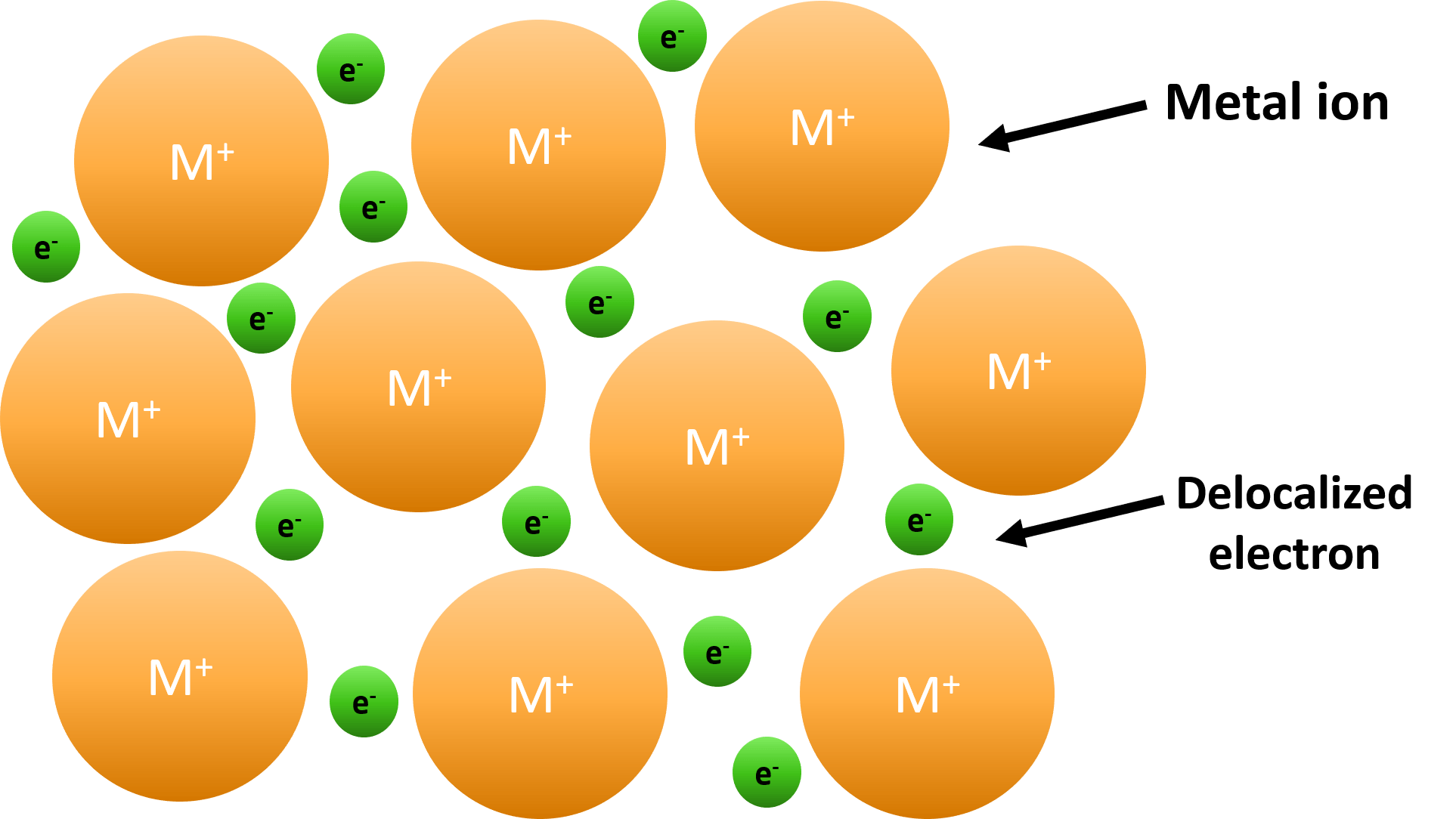
Positive metal ions with delocalized electrons.

Here is a depiction of a metallic bond. The positive metal ions are surrounded by delocalized electrons which can move freely.

Image source: By Cassie Gates

Importance Of Metallic Bonds

Metallic bonds are important to the properties of metals. The delocalization of electrons gives rise to the electrical conductivity of metal materials. This also allows for good heat conductivity and movement of heat through the metallic substances. Since electrons are able to move freely, they can easily transfer energy and electricity through the metal. Metals are ductile and malleable, meaning they can be shaped, bent, and formed into wires. This is due to metal atoms being able to break and reform metallic bonds with neighboring atoms. The electrons flow easily, allowing metallic bond breakage and formation when the metal is manipulated. This does not mean that the metallic bonds are weak. Metal atoms form strong interactions with each other, giving rise to high melting and boiling points. Lastly, metallic bonds give rise to the characteristic shine of metals. The "soup" of electrons that metal atoms are dispersed in, reflects photons. This gives metals their luster or shine.
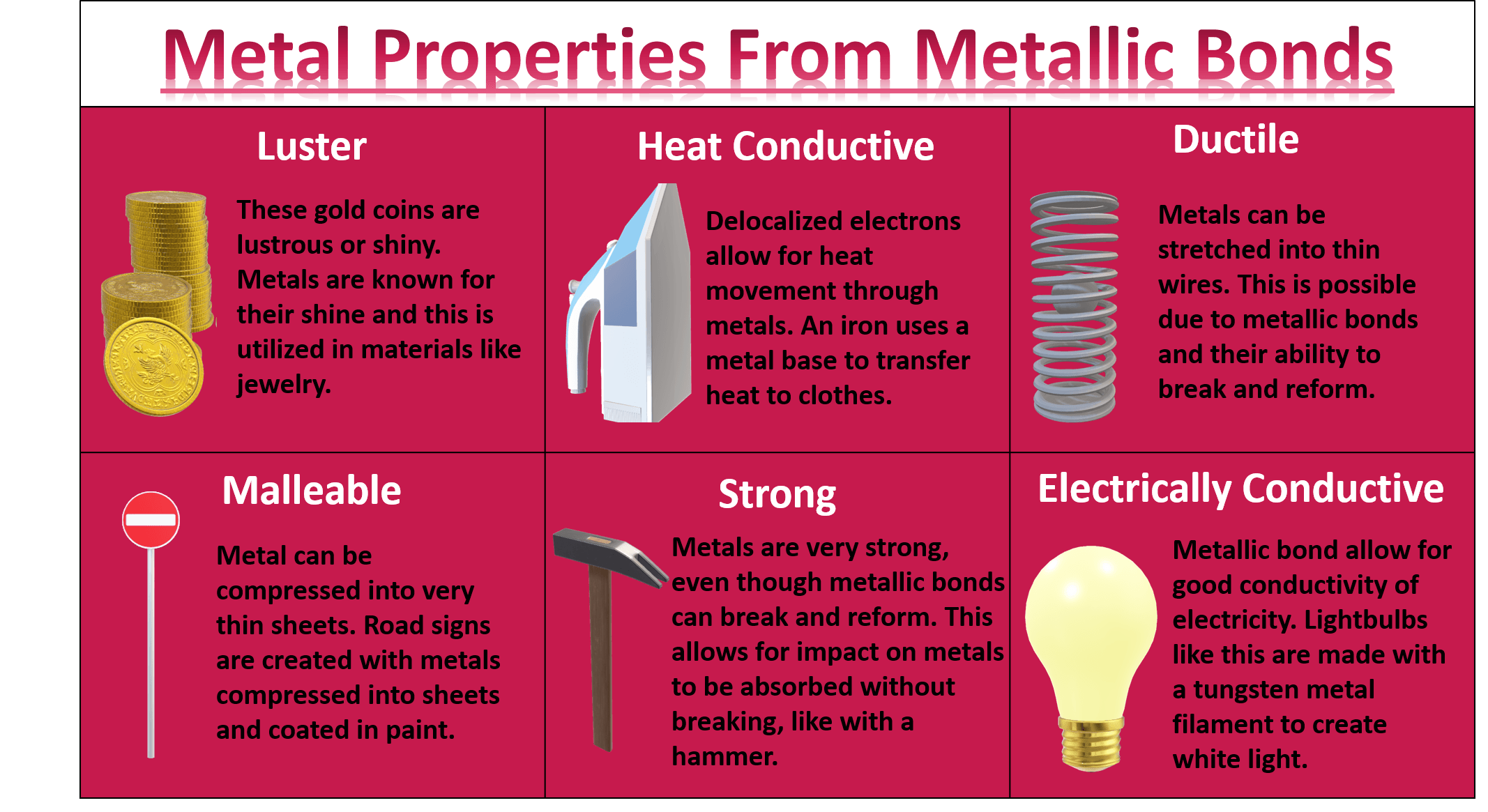
Chart of metal properties from metallic bonds

Here are some properties of metals which arise from metallic bonds.

Image source: By Cassie Gates

Illustrated · 1 min

When we introduced the periodic table, we spent some time discussing elemental metals and nonmetals. But many compounds that contain metal atoms aren't what we typically think about when we think of metals. For example, sodium is an alkali metal- but Sodium Chloride (NaCl), or table salt, is an ionic compound. The typical traits we associate with metals- shiny, conductive, dense- are actually traits of metallic compounds.

So what are metallic compounds? Just like ionic compounds are compounds formed by ionic bonding between atoms, metallic compounds are materials formed by metallic bonding.

Image of closely packed metal nuclei surrounded by a sea of electrons.

A macroscopic diagram of the nuclei and electrons in a metal compound. Image source: By Sjlegg CC BY 2.0, via Wikimedia Commons

Rather than sharing or exchanging valence electrons, as covalently and ionically bonded atoms do, atoms in metallic bonds are surrounded by a sea of free-flowing electrons that do not belong to any specific nucleus. These electrons are called delocalized. This is what allows metals to be such good conductors of electricity- which is literally the flow of electrons. Any metal element can form a metal compound when surrounded by other metal atoms.

Video

(Video) GCSE Chemistry - Metallic Bonding #19

By: Cognito

Metals bond to other metals through metallic bonding, a specific type of chemical bonding. Metals are organized structures of atoms. The outer shell electrons of each atom are shared between each other. Giving the metal atoms a positive charge. The electrons are called delocalized. The interactions between the atom and electrons are electrostatic interactions called metallic bonding.

Due to the atomic and electronic structure of metals this gives rise to strength, high melting points, high boiling points, and electrical conductivity. While metals are very strong, they are also malleable. This means they can be formed into sheets.

Alloys are a combination of two or more different types of elements with at least one metal. Alloys are stronger than pure metals. Alloys are usually made from two different sized atoms which varies the structure. Steel is an alloy made of iron and a small percentage of carbon.

Type a concept, like “slope” or “photosynthesis”.

↑ ↓ to choose · Enter to openSearch explanations and problems