Migration — Role in Allele Frequency & Natural Selection

Illustrated · 1 min

Migration, Alleles, and Gene Flow

Genetic migration can either introduce new alleles or remove alleles from a population. Genetic migration is sometimes called gene flow. You may know "migration" as when birds or other organisms move to a different location for part of the year. In population genetics, migration for genes is a bit different.

The diagram shows two populations of birds that live on different sides of a mountain. Population A is made up of blue birds and the presence of selective pressure against a recessive phenotype has created a homozygous population (HH). Population B is made of red birds and the presence of selective pressure against dominant phenotype has created a homozygous population (hh). A bird from population A migrates to population B and vice versa. The offspring of the red immigrated bird has a genotype of Hh. The offspring of the immigrated blue bird has a genotype of Hh, too. Both sets of offspring are blue.

Image source: By Jessica Krueger CC BY-SA 3.0, via Wikimedia Commons

  • Immigration: If some organisms join a population, they might bring new alleles into the gene pool. In other words, they add genetic diversity. During immigration, the organisms move into a different, existing population.

  • Emigration: If some organisms leave a population, they may take some alleles away from the gene pool. This reduces the genetic diversity of the original population. During emigration, the organisms exit their population.

Basically, any organisms moving into or out of a population can change the gene pool. This has a direct effect on genetic diversity.

Vocabulary Review:\color{#8925AE}{\text{Vocabulary Review:}}

Migration\color{#8925AE}{\text{Migration}} : The permanent movement of genes into or out of a population, causing a change in allele frequency

Illustrated · 1 min

Entering or Leaving a Population

Migration can either increase or decrease genetic diversity. As individuals leave or enter a population, they bring or take away unique alleles.

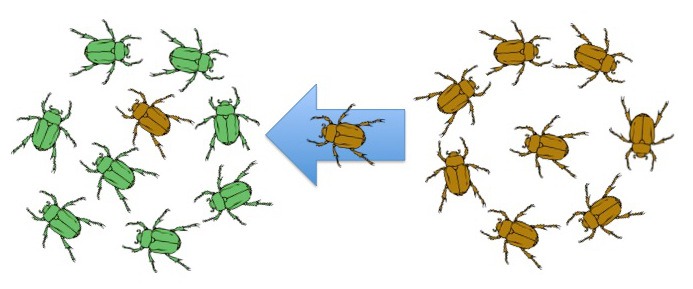
  • Immigration is the movement of individuals into a population. It increases genetic diversity.

  • Emigration is the movement of individuals out of a population. It decreases genetic diversity.

A group of brown beetles is pictured to the right. There is an arrow pointing left with a brown beetle on it. A group of green beetles with one brown beetle is shown to the left. The diagram represents a brown beetle migrating to a population of green beetles.

A brown beetle migrating to a population of green beetles. \\ Image source: By Tsaneda CC BY 3.0, via Wikimedia Commons

Remember that alleles are different versions of a gene. By having many versions of a gene, a population remains healthy. Immigration and emigration allow for gene flow between different populations. A steady migration rate allows all of the populations of a species to remain healthy and have a high amount of genetic diversity.

Remember, this is a bit different than natural selection because the genes that are entering or leaving a population are random.

Read · 1 min

Migration and Gene Flow

One way species combat genetic drift is through the migration of alleles. This is called gene flow. Gene flow is when alleles either enter or exit a population. Entering is called immigration, and exiting is called emigration.

When new, genetically unique individuals immigrate to a preexisting population, they bring along new alleles with them. When the new organisms mate with the preexisting ones, this enhances the species' overall genetic variation by creating new combinations of alleles.

Emigration happens when genetically unique organisms leave one population for another. It is another form of gene flow, but it usually results in decreased genetic diversity. This is because rare alleles leave the existing gene pool.

Video

(Video) Gene Flow - Migration

by Brightstorm

This video defines immigration and emigration. It also makes sure you know the difference between migration and gene transfer.

Frogs and pandas and frog-pandas, oh my.

Image source: By Valeri Natole

Type a concept, like “slope” or “photosynthesis”.

↑ ↓ to choose · Enter to openSearch explanations and problems

