Interactive · 1 question
Molar Mass
What is the molar mass of a molecule?
- The molar mass tells you the mass of a compound/molecule per unit mole.
- Molar mass is calculated the same way as molecular mass.
- Molar mass and molecular mass are almost the same. But, the molar mass has units of g/mol. The molecular mass has units of amu or daltons (Da).
Molar Mass unit: g/mol
How do you calculate the molar mass of a compound?
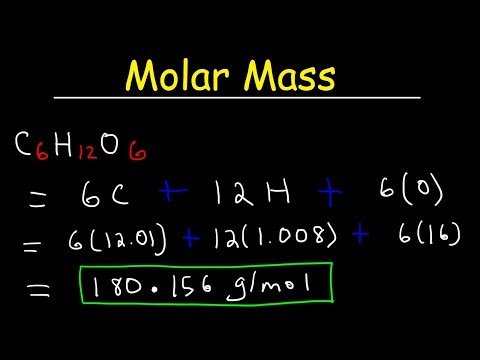
- You simply add together the atomic weight of each element in a molecule.
- Remember, atomic mass is the sum of the protons and neutrons. One AMU is defined as the mass of carbon-12. But, the atomic weight averages the relative abundance of the isotopes. Sometimes these terms get used interchangeably.
Reminder on where to find the atomic mass of an element:

Image source: By Caroline Monahan
Example: The molecular formula for the organic compound propanone is . Find its molar mass.
- Remember, the numbers after the carbon (3) and hydrogen (6) tell you how many are in the molecule. So there are 3 carbons and 6 hydrogen atoms in this molecule. The oxygen doesn't have a subscript because there is only one.
Carbon: 3 X 12.011 = 36.033
Hydrogen: 6 X 1.008 = 6.048
Oxygen: 1 X 15.999 = 15.999
Add the masses together:
36.033 + 6.048 + 15.999 = 58.08 g/mol ← This is the molar mass of
How do you determine the number of moles of an element in a certain molecule?

Image source: By Caroline Monahan
Using these conversion factors, you can determine the number of moles or mass of a compound!
Example: A student measures out 14.66 grams of sodium bicarbonate or baking soda, . How many moles of baking soda does she have?
- First determine the molar mass of the baking soda:
Sodium: 1 X 22.990 = 22.990
Hydrogen: 1 X 1.008 = 1.008
Carbon: 1 X 12.011 = 12.011
Oxygen: 3 X 15.999 = 47.997
22.990 + 1.008 + 12.011 + 47.997 = 83.92 g/mol
- Use the correct conversion factor to determine the number of moles!
The grams cancel out, leaving us with just the amount of mols of
Now try to convert from moles to mass!
A student has 0.5677mols of hydrogen peroxide (). What is the mass in grams of hydrogen peroxide present?