Read · 2 min
We've been studying solution concentrations. We have many different ways to define concentrations. Each has its benefits and drawbacks. But, so far, we've mostly been looking at liquids. Today, we'll look at a great way to measure gas concentration. That's the mole fraction! We write it as .
What is the mole fraction?
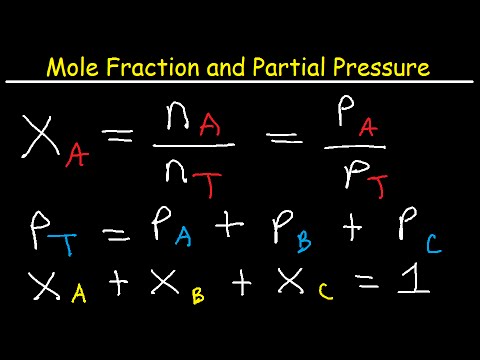
Let's assume we have a two-component homogenous mixture. How would we describe each component's amount? We could use molarity, molality, or percent concentration. But, what if our mixture was two gases? Those become more difficult. It'd be far easier to describe gases by the number of particles. So, we created the mole fraction. The mole fraction is the ratio of a component's moles to the total moles. It's formula is or .
Where have we seen the mole fraction?
Does the mole fraction look familiar? We've seen it a few times. Most often, we've used it for the gas laws. For example, we've seen it in Dalton's, Raoult's, and Henry's laws. Notice all these deal with partial pressures or vapor pressure.
Why do we use the mole fraction?
The benefit of the mole fraction is that it is not temperature-dependent. Volume-based concentrations, like molarity, are. Why? Volumes depend on Van Der Waal's forces. At higher temperatures, atoms and molecules have more kinetic energy. So, they experience less electrostatic attraction. The weaker the attractive forces, the greater the volume. That's also why liquid volumes aren't additive. When we mix liquids, we use the densities to account for the changes.
Consider an ideal gas. Remember, the kinetic molecular theory assumes there are no intermolecular forces. Without attractive forces, a gas's temperature and volume are directly proportional. That's Charles' law or the Ideal gas law! The same is true for the other phases of matter. Solids and liquids are not very compressible or expandable. So, their volume change is much smaller than gases. But, technically they do change.
The mole fraction is a ratio. It compares a component's moles to the total. But, the mole measures the number of particles. Particle number is volume independent. It doesn't matter if 5.0 moles fill 1.0 liter or 1000.0 liters! It's still 5.0 moles. The same reasoning also shows us that the mole fraction is pressure-independent.
Obviously, the mole fraction is based on the number of moles. But, we can always relate moles and mass. Using the molar mass of a compound we can convert mass to moles. So, another benefit is our ability to weigh out a known mole fraction. This assumes we start with a solid or liquid and vaporize it. But, that's not too uncommon. Also remember, measuring moles of gas is even easier if we are at STP. Why? One mole equals 22.4 liters!
Mole Fraction and Partial Pressure
The other benefit of the mole fraction is its relationship with partial pressures. For an ideal gas mixture, the ratio of the partial pressures equals the mole fractions. We can derive the relationship! Just solve the Ideal gas law for a component gas and total mixture.