Video · + 1 min read

+2 contributors

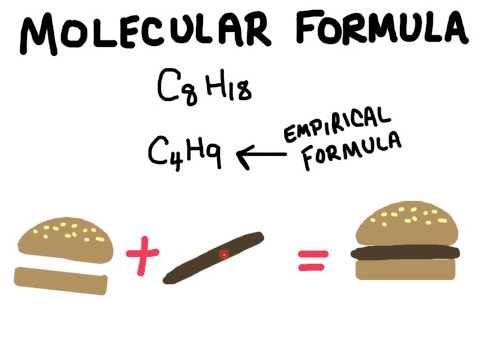
Like the secret Krabby Patty formula in Spongebob, a molecular formula is a kind of recipe that tells you the ratios of different ingredients, or elements, in a molecule.
There are a few types of molecular formulas. An empirical formula describes the simplified ratio of elements in a molecule, regardless of how many atoms are actually found in that molecule. A structural formula shows the bond connections, instances of multiple bonds, and lone pairs of electrons. They are also called Lewis dot structures. The most common type of molecular formula, and what people usually mean when they say "molecular formula," just lists the exact number of atoms of each element present in a molecule.
For example, is the molecular formula for glucose or sugar. It tells us what elements are in this substance and how many atoms per molecule. is the empirical formula for the same molecule. It still tells us the elements' ratio but doesn't tell us how big a molecule is.
Sometimes, the molecular and empirical formulas are the same. A great example is water (). Water has two hydrogens and one oxygen. So, the formula is already irreducible. The same is true for any molecule with a 1:2 ratio. So, another example is carbon dioxide (). It is also common in organic chemistry. An example is methane () gas. It's the gas that is commonly used to heat homes. Sometimes it's called natural gas.
There are also compounds that have 1:1 ratios. For example, soon we'll learn about acids and bases. Many strong acids have 1:1 ratios. For example, halogen-based acids, like hydrochloric acid (), all have 1:1 ratios. So, they all have one proton to donate when they dissolve in solution.