Read · 3 min
We know four phases of matter: solids, liquids, gases, and plasmas. An element or molecule's physical state depends on the amount of energy. Systems with the least kinetic energy are solid. As you add heat, you create liquids and then gasses. Plasmas are rare, high-energy phases of matter. For plasmas, there is enough heat to ionize the molecules.
We also learned about the arrangement of particles in each phase of matter. Solids have strong intermolecular forces. In a solid, the molecules cannot move past one another. So, solids are rigid. In contrast, liquids have fewer intermolecular forces. The molecules can move past one another with ease. Any fluid will take the shape of its container. But, it is not compressible. Gases have the fewest intermolecular interactions. They fill their container and are compressible.
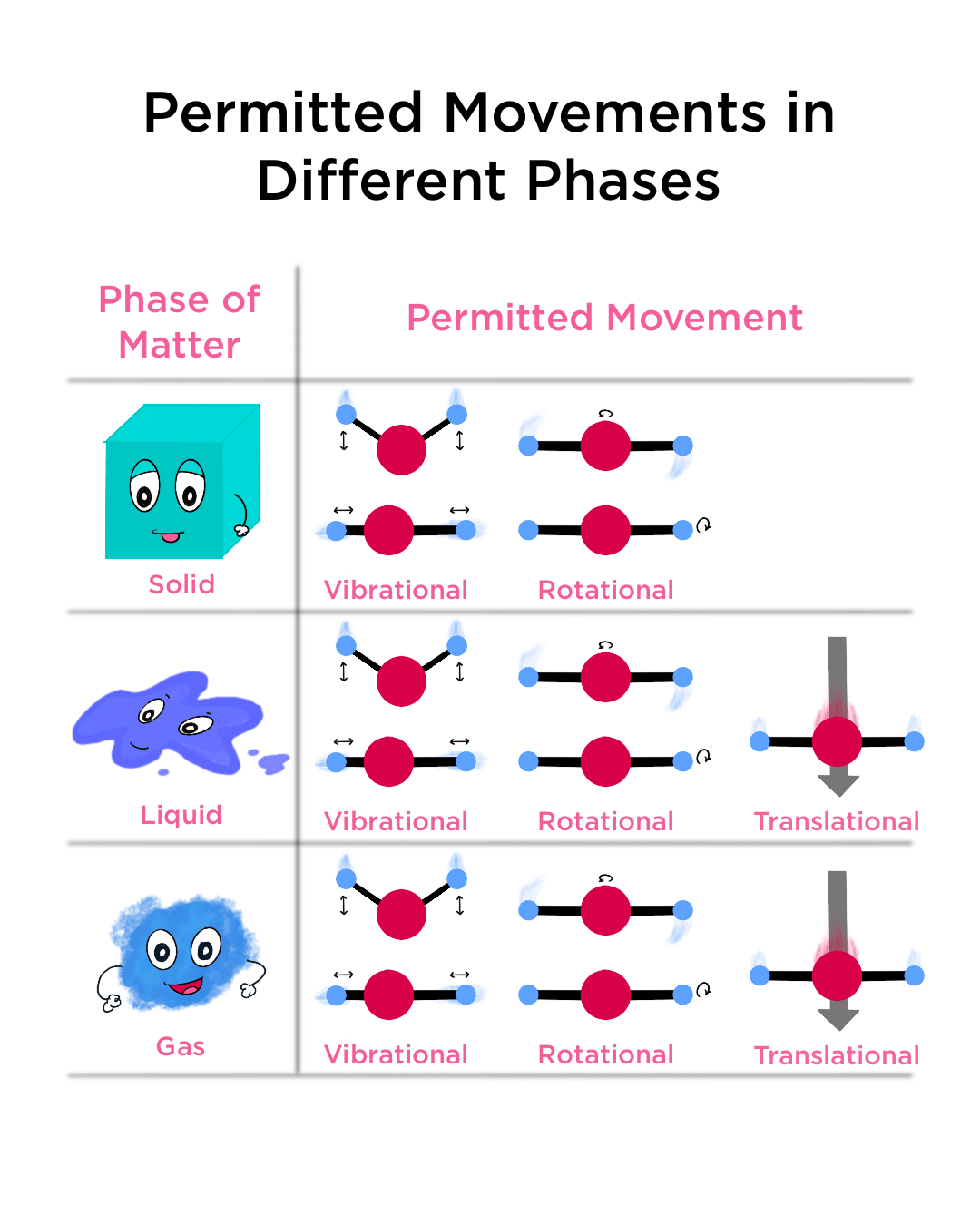
But, what is happening to the individual molecules in each phase? A molecule can have three types of movement. Let's look at each type!
Three Types of Movement:
-
Vibrational: Every molecule exhibits vibrations. Covalent bonds are not rigid. They can move in and out, called stretching. They can move side to side, named bending. Sometimes whole groups can move. For example, in ethane (), each of the methyl (-) groups can move. The carbon-carbon bond stretches or bends to move the whole group. At the same time, all the carbon-hydrogen bonds also stretch and bend. The atoms in ionic bonds can also vibrate. Because ionic bonds are crystalline, the movement of one atom causes the movement of surrounding atoms. So, the vibrations in ionic bonds cause a vibrational wave through the lattice structure.
-
Rotational: Just as electrons have spin, atoms and molecules do too. Like most things in quantum mechanics, molecules have quantized rotational energies. Remember, molecules are three-dimensional. So, a molecule rotates in all three dimensions.
-
Translational: Translation is the most straightforward movement. A molecule can move from one point to another. It is no different than you walking down the street. You move from point A to point B. A molecule can move from point A to point B.
Movement in each Phase of Matter:
Solids:
We know that the molecules in solids do not move past one another. The intermolecular forces are too great. They cannot translate and have zero translational energy.
There is experimental evidence that solids do have rotational energy. A solid's ability to rotate depends on its geometry. More packed geometries will display less rotation. Some solids experience a transition point. Before the transition point, they do not spin. After the transition point, they have rotational energy but have not changed phases. We observe a shift in the chemical and physical properties at the transition point.
All solids have vibrational energy. Even in the most tightly packed crystalline geometries, the molecules will vibrate.
Liquids:
Like solids, the molecules in liquids rotate and vibrate. But unlike solids, liquids have translational energy. The liquid molecules can move past each other. But, the molecules still experience strong intermolecular forces. For example, water is a liquid because it can hydrogen bond. So, there is only a small amount of empty space between the molecules. The translational movement is more inhibited than in gasses.
Gases:
Gases have the most translational energy and the weakest intermolecular forces. So, there is a lot of empty space between the molecules. Their movement is random. The gas molecules will collide with one another and their container at high speeds. The collisions cause the gases to move in all directions. Meanwhile, the gas molecules are still rotating and vibrating.
Why do Solids have Temperature?
You may have learned that temperature is a system's average translational kinetic energy. So, you might expect a solid to not have a temperature. That cannot be true! Feel your computer. Does it feel hot or cold? It is solid and certainly has a temperature. Why is this?
In kinetic theory, translational kinetic energy is a good approximation of temperature. But, in thermodynamics, the temperature is proportional to the sum of kinetic and potential energy. The sum of the kinetic and potential energies is the internal energy. In an ideal gas, the kinetic energy is considerably larger than the potential energy. So, we ignore the potential energy. For solids, the vibrational and rotational energies contribute significantly to the potential energy.