Moving Polynomials Right or Left

Before this, knowMoving Polynomials Up or Down

Interactive · 1 question

The next lesson in polynomial transformations is about moving polynomials right and left.

In the previous lesson, we learned about moving polynomials vertically, up and down. We learned that the vertex form of the quadratic function shows us how to move quadratics. The vertex form of quadratics is,

y=a(x−h)2+ky=a(x-h)^2 + k

The kk value affects the translation up and down. The hh value, which we'll focus on in this lesson, affects the translation right or left.

Let's review the characteristics of parent quadratic functions.

  • Vertex at (0,0)(0,0)

  • Function goes through (1,1)(1,1) and (−1,1)(-1,1)

  • Parabola opens upwards

  • Standard form: ax2+bx+cax^2+bx+c

Translating Quadratics Right or Left

Translating quadratics horizontally is very similar to translating quadratics vertically, but there's a key difference: signs! If you look back to the vertex form of the quadratic equation, you'll notice that there is a negative sign in front of the hh.

Say we want to translate the parent function of a quadratic by 33 units to the right. That means that h=3h=3. If we plug this into the equation, we get,

y=(x−3)2y=(x-3)^2

This may seem confusing - it feels like the negative 33 should indicate that the function is moving three units to the left, but that is not the case!

The function graphed looks like:
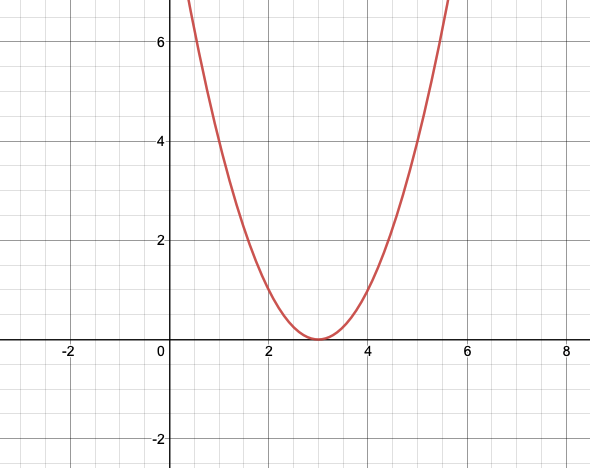
Graph of y=(x-3)^2

Made using Desmos

As we can see, the function was shifted three units to the right!

Example

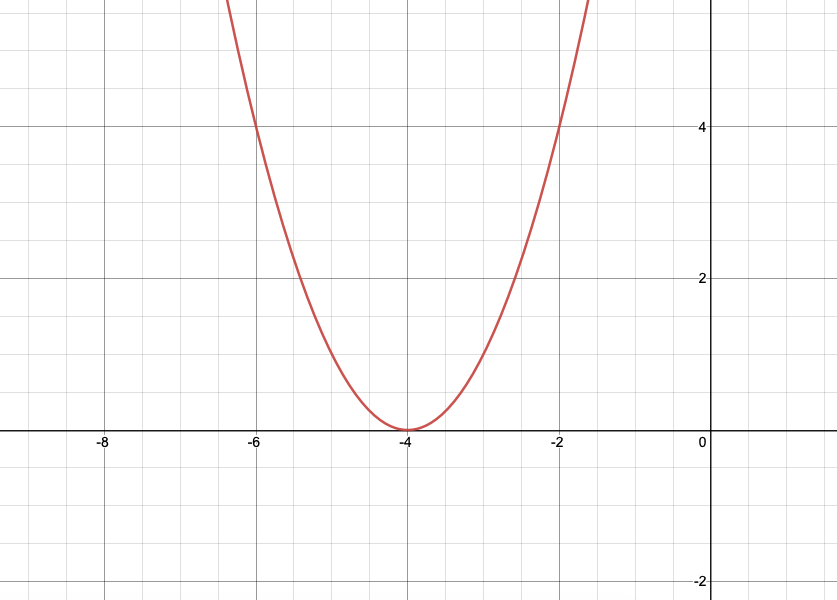
Graph the function y=(x+4)2y=(x+4)^2.

First, we need to figure out what hh is. We know that the vertex form of the quadratic function is y=a(x−h)2+ky=a(x-h)^2+k. Our problem has a=1a=1 and k=0k=0, so we know there are no dilations and no vertical translations. But, we know there is a horizontal translation, as there is some value of hh.

Your first instinct may be to say that h=4h=4, but it's important to watch your signs! For this problem, h=−4h=-4.

y=(x−h)2y=(x−(−4))2y=(x+4)2\begin{align} y &= (x-h)^2 \\ y &= (x-(-4))^2 \\ y &= (x+4)^2 \\ \end{align}

The graph looks like:

Graph of y=(x+4)^2

Made using Desmos

Practice

Identify the transformations from the parent function for: y=(x−2)2+4y=(x-2)^2 +4
Choose one answer

Illustrated · 1 min

Moving Polynomials Left or Right

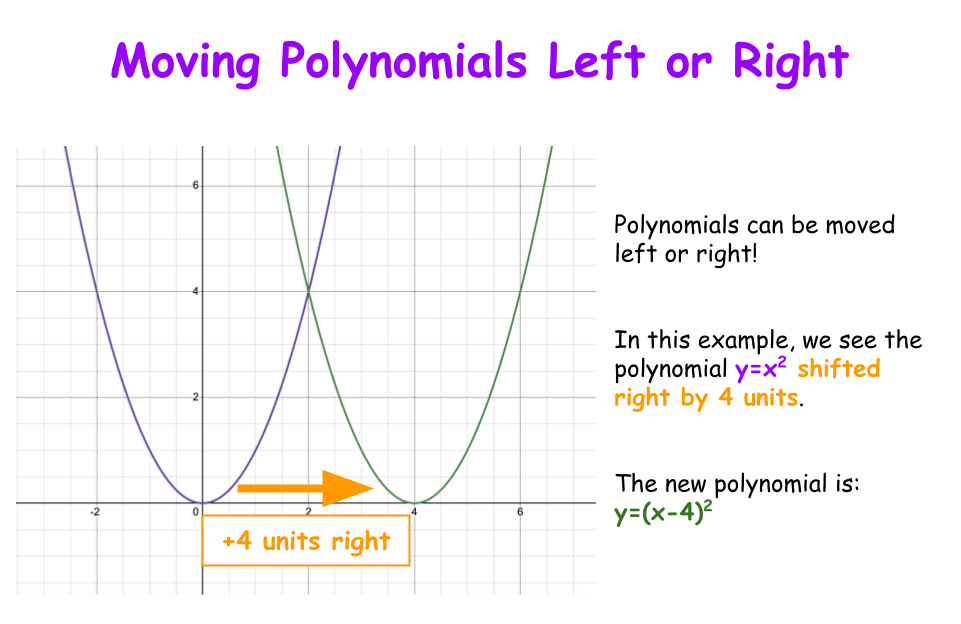
In the previous lesson, we learned how to move polynomials up or down by adding or subtracting numbers outside the parentheses. Now, we're going to learn how to move polynomials left or right. Just like adding or subtracting moves the graph up or down, adding or subtracting inside the parentheses will move the graph left or right.

Moving Polynomials Left or Right
Polynomials can be moved left or right!
In this example, we see the polynomial y=x^2 shifted right by 4 units.
The new polynomial is: y=(x-4)^2

Made using Desmos

If you have a polynomial like y=(x−4)2y=(x-4)^2, this graph moves to the right by two units. The minus sign means "move right". If the equation is y=(x+3)2y=(x+3)^2, the graph moves to the left by three units. Here, the plus sign means "move left".

So, whenever you see a (x−h)(x-h) term, it moves the graph to the right by hh units. If it's (x+h)(x+h), it moves the graph left by hh units. It’s important to remember that the sign inside the parentheses works the opposite way you might expect. If there’s a minus sign, the graph moves to the right, and if there’s a plus sign, the graph moves to the left.

You can try this with different polynomials to see how changing the number inside the parentheses affects the graph. Moving the graph left or right does not change the shape or size of the graph; it just shifts where it is located on the coordinate plane.

Video

(Video) Moving Polynomials Right or Left

by Anusha Rahman

In this lesson by Anusha Rahman, you will learn how to shift polynomials left or right.

Summary

Horizontal transformations involve shifting the graph of a polynomial left or right. These transformations occur when we add or subtract a constant from the xx value in the polynomial function.

Type a concept, like “slope” or “photosynthesis”.

↑ ↓ to choose · Enter to openSearch explanations and problems