Multiple Alleles — Definition & Examples

Illustrated · 1 min

The Effect of Multiple Alleles

A gene can have many different alleles within a population. A single organism can only have two alleles because it receives one from each of its parents. However, in a population, there can exist many different forms of a gene. Having multiple alleles for a gene leads to things like many different kinds of hair color and body size.

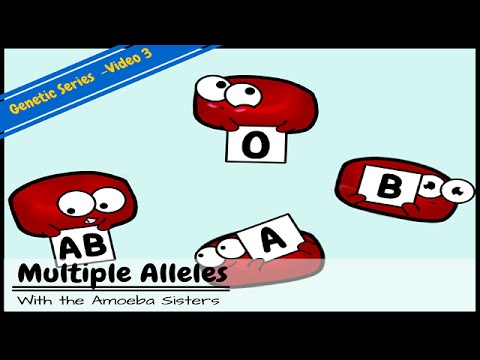
One very important trait that is controlled by multiple alleles is Blood type. A, B and O are the three alleles and they can come together in different ways to make different blood types: AB, AA, BB, OO, AO, and BO.

This concept of multiple alleles is important in the context of evolution. There has to be an ability for alleles to change so that natural selection can occur. Continued natural selection leads to evolution.

Different dog breeds exist because of different alleles.

Image source: By GraphicMama-team CC0, via pixabay.com

Within a population, there a many different allelic forms that can control phenotypic traits like fur color. In the above picture, each coloring pattern has an associated allele combination, and the mixing any of these breeds would produce a new allele combination.

Why Doesn't This Fit Mendelian Inheritance?

Mendel's Law of Segregation talks only about how one offspring gets two alleles from its parents. At the time Mendel was doing his experiments, scientists didn't know about the molecules involved in genetics. So, Mendel was really looking at traits and not where the traits come from. He assumed that there were only two possibilities for each trait and that any trait is only controlled by two alleles. Scientists know now that that isn't always true.

Illustrated · 1 min

Different Versions of Alleles

Many genes have more than two alleles (versions of the gene). This means that more than two forms of the allele exist in a species.

Multiple alleles code for different fur color in rabbits.

Image source: By CNX OpenStax CC BY 4.0, via Wikimedia Commons

Blood type is an example of this. The color of a rabbit's coat is also an example of multiple alleles, as shown above. For rabbits, there is one gene that controls the color of their fur, with four possible versions of that gene (alleles).

Vocabulary Review:\color{#8925AE}{\text{Vocabulary Review:}}

Allele\color{#8925AE}{\text{Allele}} : Genes of the same type that contain different kinds of information. You can have dominant or recessive alleles.

Dominant\color{#8925AE}{\text{Dominant}} : The dominant allele will always produce a phenotype

Recessive\color{#8925AE}{\text{Recessive}} : The weaker of two expressed genes. Only shown if a person carries two recessive alleles

Heterozygous\color{#8925AE}{\text{Heterozygous}} : Two different kinds of allele, one dominant and one recessive

Homozygous\color{#8925AE}{\text{Homozygous}} : Two of the same type of allele, both dominant or both recessive

Codominance\color{#8925AE}{\text{Codominance}} : Occurs when two different alleles are fully expressed. Neither allele can dominate, so they both show up but they do not blend

Incomplete Dominance\color{#8925AE}{\text{Incomplete Dominance}} : Occurs when neither of two alleles is completely dominant nor recessive. The alleles are both expressed and show up as a mixture of the two alleles

Sex-Linked Traits\color{#8925AE}{\text{Sex-Linked Traits}} : Traits caused by alleles located on a sex-chromosome

Polygenic\color{#8925AE}{\text{Polygenic}} : Traits that are controlled by two or more genes

Video

(Video) Multiple Alleles (ABO Blood Types) and Punnett Squares

by Amoeba Sisters

In this video by Amoeba Sisters, you will learn about traits that are coded for by multiple alleles, like blood type. You may have heard that blood type can be A, B, AB, or O, but how do we determine that? Watch the video to find out.

This video also includes a nice review of the terms genotype, phenotype, homozygous, and heterozygous.

Type a concept, like “slope” or “photosynthesis”.

↑ ↓ to choose · Enter to openSearch explanations and problems

