Multiplying Matching Binomials
What do we do when we want to multiply a pair of "matching" binomials (i.e. two binomials that happen to be the sum and difference of the same two terms), like 2x−5 and 2x+5?
We could certainly use FOIL but it turns out that there's an even easier approach available to us when our binomials have "matching" terms.
Let's break it down.
Use FOIL to multiply (2x−5) and (2x+5). What is the result?
The result is 4x2−25.
See how the expression we got from FOILing together our two binomials contained a couple of middle terms that simply canceled out?
Well, this observation sets us up to learn a new shortcut for multiplying matching binomials.
When we've got matching binomials, we can simply perform the following two steps:
1. Square the binomials' first term
2. Square the binomials' second term and subtract the result from the previous step's result
Note that we can only use this shortcut because, since our two binomials have the same terms, and since one binomial uses addition while the other uses subtraction, we know that any middle terms that result from multiplying them together will cancel out.
Let's try this shortcut out on our two matching binomials from before: (2x−5) and (2x+5).
1. Square the binomials' first term
2. Square the binomials' second term and subtract the result from the previous step's result
Finally, we subtract this result from the previous step's result. This gives us:
4x2−25
Notice that this is exactly the same answer we got when we used FOIL.
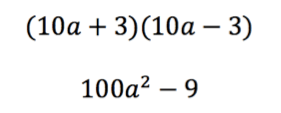
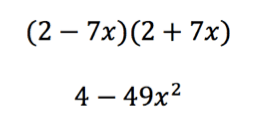
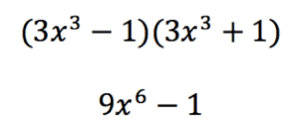
Now, let's practice this shortcut on a few more examples.
Yup! We've taken our binomials' second term, squared it, and subtracted the result from our binomials' first term (which we've also squared):
Again, we've taken the two-step process that we've learned above and applied it to our two binomials:
One last time, let's see our shortcut in action: