Multiplying Decimals by Powers of 10 — Rules & Examples

Illustrated · 1 min

Multiplying and Dividing Decimals by Powers of 1010

When you multiply a decimal by a power of 10,10, simply move the decimal place to the right as many places as there are 0s0\text{s} in the power of 10.10.

When you divide a decimal by a power of 10,10, simply move the decimal place to the left as many places as there are 0s0\text{s} in the power of 10.10.

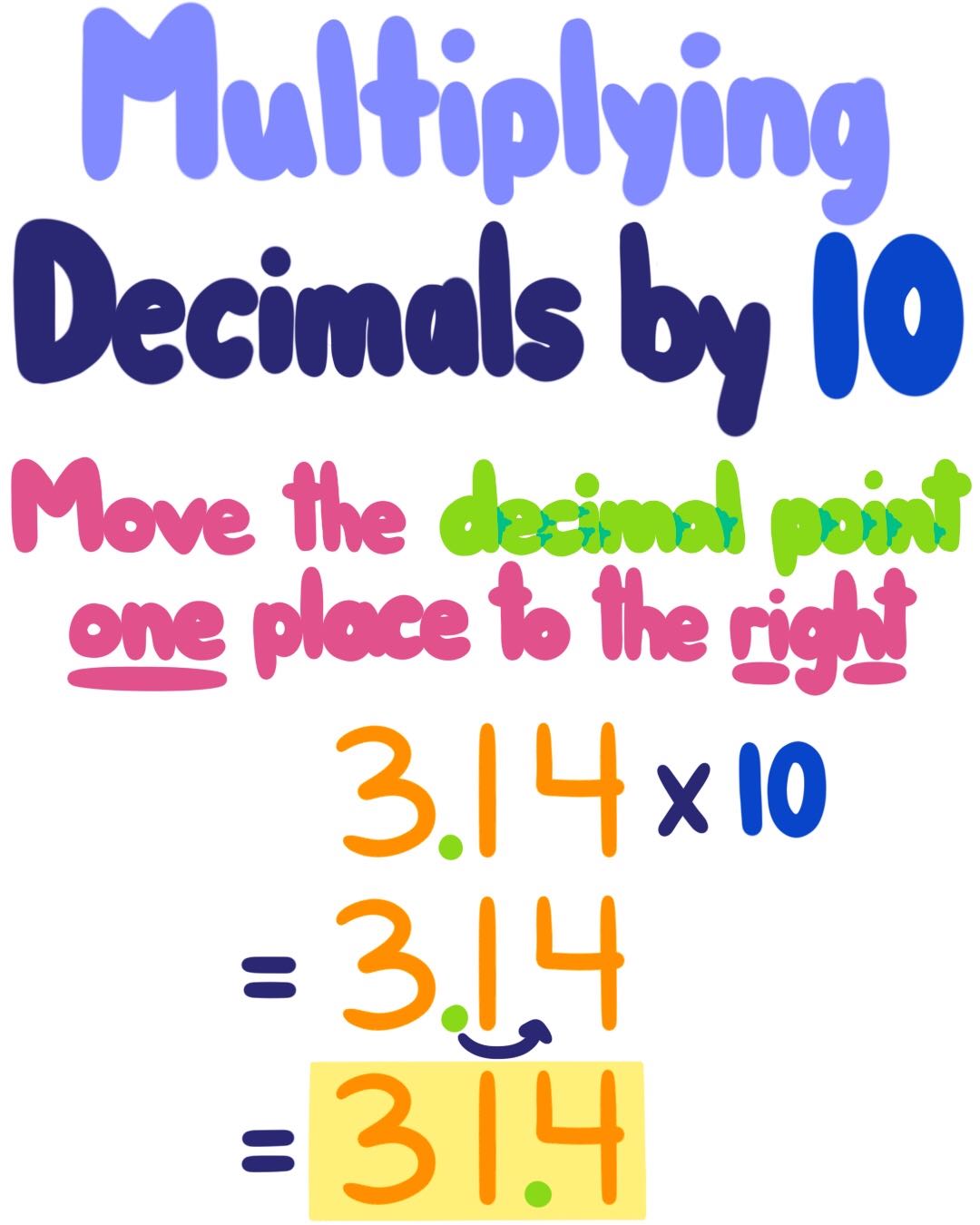
Multiplying Decimals by 1010

Multiplying Decimals by 10: Move the decimal point one place to the right. Example: 3.14 x 10 = 31.4

Image by Caroline Kulczycky

Multiplying Decimals by 100100

Multiplying Decimals by 100: Move the decimal point two places to the right. Example: 3.14 x 100 = 314

Image by Caroline Kulczycky

Dividing Decimals by 1010

Dividing Decimals by 10: Move the decimal point one place to the left. Example: 3.14/ 10 = 0.314

Image by Caroline Kulczycky

Dividing Decimals by 100100

Dividing Decimals by 100: Move the decimal point two places to the left. Example: 3.14/ 100 = 0.0314

Image by Caroline Kulczycky

Video · + 2 min read

(Video) Multiplying and Dividing Decimals by 1010, 100100, and 1,0001{,}000

by Richard Russell

Here's a great video in which Richard shows you how to multiply and divide decimals by powers of 1010. He uses a visual method to help you understand what is happening to numbers as you do this.

Summary\large{\text{Summary}}

One of the important parts of the decimal system is learning when to move the decimal point.

When we multiply a decimal by a power of 1010, we're making the number larger. When we divide by a multiple of 1010, we're making the number smaller.

Multiplying

The first example he looks at is 3.6×103.6\times10. We want to put this number into the following grid.

grid

Here, the decimal place will stay put. Putting in 3.63.6, we get:

3.6 in the grid.

Now, we want to multiply by 1010. Multiplying will make our decimal larger, meaning we want to move the digits to the left. We mean the digits move to the left of the decimal point. How far to the left though? You move it the number of spaces equal to the number of zeros in the power of 1010. Since 1010 has one zero, we move one space to the left.

36 in the grid.

We now have our solution! 3.6×10=363.6\times10=36

Dividing

Dividing is the same, we just move the digits in the opposite direction. The example he looks at is: 4.63÷1004.63\div100. Start by placing your decimal number in the grid.

4.63 in the grid.

Now, we divide by 100100. Since it's division, we move the digits to the right. And, because 100100 has two zeros, we move each digit two spaces to the right.

.  463 in the grid.

Since there is empty space between the digits and the decimal, we fill it in with 00s.

0.0463 in the grid

We have our solution! 4.63÷100=0.04634.63\div100=0.0463

If you're familiar with scientific notation, we could also write this as

4.63×10−24.63 \times 10^{-2}

Think of the −2-2 as a signal. The decimal was moved two places to the left!

Although this explanation focuses on 1010 and 100100, we can do larger powers of 1010 too. For instance, multiplying

4.63×1044.63 \times 10^4

puts the 44 in the ten thousands place. It also puts the 66 in the thousands place. Finally, the 33 goes in the hundreds place. Since we have some gaps we just fill them with zeros. The result is

4.63×104=46,3004.63 \times 10^4 = 46{,}300

This result is a whole number. That means we don't write any digits after the decimal point. In fact, we don't even have to write the decimal point! It's invisible, right after the last zero.

Try Yourself!

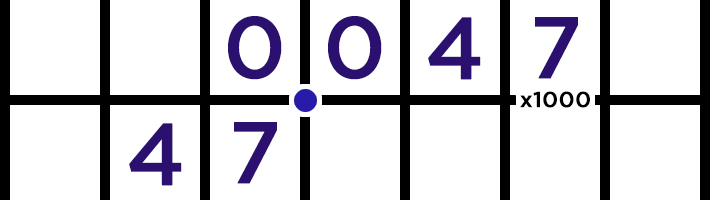
What is 0.047×1,0000.047\times1{,}000?

Choose one answer

Interactive · 3 questions

Multiplying or Dividing Decimals by 1010 or 100100

If you multiply a decimal by 1010, the decimal point will move one place to the right.

If you divide a decimal by 1010, the decimal point will move one place to the left.

If you multiply or divide by any power of 1010, it will move a number of spaces equal to the number of 00’s.

Example 1

What is 15.678×10015.678 \times 100?

We must first note that 15.678×10015.678 \times 100 is multiplication, so the decimal place for 15.67815.678 will move to the right.

Next, the multiple of ten is 100100, which has two zeros. Therefore, we move the decimal place in 15.67815.678 to the right by two places. 15.678→1567.815.678 \rightarrow 1567.8

Example 2

What is 109.42÷100109.42 \div 100?

We must first note that 109.42÷100109.42 \div 100 is division, so the decimal place for 109.42109.42 will move to the left.

Next, the multiple of ten is 100100, which has two zeros. Therefore, we move the decimal place in 109.42109.42 to the left by two places. 109.42→1.0942109.42 \rightarrow 1.0942

We are now going to take a look at some of the types of problems you might encounter about multiplying or dividing decimals by 1010 or 100100.

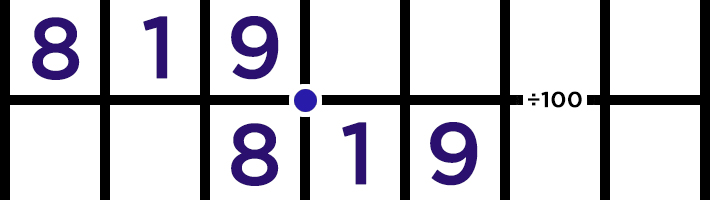
Practice 1 \\ What is 831÷10,000831 \div 10{,}000?

Choose one answer

Type a concept, like “slope” or “photosynthesis”.

↑ ↓ to choose · Enter to openSearch explanations and problems