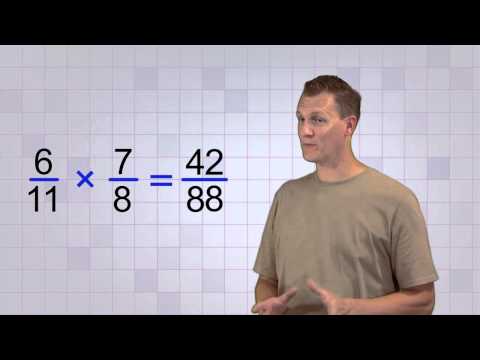
Multiplying fractions is actually much easier than adding fractions. To add fractions, you have to find common denominators before you can add them together at all.
Multiplication has no such requirement. We can multiply any fraction together immediately, without any preparation. It takes just a couple of simple steps. Let's use the example of: 53×32 to help us through this progress. The most important thing to remember is to simply keep the numerators (numbers on the top of the fraction) separate from the denominators (numbers on the bottom of the fraction). We don't multiply them together at all, and we can treat them as completely separate.
Multiply numerators with numerators and denominators with denominators
Let's use our example, and do each of the numerator and denominator separately.
Let's start with the numerators: 53×32 The numerators above are highlighted in green. Pulling them out, we can multiply them on their own: 3×2=6 We keep the result of that for the solution, which we now have half of: ?6.
Let's continue with the denominators: 53×32 The denominators above are highlighted in green. Pulling them out, we can multiply them on their own: 5×3=15 We then put that result in the solution: 156
Simplify, if possible
But wait, we're not done yet! The last step, as with most fraction problems, is to simplify the result, if possible. The above result, 156, can be reduced to lowest terms. We factor the numerator and denominator. It turns out the greatest common factor (GCF) is 3, then reduce: 156=(3)(5)(2)(3)=52 Our final answer is 52.