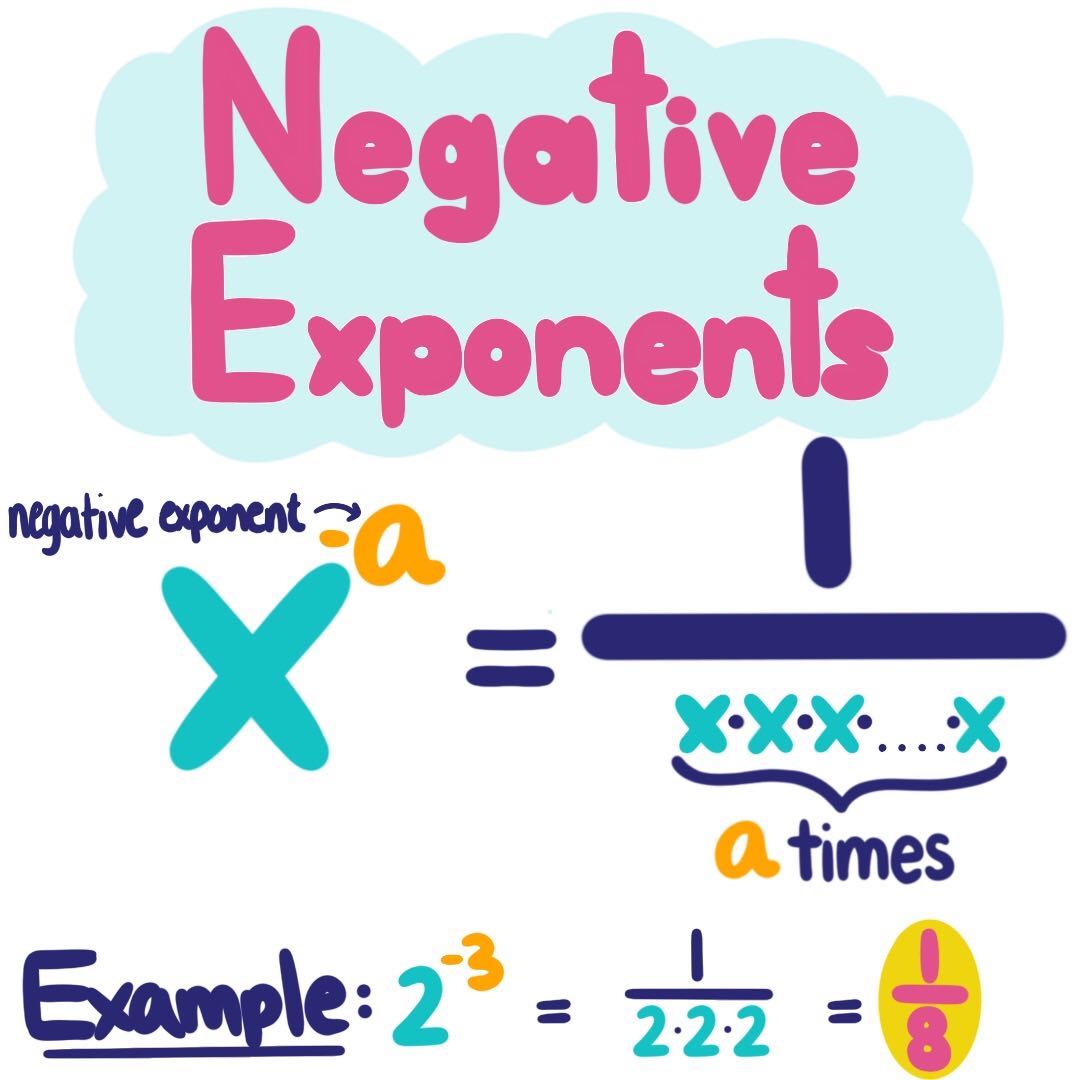
Raising a number to a negative exponent isn't much different than raising a number to a positive exponent. The only difference is that a negative exponent makes you take the reciprocal of the base first. This will turn the expression into one with a positive exponent.
Let's look at an example to understand this more clearly. Suppose we want to find 4−2.
4−2=421
The negative sign next to the 2 indicates that we want the reciprocal of the base. Then, we simplify the denominator by squaring to get our answer.
421=4×41=161
In general, the rule is:
Image Source: Caroline Kulczycky
and this rule is sometimes called the negative exponent rule. It can be used to go from a negative exponent to a fraction and vice-versa. Most of the time, however, we start with the negative exponent and finish with the fraction.
One more thing to note: if the base is positive, the entire expression is positive. This is true even if the exponent is negative. This happens because the reciprocal of a positive number is positive. As the image demonstrates, we are just multiplying a positive number by itself repeatedly.
Some rules we use in this explanation are useful for all types of exponents. This includes exponents that are negative numbers.
Summary
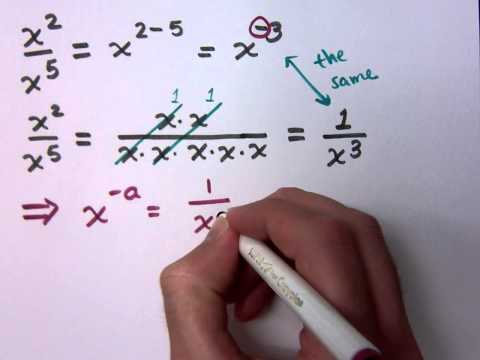
Let's first look at an example that introduces negative exponents: x5x2. We can use the quotient rule to simplify this expression.
x5x2=x2−5=x−3
It will be very important that the power −3 is a negative number. What does the −3 mean though? Well, we can solve this problem a different way and find out.
x5x2=x⋅x⋅x⋅x⋅xx⋅x=x⋅x⋅x⋅x⋅xx⋅x=x⋅x⋅x1=x31
This means x−3 and x31 are the same. They are two algebraic expressions that mean exactly the same thing.
This leads us to our rule for negative exponents, which we can write in two different ways.
x−a=xa1x−b1=xb
In this formula a is a number (positive or negative) and x is a variable. Since x−3 and x31 are the same, we can write this as an equation:
x−3=x31
The first boxed formula tells us this is true, when a=3. We could also use the second boxed formula when b=−3.
More Examples
Let's try another example. We will simplify x12x5.
x12x5=x5−12=x−7=x71
It is usually common practice to not put negative exponents in final answers. That is, if an answer has a negative exponent, rewrite the answer to use a positive exponent instead. That's why we have the last step in this example.
Sometimes the expression we start with will have a negative exponent. However, that doesn't make things more difficult. As a new example, we try simplifying y16y−3. Just as in the previous examples, we use the quotient rule for exponents to rewrite
y16y−3=y−3−16=y−19
In the first step, we wrote the expression with a single exponent. This is an instance of combining like terms. In the second step, we simplified the exponent so there is only one number.
Once again, we flip the exponent on its head to make the exponent positive. Put the new exponent underneath the fraction bar.
y−19=y191
One other scenario to consider: there's a coefficient in front of the exponent. If this happens, leave the coefficient on top if you have to move the exponent around. For instance, to simplify
7x−2
we flip the exponent just like before, and leave the 7 alone. The steps are written out as follows:
7x−2=7⋅x−2=7⋅x21=x27
Try this question on your own now. Simplify x7y20x10y12.
Raising a number to a negative power flips it on its head
When you raise a number to a negative power, first raise the number to the absolute value of the power. The number we raise to a power is called the base. In this explanation the power we start with is always a negative number. The absolute value of that power will always be a whole number.
Then, flip the number over so that the denominator becomes the numerator and the numerator becomes the denominator. In other words, find the reciprocal of the number.
If your number doesn't seem to have a denominator, that means you're working with an integer. You can just say that the denominator is 1. This is because dividing a number by 1 doesn't change the number you started with. For example, 8=18 and −15=−115.
An Example
Let's work through an example of simplifying negative exponents: 4−3.
First, raise 4 to the 3rd power: 43=4×4×4=64. There are more examples of this step on our page about regular exponents.
Second, figure out what 64 looks like as a fraction. It's an integer, so we can just say that its denominator is 1: 164. Remember that dividing a number by 1 doesn't change its value.
Third, swap the numerator and the denominator so that the 64 is on the bottom, and the 1 is on the top: 641.
And we're done!
Try it! Using the steps above, solve the following problem:
2−4=?
2−4=161
We can solve this by first finding 24=16, then flipping it over so that the numerator and the denominator are swapped: 161.
Next, let's try this technique on a number that already has a denominator and a numerator already written out: a fraction.
Solve the following problem:
(78)−2
(78)−2=6449
First, square both the top and bottom numbers: 4964. Then, flip the whole fraction over so that you get the reciprocal: 6449.