
Illustrated · 2 min
In the early 20th century, experiments with naturally-radioactive elements showed something strange. Sometimes, an atomic nucleus will decay and produce a different nucleus plus either an electron or an anti-electron (also called a positron). This is called beta decay.
The strange part:
While beta decay conserves electric charge, it was not immediately clear how momentum and energy were being conserved.
For example: A stationary potassium-40 atom might decay and produce an electron and a calcium-40 atom that both moved upwards. And totaling up all of the energy in those two products and comparing it to the initial energy of the potassium-40 atom, you might find that ~600 keV was missing.
It turns out that beta decay does conserve momentum and energy - there is a third decay product. It is either a neutrino or an anti-neutrino. In the example above, energy and momentum would be conserved with a 600 keV anti-neutrino moving downwards.
Neutrinos (and anti-neutrinos) are very hard to detect. Rather than interacting electromagnetically, as normal matter does, they interact only by means of the nuclear weak force. This makes them impossible to see directly with light of any kind.
Neutrino detectors work by detecting the extremely rare interactions that neutrinos & anti-neutrinos have with atoms. As one example, the Homestake experiment worked by counting every neutrino that interacted with any of the atoms in roughly 600 tons of detector. Only a few neutrinos were detected every day.
The neutrinos produced during the beta decays that are part of the nuclear fusion reactions inside the Sun's core travel at very nearly the speed of light. Almost all of them pass through all of the overlying material without interacting with a single atom, and continue on into space. But a very few of those that pass through the Earth will interact with something - and sometimes that is the material of a neutrino detector.
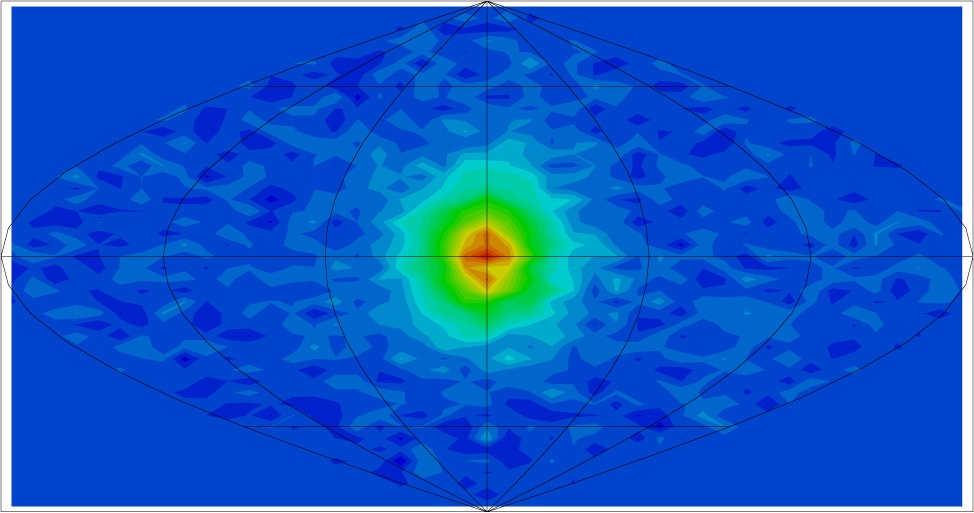
The Sun, imaged in neutrinos by the Super-Kamiokande neutrino observatory. This picture took just over 4 years to produce, counting all of the neutrinos that interacted with the detector.
Image from Super-Kamiokande
Neutrino observations allow us to directly measure the current nuclear fusion rate of the Sun.
The Sun is indeed in a stable state: the amount of energy being produced by nuclear fusion in the Sun's core is the same as the amount of energy being radiated off of its surface.