Illustrated · 2 min
+1 contributors

Newton's Method allows us to approximate the zeroes of any function, by using derivatives.
The process is relatively simple: Suppose we want to estimate a zero of . First, choose any guess for the zero, and call it . Then, calculate , and so on using the recursion Each gives a better estimate for the zero than the previous value , and so by repeating this process enough times we can arrive at a reasonably close approximation.
Let's take a look at an example: suppose .
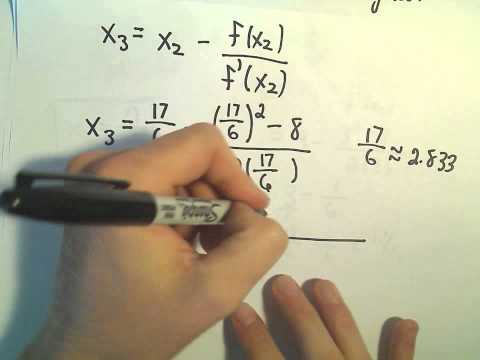
Since , which is somewhat close to , we can start by letting . (The value that we choose does not actually matter as much in the long-run, so in theory we can start with if we really want. However, choosing a reasonable guess from the start will let us reach an approximation much more quickly.) Before we use the formula provided above, we should find out what the derivative of is: So, we have This is closer to the actual solution than , but let's continue: Now, we're much closer! By doing the same steps, we can find that which is a pretty good estimate for the actual value of . (If you go one step further, you'll get which is even more accurate but a lot more painful to calculate by hand.
To show why this process works, let's play around with the general function . Suppose we start with an initial guess for the zero- say . Our goal is to determine a closer approximation for the zero, in terms of .
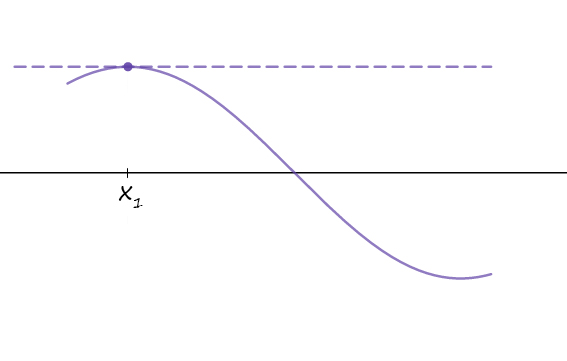
To do so, imagine the graph of , and let be one point on the curve. If we draw the tangent line to the curve at , we can see that the tangent line intersects the -axis at , where closer to the actual solution to than . So, let's let the -coordinate of be . If we repeat the same process, we can similarly get , and so on. Each gives a more accurate approximation of the zero of .
Great, so we now have a graphical method of approximating the zeroes of . But can we now find a formula algebraically? Of course, we can!
Recall that the main step of the process is to find the tangent line of the graph at and find its -intercept. Let's start with the tangent line: If we let the line be , we simply need to solve for and . Here represents the slope of the tangent line at , which by definition is . Then our equation becomes Since we know passes through the point , we can plug this value in to get Solving for , we get . Therefore, our final equation of the tangent line becomes Since we want to find this line's -intercept, we set to find that By setting this new value as , we get the exact formula described above. So, we are done with the proof!