
Video · + 2 min read
Throughout history, many people have proposed perpetual motion machines, or machines that will continue running indefinitely without needing any electricity or gas.
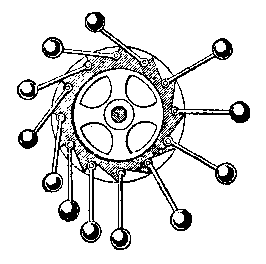
Above is an example of a proposed perpetual motion machine. In this example, the theory is that the balls, because they swing on poles, will actually travel further downwards than they will travel upwards, meaning that gravity will have more of an effect on the downwards side than the upwards side, making the wheel spin.
In this video, you can see a "perpetual motion machine" in action.

Although the wheel is spinning and the balls are changing places, the wheel does not spin independantly. The wheel's builder needs to keep nudging the wheel with his hands.
Why are perpetual motion machines impossible?
First: let's build up an intuitive sense of why the overbalanced wheel doesn't work. From the video of the above, you can see that for the balls shift unevenly in the wheel, and that if they do not shift soon enough the wheel stalls. This is because the tracks the balls are in have friction, resist moving through the tracks with perfect precision. This friction keeps the wheel from spinning perfectly and generating energy.
If there were no friction, then objects like perpetual motion machines could spin indefinitely. For example: here's a video of a top being spun on the international space station.

In this video, the top can spin for a long time because there is much less friction acting on it than there would have been on earth. If the top were in a vacuume, it's likely true that the top would be able to spin even longer.
Perpetual motion machines that generate energy
When lots of people talk about perpetual motion machines, they're talking about how to build machines that generate energy without fuel. An overbalanced wheel, to a lot of people, is a way to cheat the universe: to get energy without fuel.
Unfortunately, it's probably impossible to generate energy without fuel: at least in the way that the overbalanced wheel does it. In order to generate energy, the wheel would need to generate extra energy that could be used to spin a generator or run a car. Most perpetual motion machines have trouble running themselves. And even somewhat successful examples like the top in zero gravity would slow down if you tried to hook them up to a generator. They can only spin because nothing is holding them back, they are not actually generating extra energy.
If you want to learn more about why a perpetual motion machine is impossible, check out the expii articles on the first and second laws of thermodynamics.