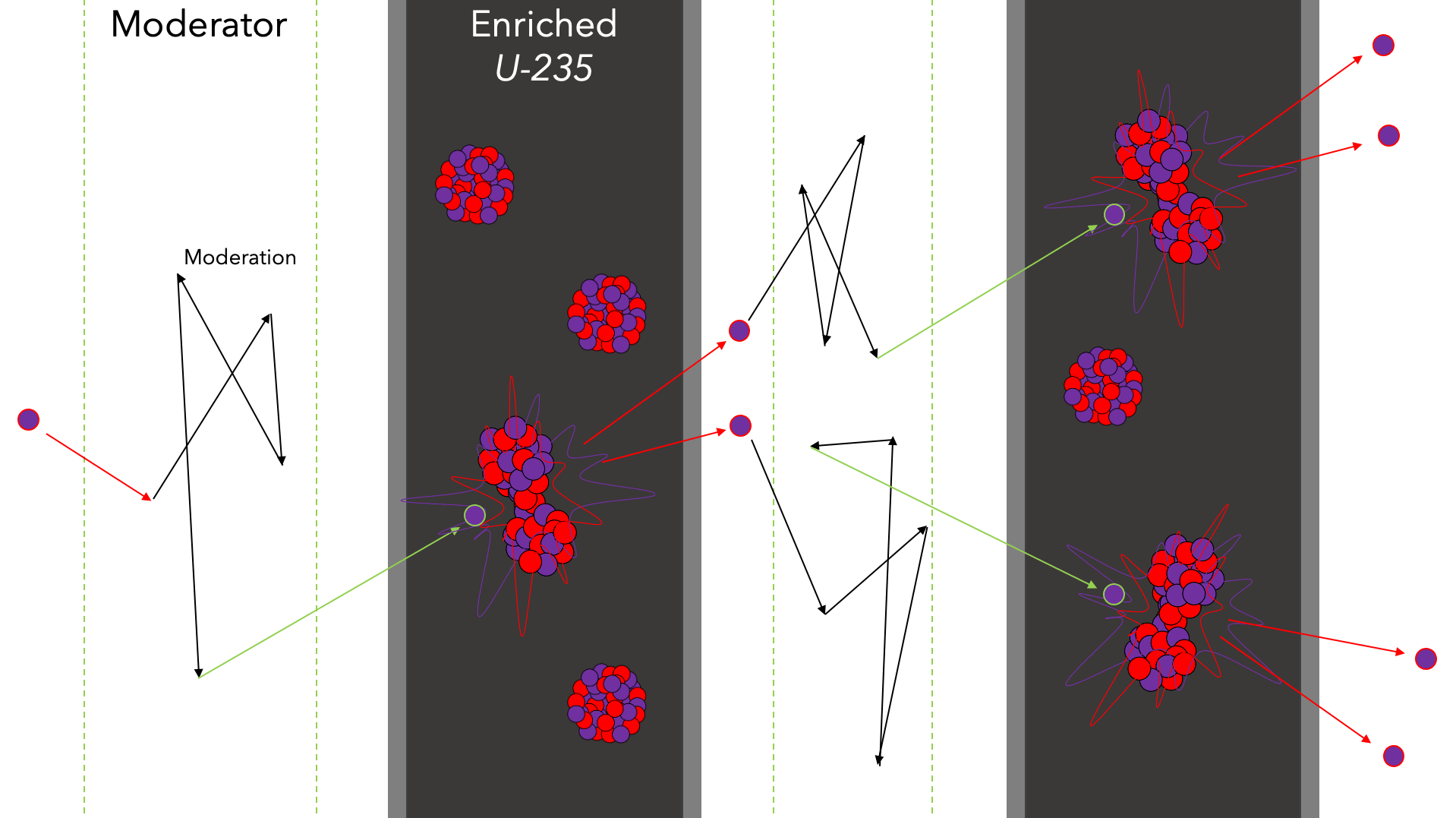
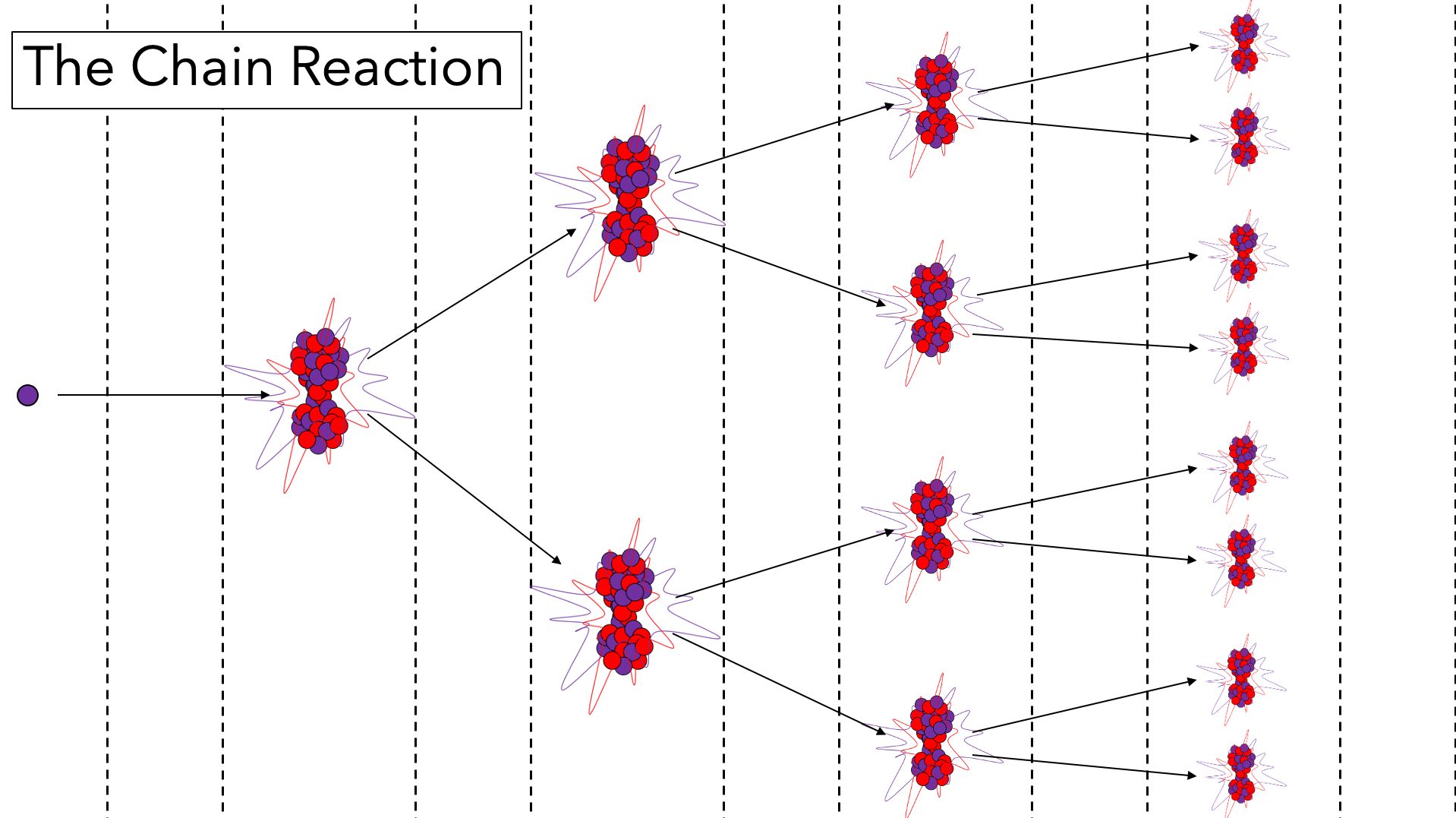
We've been studying nuclear reactions. We've looked at both fusion and fission. In fusion, we slam two small nuclei together. It releases a ton of energy because of the binding energy and mass defect. But, it requires unfathomable temperatures. So, it's unpractical. In fission, we're taking advantage of unstable nuclei to generate energy. We bombard fissile atoms with neutrons. Sometimes, it absorbs the neutron. But, the extra neutron makes it unstable. So, it splits into multiple smaller elements and more neutrons. What would happen if the new neutrons hit other fissile atoms? They would also undergo fission! The process continues until there are no atoms left.
Nuclear Chain Reactions
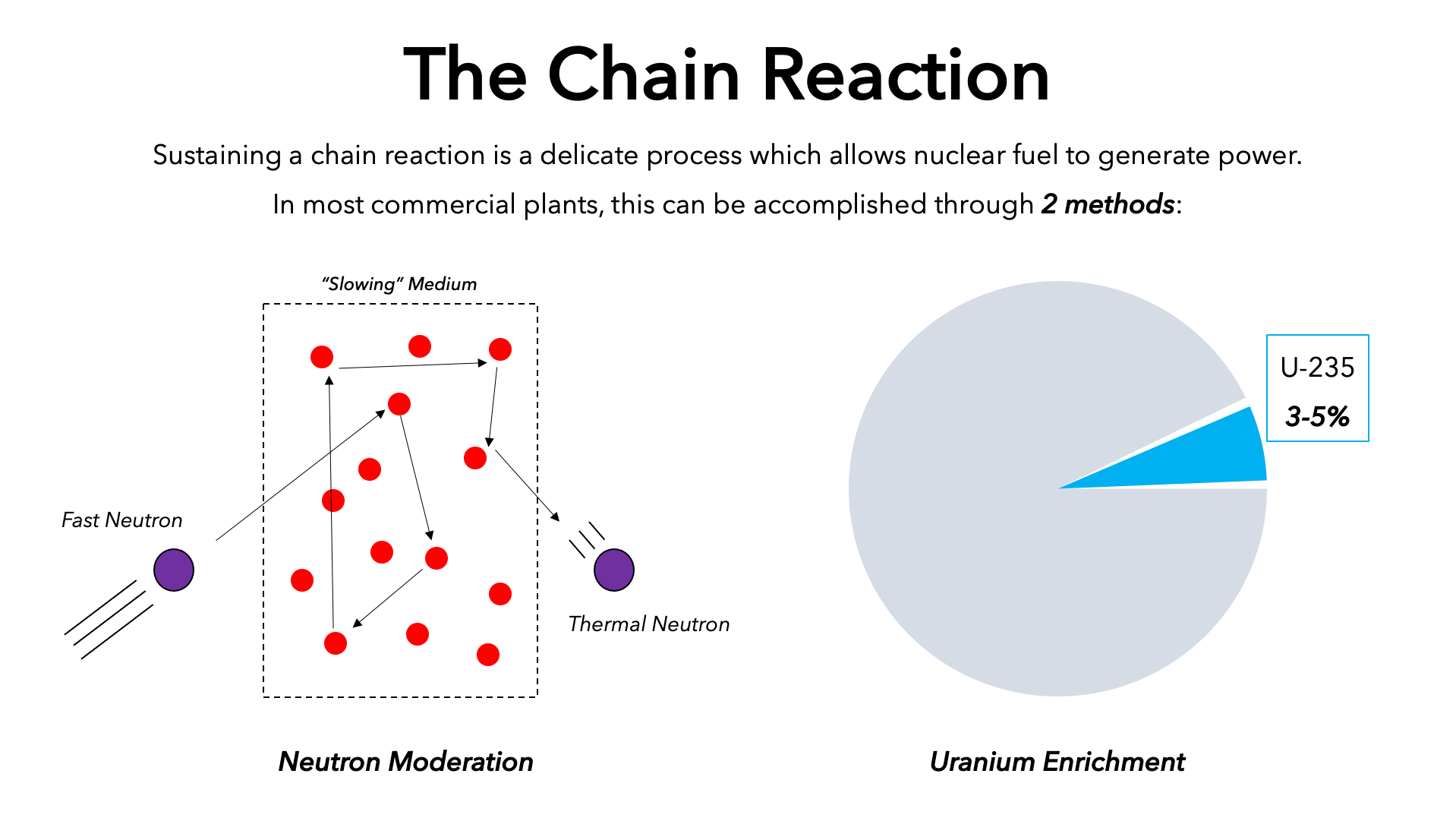
A chain reaction is any chemical reaction where the products contribute to further chemical reactions. In nuclear chemistry, we apply it to fission reactions. The first step is initiation. Initiation is the formation of an intermediate. For a nuclear chain reaction, the intermediate is unstable. So, it will undergo fission. The next step is propagation. In propagation, the intermediate is continually regenerated. So, our reaction is self-sustaining. In fission, we create new neutrons. Those neutrons hit other fissile atoms. Those atoms undergo fission and produce more neutrons. Propagation continues until the intermediate can't form anymore. Finally, we have termination. We are no longer able to generate the intermediate. So, the reaction stops.
Let's look at the most common nuclear chain reaction. That's the fission of U-235. We start by hitting U-235 with a neutron.
92235U+01n→92236U
U-236 is unstable and undergoes fission to produce krypton-92 and barium-141.
92236U→3692Kr+56141Ba
But, you'll notice that the atomic mass is unbalanced. Let's balance it!
236−92−141=3
92−36−56=0. The atomic number is already balanced!
How do we raise the atomic mass without changing the atomic number? We use neutrons! So, the reaction produces three neutrons. Let's write the complete balanced equation.
92235U+01n→92236U→3692Kr+56141Ba+301n
Our initial fission reaction generated three neutrons. If the three neutrons hit other U-235 atoms, they'll also experience fission. Let's say three more U-235 atoms do undergo fission. So, they each emit three more neutrons. That's nine neutrons! Now, we can initiate nine reactions. During propagation, we're seeing an exponential increase!
The Neutron Multiplication Factor
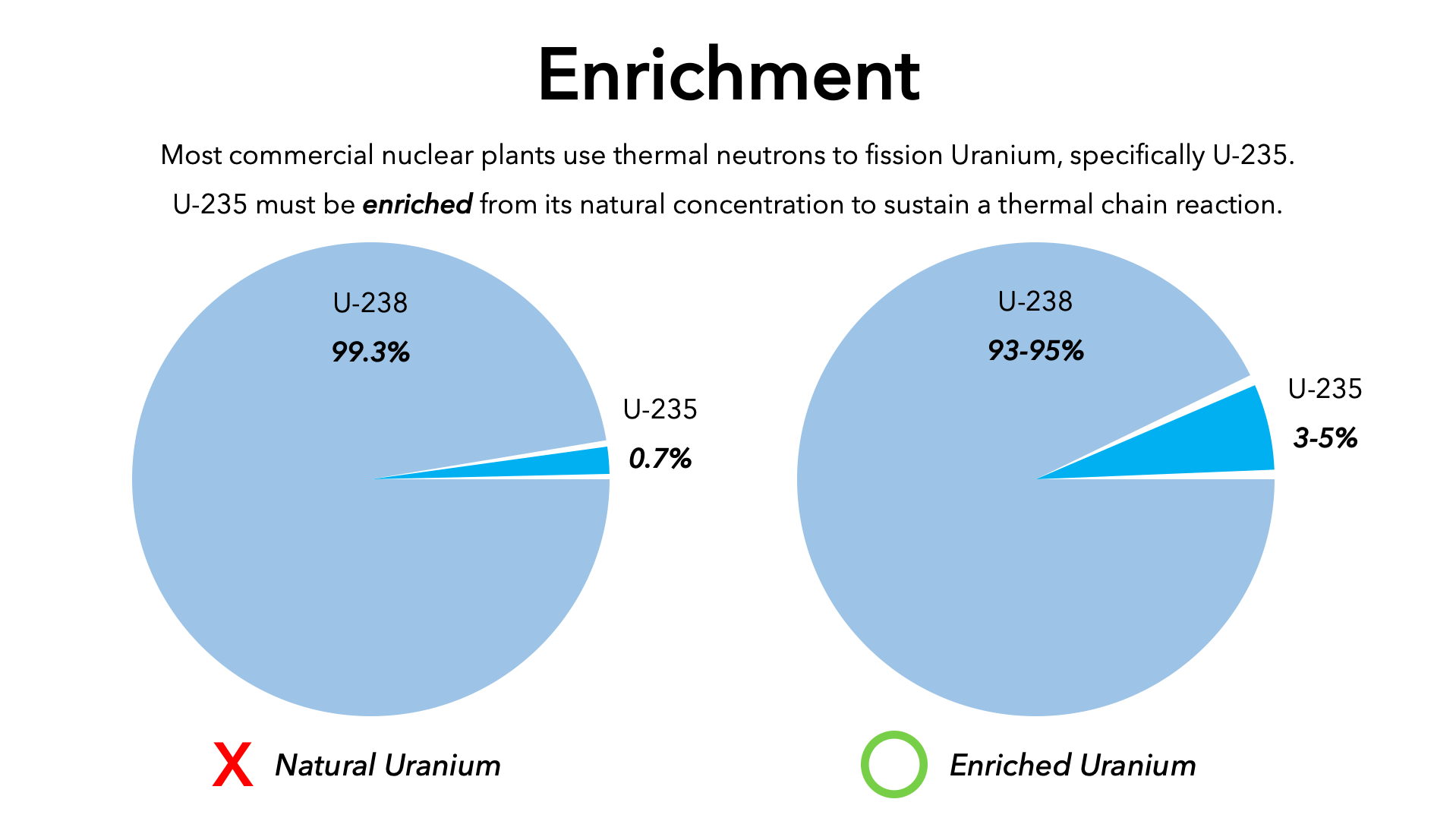
In our U-235 example, we imagined that every neutron caused more fission. For nuclear chemists, that's the experimental best-case scenario. But in application, that's not always true. Let's imagine we're using U-235 in a reactor at a nuclear power plant. In a reactor, we don't have pure U-235. Instead, we have a mixture of three isotopes: U-238, U-235, and U-234. Let's consider U-234. What happens if it absorbs a neutron? It becomes U-235. So, it used up a neutron without producing more. Furthermore, not every neutron hits another atom. Neutrons are minscule. Atoms have a lot of empty space. So, it's possible that the neutron completely misses and leaves the system.
How do we measure nuclear reaction propagation? We use the average neutron multiplication factor (k). It measures the average number of neutrons that produce more fission reactions.
There are three possible scenarios for k.
-
k<1: Each fission reaction averages less than one subsequent reaction. In this scenario, the nuclear reaction is unsustainable. We call this situation subcritical.
-
k=1: Each fission averages one more reaction. In this scenario, the nuclear reaction is sustainable. We call this situation critical. It has a constant rate and energy output. So, it's ideal for reactors.
-
k>1: Each fission averages more than one further reaction. In this scenario, the nuclear reaction proliferates exponentially. So, we call this situation supercritical. A supercritical reaction has an increasing rate and energy output. The exponential increase can happen within microseconds. So, this is the goal of atomic weapons. For nuclear power plants, an uncontrolled supercritical situation is unbelievably dangerous.