Illustrated · 3 min

Nuclear Fission

Nuclear Fission is a highly probabilistic phenomenon, where a fissionable nuclide breaks apart, releasing a tremendous amount of energy. U-235 is not the only nuclide capable of fissioning, but it is the most common fissionable material in commercial nuclear reactors. For the sake of simplicity, U-235 will be the subject of this model.

Fission can be broken down into 4 major steps:

1.) A neutron is emitted from a fission somewhere else in space. It is initially at an extremely high energy and must bounce around in some medium to reach a lower energy level before it can cause U-235 to fission.

2.) The low-energy neutron’s path intersects with an atom of U-235 and is absorbed into the nucleus. This extremely unstable atom of U-236 will oscillate until the strong nuclear force can no longer sustain the atom and breaks into several smaller nuclei. This is fission.

3.) The smaller nuclei are newly formed atoms, called fission products. Fission products are highly radioactive components of a Uranium atom. Their proton numbers should add to 92, which is the proton number of Uranium.

4.) In addition to fission products, fission will almost always emit neutrons – approximately 2.5 neutrons per fission. This is the key to sustaining a chain reaction, where neutrons cause fissions, which emit more neutrons, each of which is probable to cause a fission somewhere else, repeating these events over and over again.
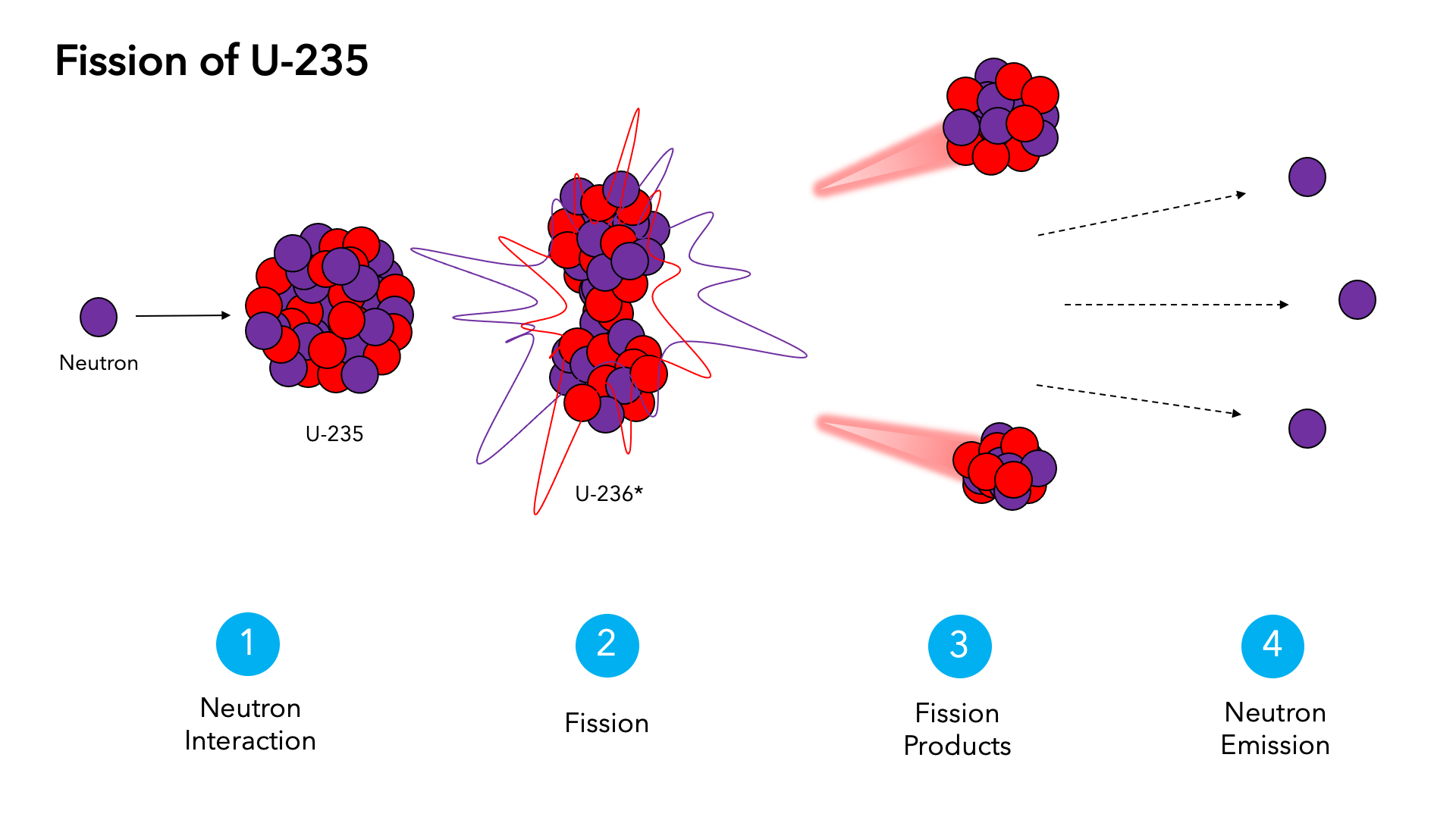
steps of nuclear fission

Steps of Nuclear Fission

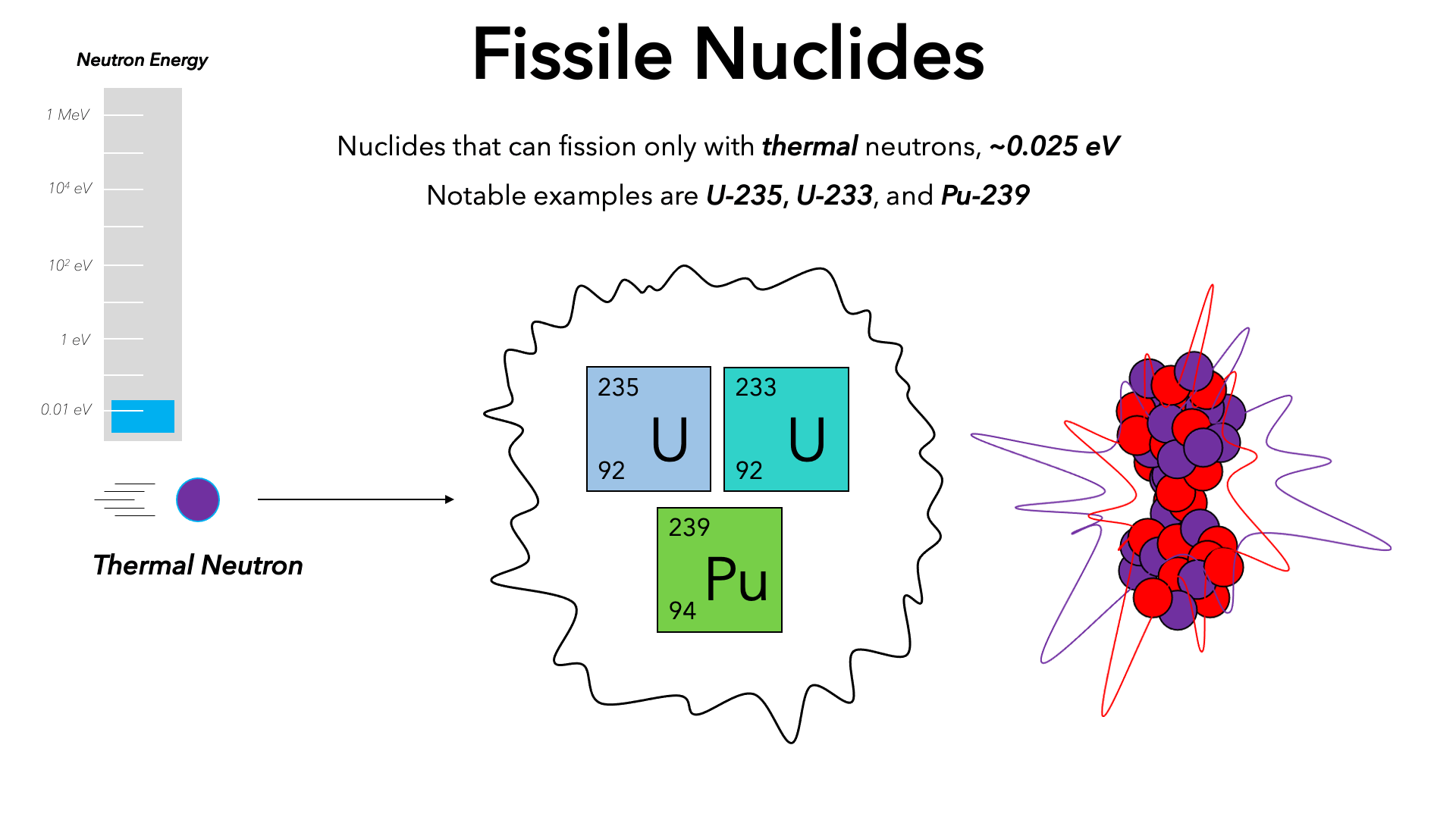
Whether a neutron interaction will occur depends on a neutron’s incident energy. High energy neutrons are called fast neutrons and have energies above 1 MeV. Low-energy neutrons are called thermal neutrons and have energies of approximately 0.025 eV.

In other words, fast neutrons are 100 million times more energetic than thermal neutrons. These energies define whether an interaction is probable to occur; this probability is called a cross-section (link here).

There are several types of neutron interaction, but 3 are most relevant to nuclear fission. These interactions are defined by what the target nuclide is:

Fissionable Nuclide: a nuclide that can fission from either high or low-energy incident neutrons.

Fissile Nuclide: a subset of fissionable nuclide that can only fission with low-energy incident neutrons. All fissile nuclides are fissionable, but not all fissionable nuclides are fissile. This is a subtle, but important difference.

In most commercial reactors, Uranium-235 must be enriched from its natural mined content (0.73%) to between 3% and 5%. This enrichment is enough to sustain a chain reaction.

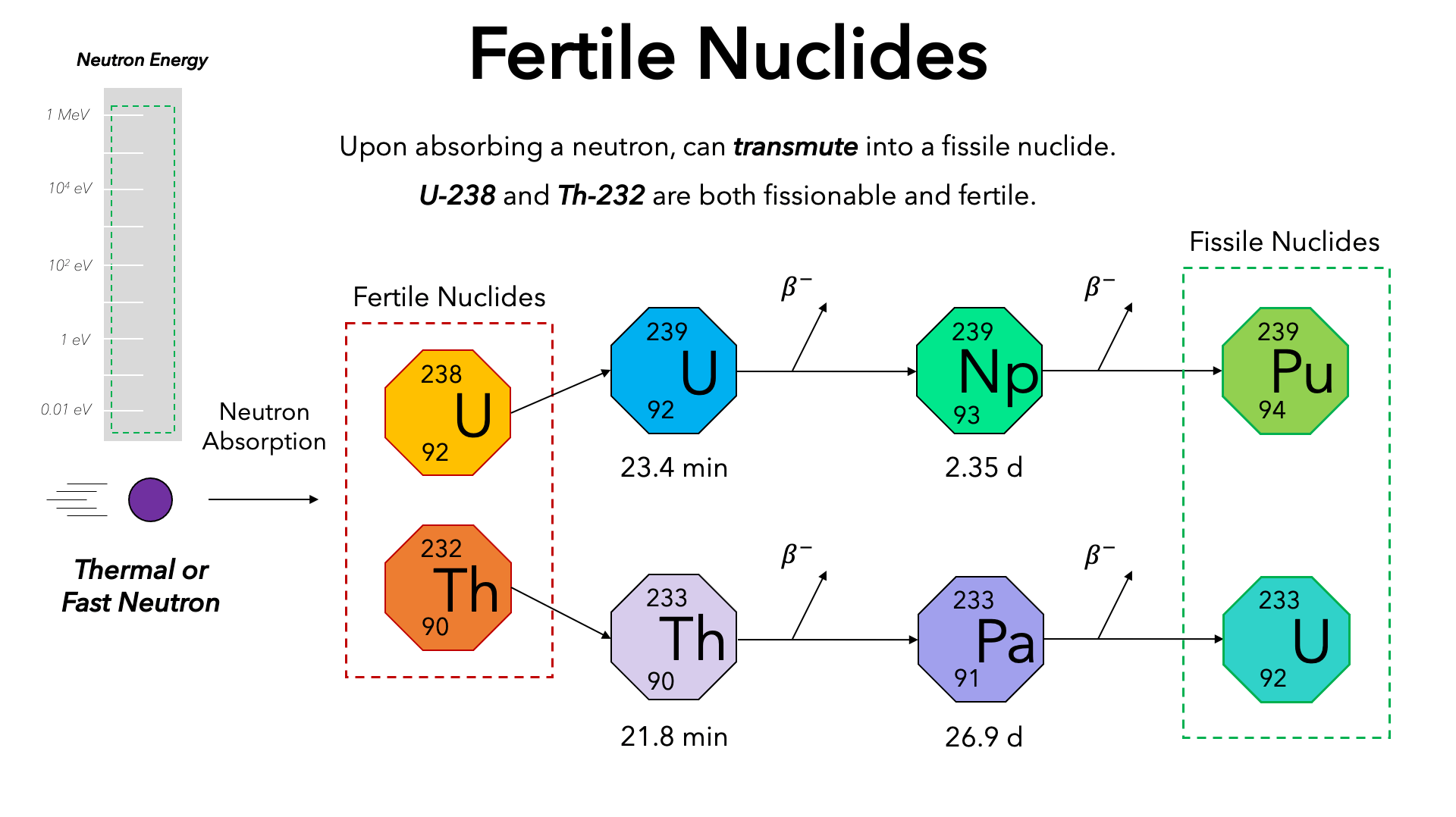
Fertile Nuclide: a nuclide that can readily absorb incident neutrons, and through radioactive decay can become a fissile nuclide
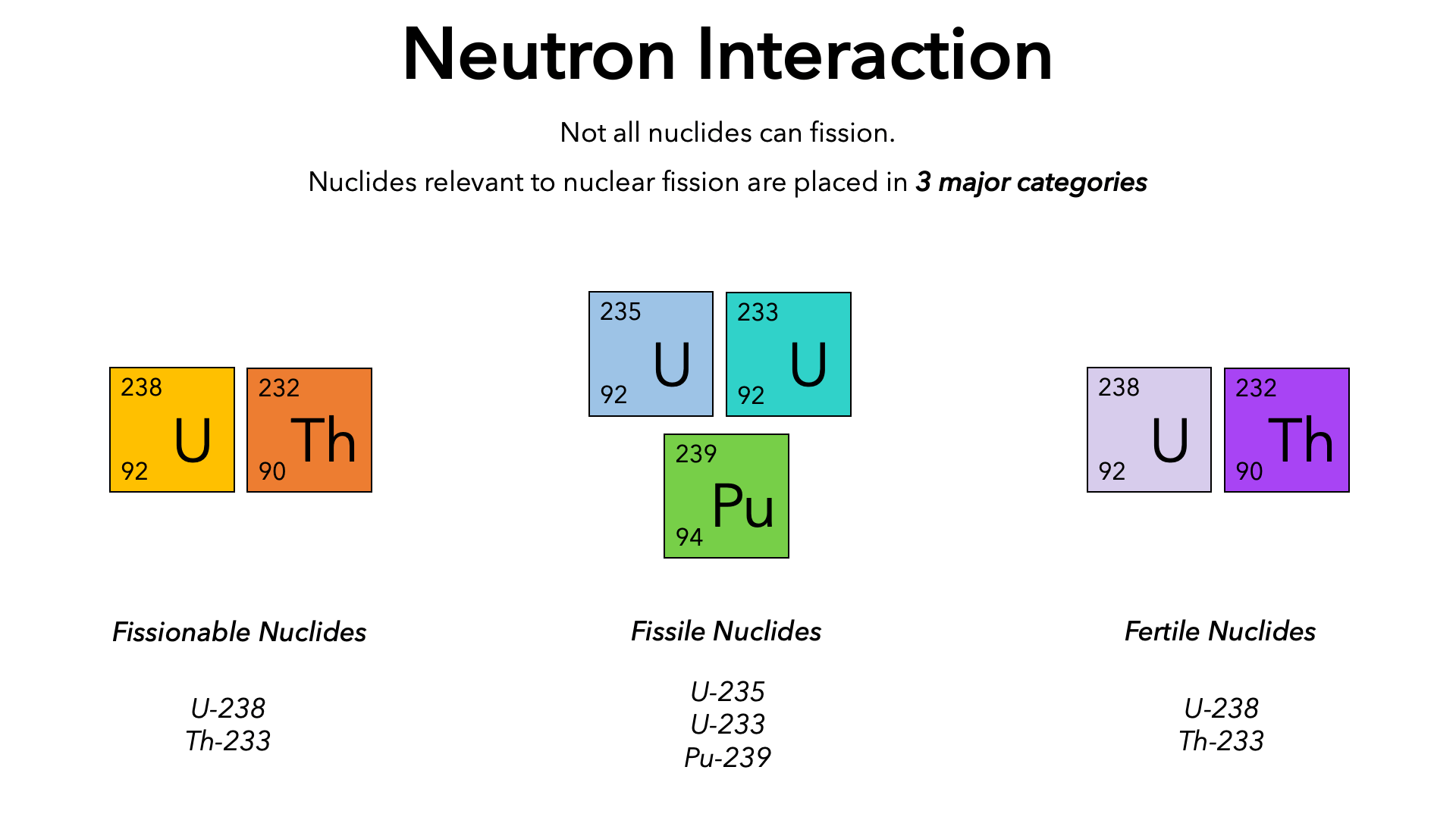
Periodic table visual of fisionable, fissile, and fertile nuclides

Types of nuclear material relevant to neutron interactions.
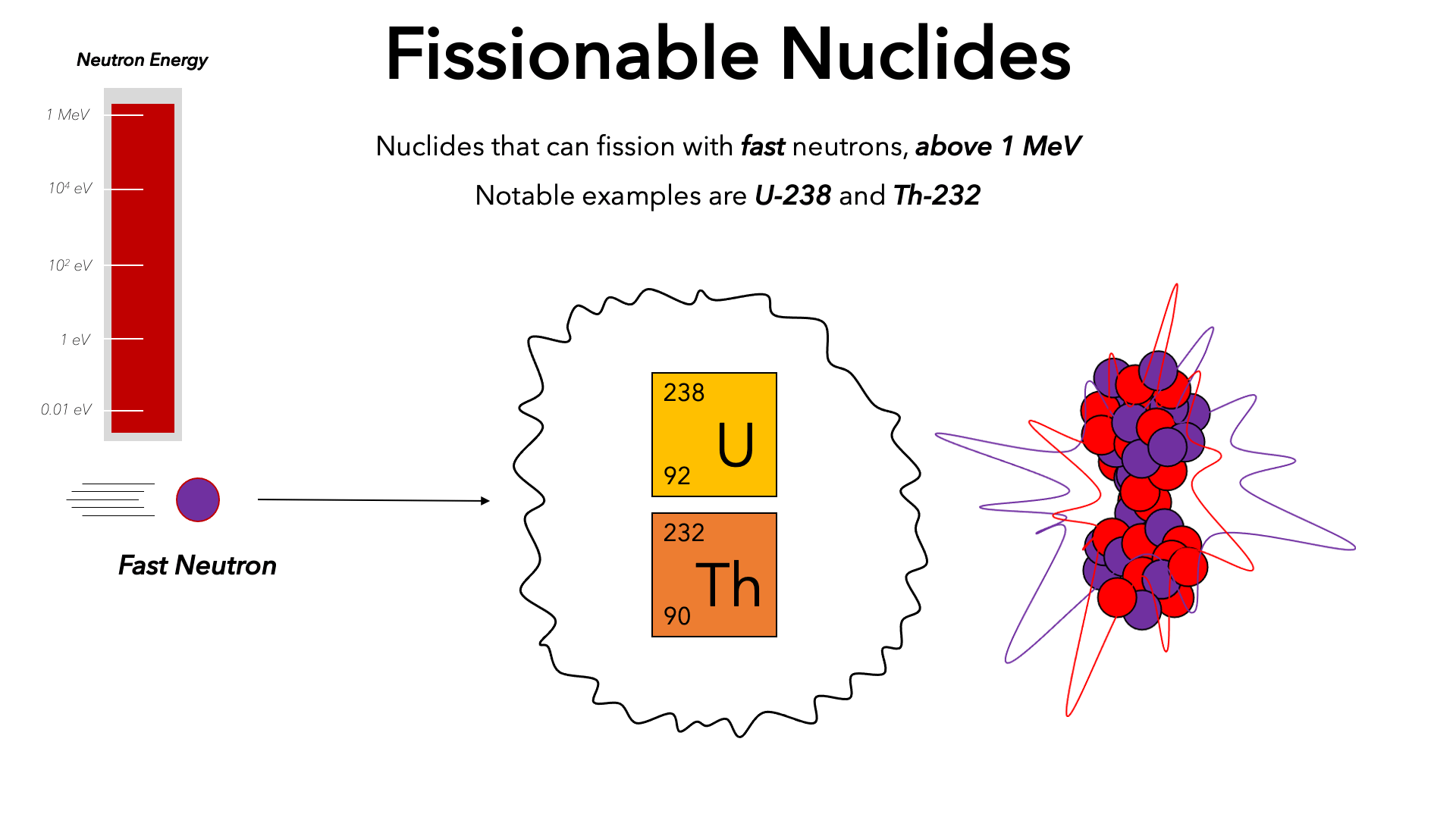
fissionable nuclide visual, fast neutron interaction
fissile nuclide visual, thermal neutron interaction
fertile nuclide visual; U-238 decay chain and Th-232 decay chain

Decay chains of U-238 and Th-232 upon absorbing a neutron
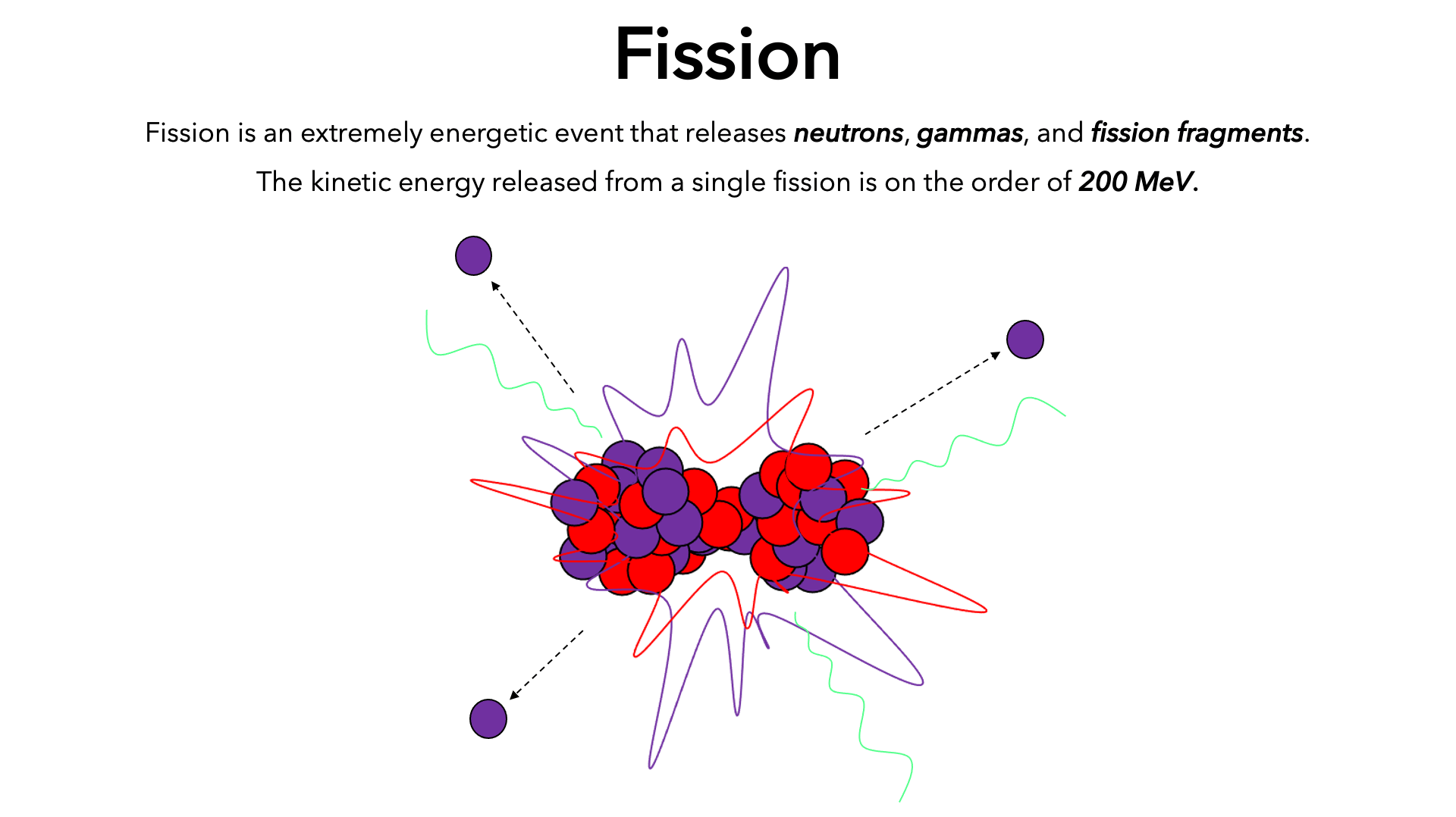
Fission visual

It is hard to comprehend the amount of energy fission releases. In short, there is no event, other than fusion, that can create such an immense amount of energy at the atomic scale. Multiply this by how many fissile atoms exist in a fuel material, and the picture becomes clearer...

Consider a tootsie pop, a small piece of candy that is usually a nice treat. In this case, it would not be so nice since we are assuming it is made entirely out of U-235.

To visualize fission’s energy density, how much power could a tootsie-pop sized fuel element release, and would it be useful to humans at a large scale? The answer may surprise you.
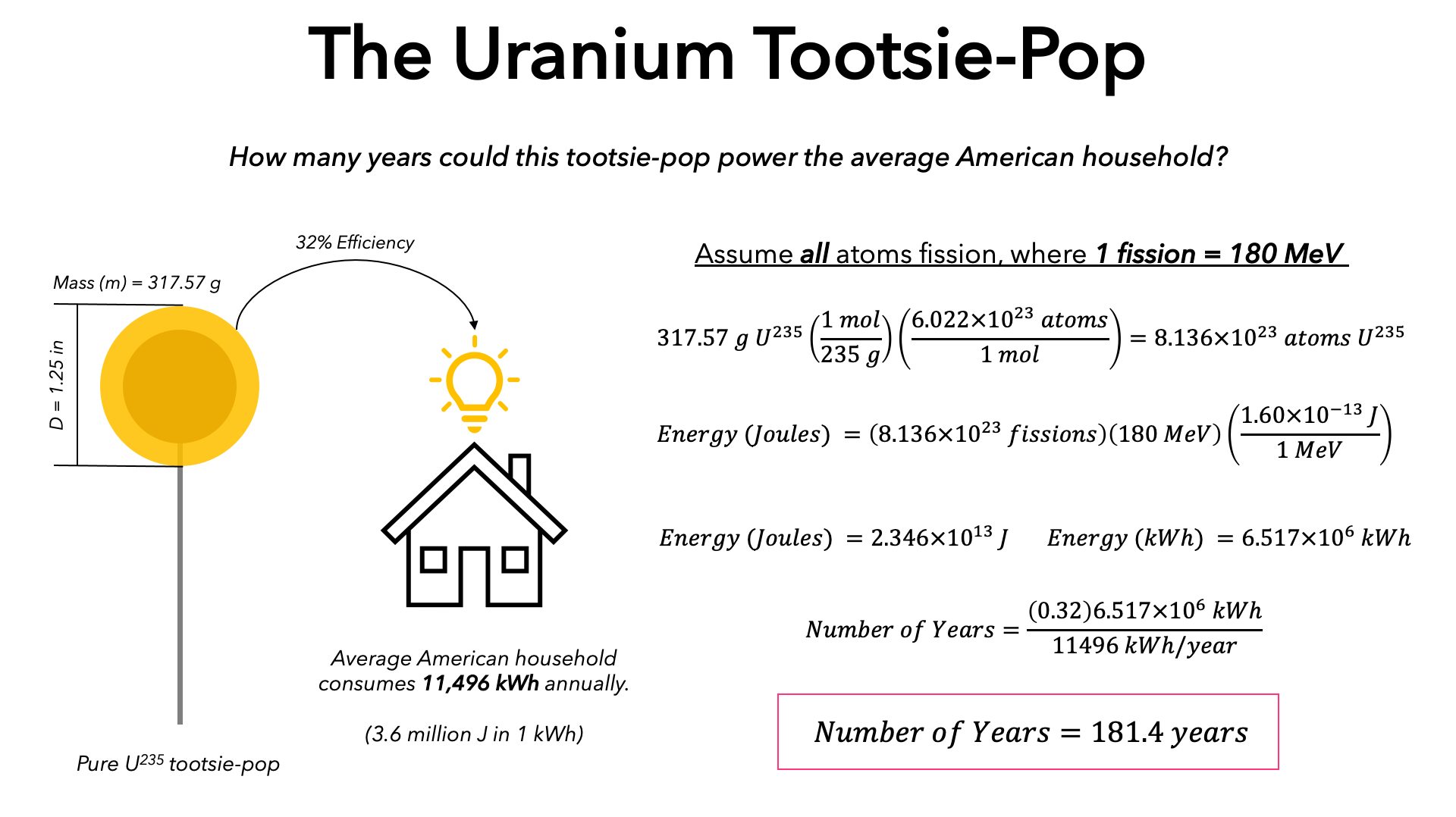
Visualization of energy released from fission

The Tootsie-Pop problem, adapted from Nuclear Operations and Safety, taught by Dr. Thomas Congedo at the University of Pittsburgh

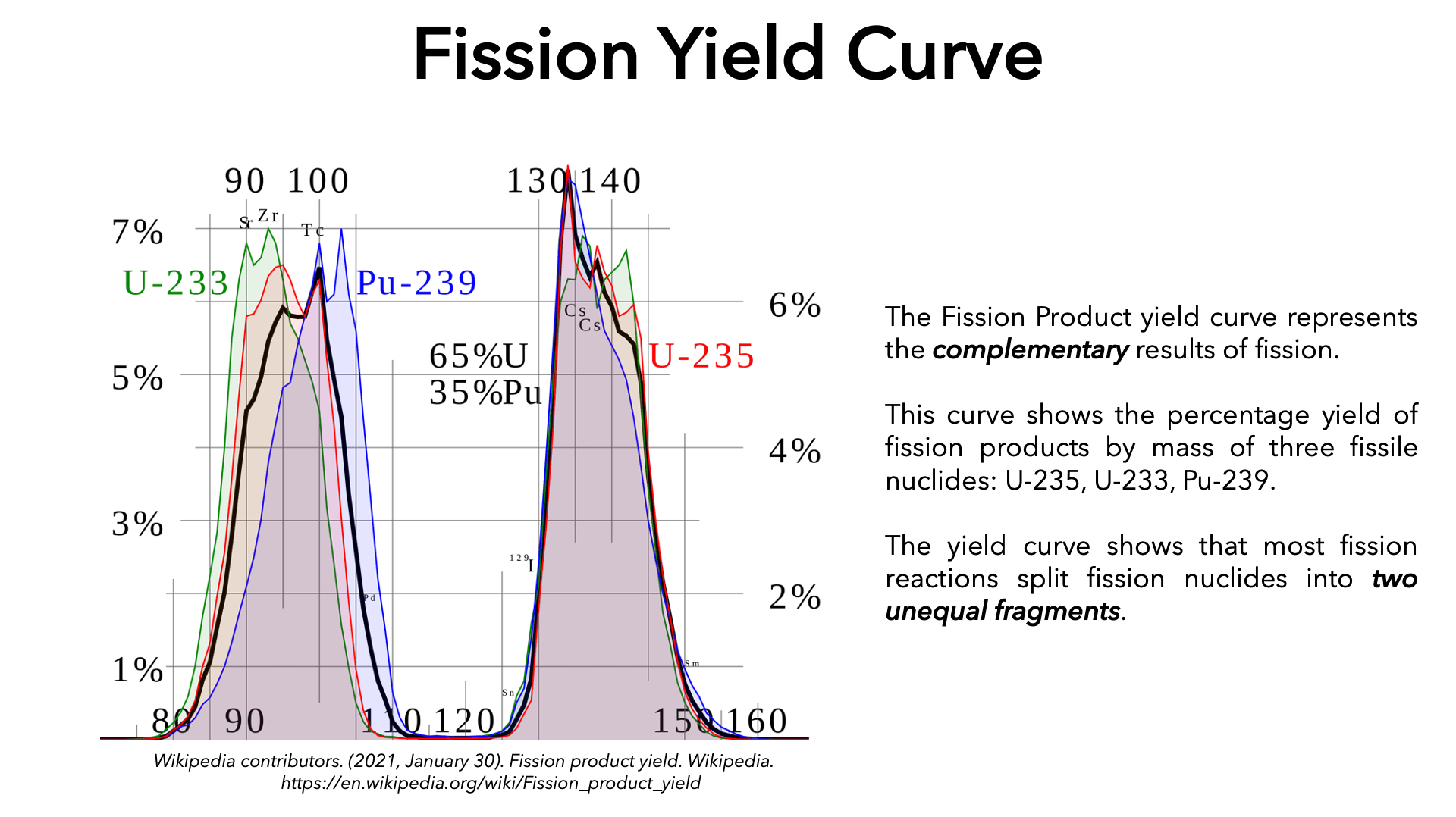
Fission products are the highly radioactive fragments that separate from a fissioned nuclide. Depending on the fissioning nuclide, the composition of these fission products vary. There is no guarantee what will result, so long as the sum of their masses and the neutrons released from fission add up to the mass of the original nuclide. A considerable portion of spent nuclear fuel is fission products.

Due to their radioactivity, they can experience several radioactive decays. These decay chains can last anywhere from minutes, to years.

In the nuclear industry, it is essential to keep these materials away from workers and the public at large.
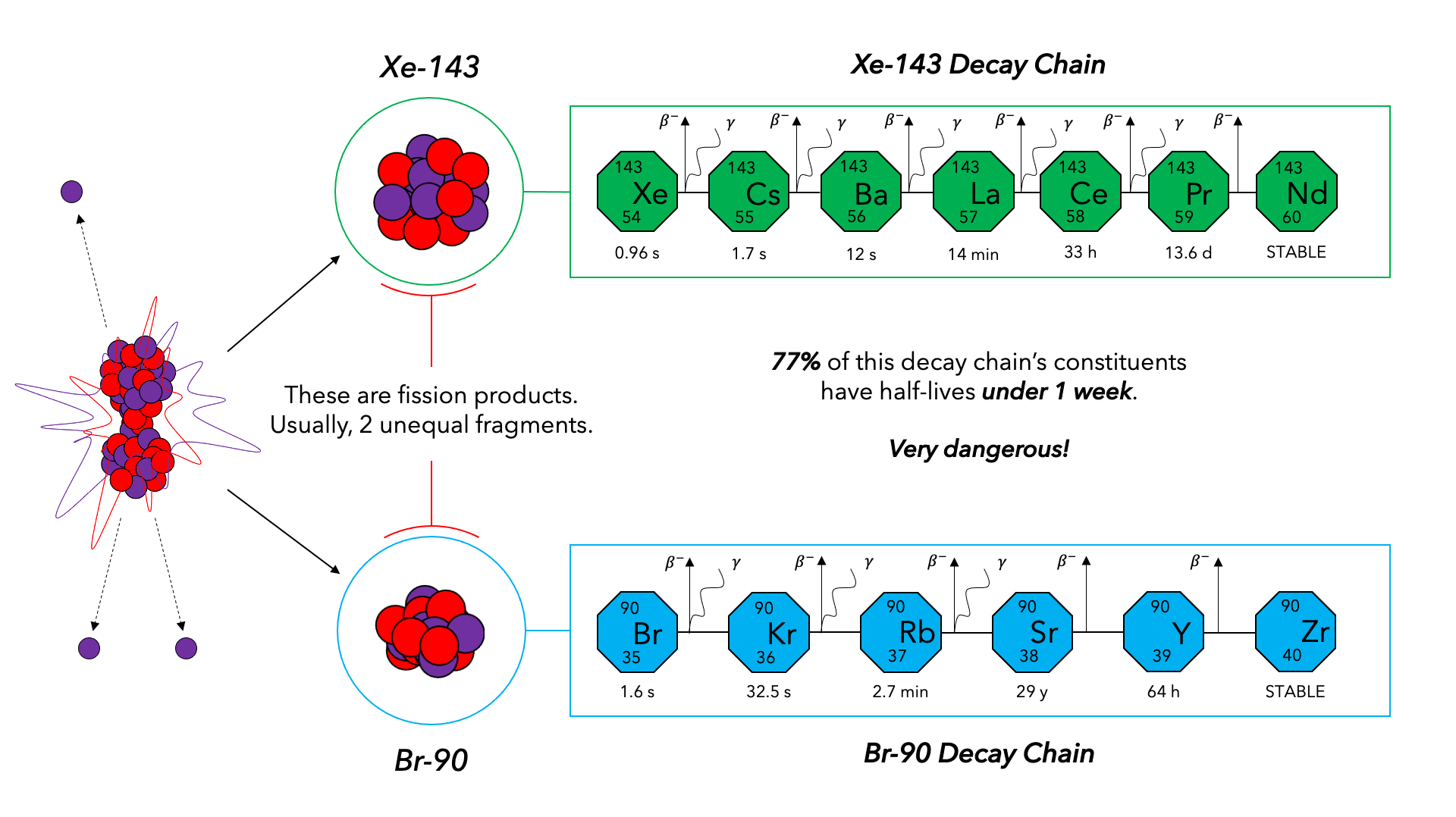
xe-143 and br-90 decay chain to stable nuclides
the fission product yield curve
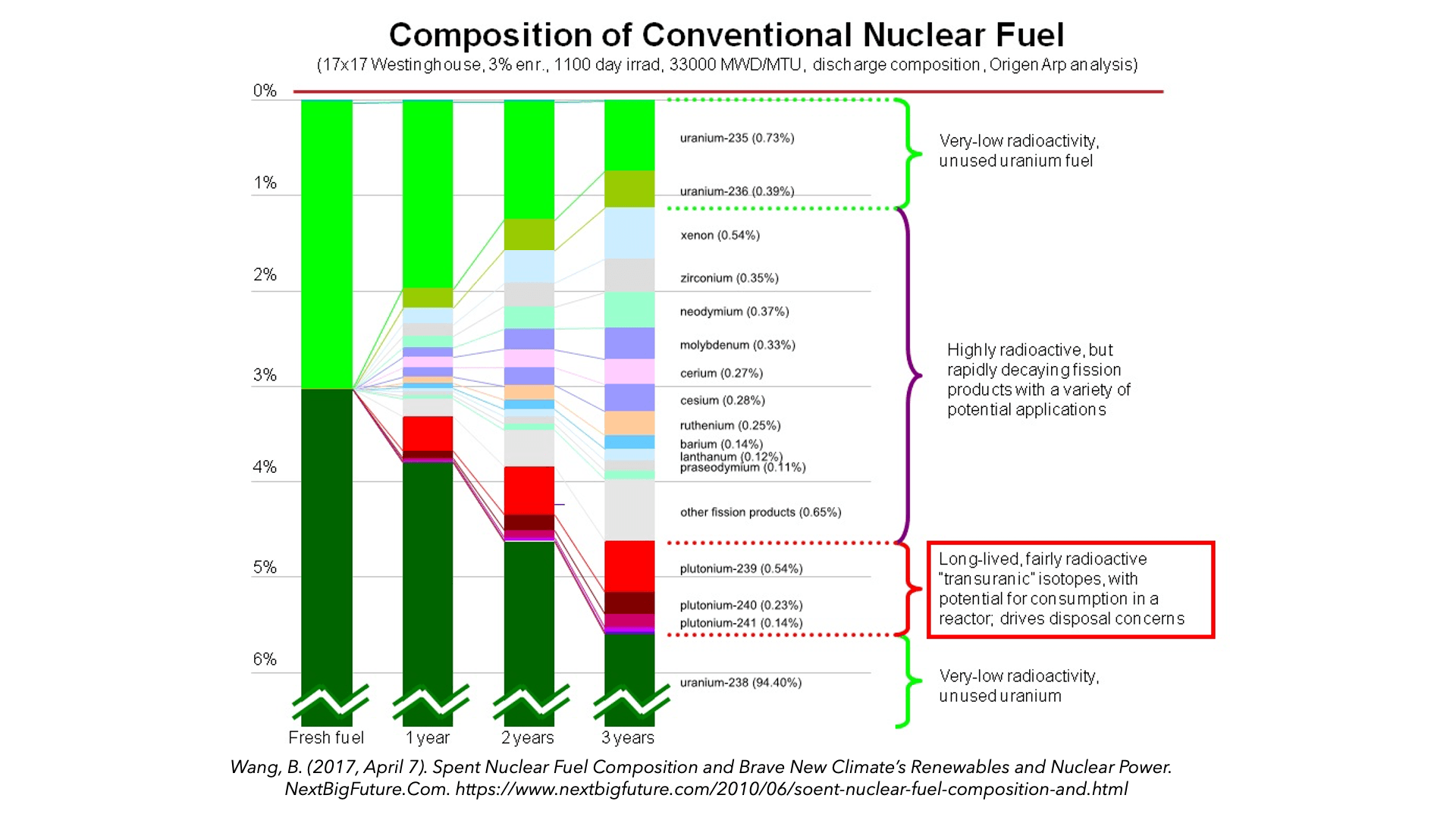
the composition of nuclear fuel

Composition of a Westinghouse 17x17 fuel rod assembly. Chart shows the buildup of fission products and consumption of uranium over time

Explanation by T. Gibbons (Neutron emission in progress)

Read · 4 min

We've been exploring radioactivity. We started by studying nuclear stability. Inside the nucleus, there is a raging competition! Electrostatic repulsion between the protons wants to rip the nucleus apart. But, the strong nuclear force is holding everything together. Let's consider the periodic table. As we increase the atomic number, the binding energy also elevates. It becomes harder to separate the nucleus. But there's an inflection point. Beyond the metal lead, the binding energy decrease. It becomes easier to divide the nucleon. Everything is less stable.

Nuclei want to become more stable. So, they undergo radioactive decay. We've studied various types of radioactivity. Alpha decay ejects a helium nucleus. The atom quickly sheds its mass. Beta decay and electron capture convert protons to neutrons and vice versa. Gamma decay emits a photon to relax the nucleus. Sometimes, subsequent atoms are also unstable. So they undergo a decay series. But, the goal is always more stability.

We can take advantage of nuclear decay. We use it in radioactive dating based on the half-lives of different isotopes. We employ it in medicine via radioactive tracers. But, what if we could take advantage of the instability for chemical reactions? We can manipulate radioactive elements for nuclear reactions. Before we examined fusion reactions. Now, let's look at nuclear fission.

What is Nuclear Fission?

Let's revisit nuclear fission. The word fission means to break or split. So, nuclear fission is the breaking or splitting of atomic nuclei. So, we're taking large atoms and fragmenting them into smaller ones. How? Mechanically, we bombard the nucleus with neutrons. Sometimes, it absorbs the neutron. But, that can disrupt nuclear stability. In response, the atom can split into two or more pieces. In addition, the reaction releases more free neutrons.

Spontaneous Fission

Sometimes, fission is a type of radioactive decay. We call it spontaneous fission because its a spontaneous reaction. The nucleus doesn't have to be hit by a neutron. But, it only happens in atoms with atomic masses above 232 amu. So, it's rare. The naturally occurring elements that undergo spontaneous fission are the heavy actinides. They include Th-232, U-235, U-238, P-239, and P-240. You'll notice these are the elements that undergo decay series. A decay series is the favored path. The other elements that experience spontaneous fission are all artificial. Unlike our regular decay methods, the products are unpredictable. We know various products created from the same isotope.

Let's look at Californium-254 as an example. One possible result is the formation of Palladium-118 and Tellurium-132. How would we write the nuclear equation?

We start by writing the isotope notation of the reactants and products.

98254Cf{^{254}_{98}Cf}

46118Pd{^{118}_{46}Pd}

52132Te{^{132}_{52}Te}

Let's write our nuclear equation. Californium is the only reactant.

98254Cf→46118Pd+52132Te{^{254}_{98}Cf} \rightarrow {^{118}_{46}Pd} + {^{132}_{52}Te}

Now, we need to balance the atomic mass and atomic numbers.

254−118−132=4254-118-132= 4

98−46−52=098-46-52=0

We see that the atomic number is balanced. But, the atomic mass is not. So, we need to add something to the equation. How can we add to the atomic mass without increasing the atomic number? We add neutrons! So, let's write our balanced equation.

98254Cf→46118Pd+52132Te+4o1n{^{254}_{98}Cf} \rightarrow {^{118}_{46}Pd} + {^{132}_{52}Te}+4{^{1}_{o}n}

Initiated Fission

When we talk about nuclear fission, we're almost always talking about initiated fission. In initiated fission, we slam a neutron into the nucleus. The result is that it becomes unstable and breaks.

Let's study the initiated fission of U-235. We start by hitting U-235 with a neutron.

92235U+01n→92236U{^{235}_{92}U} + {^{1}_{0}n} \rightarrow {^{236}_{92}U}

U-236 is unstable and undergoes fission to produce krypton-92 and barium-141.

92236U→3692Kr+56141Ba{^{236}_{92}U} \rightarrow {^{92}_{36}Kr} + {^{141}_{56}Ba}

Now, let's balance it.

236−92−141=3236-92-141=3

92−36−56=092-36-56=0

So, the reaction produces three neutrons. Let's write the complete balanced equation.

92235U+01n→92236U→3692Kr+56141Ba+301n{^{235}_{92}U} + {^{1}_{0}n} \rightarrow {^{236}_{92}U} \rightarrow {^{92}_{36}Kr} + {^{141}_{56}Ba} + 3{^{1}_{0}n}

These neutrons can go on to hit other atoms. What's the result? Even more induced fission.

Applications of Nuclear Fission

Historically, the most well know examples of nuclear fission are the atomic bombs. The first bomb was uranium-based. It took advantage of the U-235 reaction we described above. Naturally occurring uranium is a mixture of three isotopes: U-238, U-235, and U-234. But, U-235 is very rare. It has a natural abundance of about 0.7 percent. Moreso, U-238, and U-234 don't undergo induced fission. So, we need to enrich it. We separate the U-235 isotope to increase its concentration. At a certain point, there is enough uranium that the reaction can sustain itself. At least one of the product neutrons will start another fission. We call this a nuclear chain reaction. The second atomic bomb used plutonium instead of uranium. It used the same principle but was even more devastating. It's a sad part of history.

The other application of nuclear fission is nuclear reactors. The nuclear reaction is similar to what we've already studied. We use enriched uranium-235 as fuel. But, we use the reaction's energy to generate electricity. In a nuclear power plant, we use the energy to heat water. As the liquid water vaporizes to steam, it spins a turbine. The turbine attaches to an alternator. As the alternator rotates, it generates a current. Another application is nuclear submarine propulsion. Obviously, the reactor is much smaller than in a power plant. But, the premise is similar. The reactor again turns a turbine. But, this time, the turbine connects to the propeller. So, the submarine can move.

Video

(Video) Nuclear Fission

by Tyler DeWitt

In this video, Tyler DeWitt illustrates nuclear fission. He starts by explaining why some atoms have unstable nuclei. Next, you'll learn the fission reaction for uranium-235. Tyler will use this as a launching point for explaining chain reactions. This video is a great introduction to fission reactions.

Type a concept, like “slope” or “photosynthesis”.

↑ ↓ to choose · Enter to openSearch explanations and problems