
Illustrated · 3 min
Nuclear Fission
Nuclear Fission is a highly probabilistic phenomenon, where a fissionable nuclide breaks apart, releasing a tremendous amount of energy. U-235 is not the only nuclide capable of fissioning, but it is the most common fissionable material in commercial nuclear reactors. For the sake of simplicity, U-235 will be the subject of this model.
Fission can be broken down into 4 major steps:
1.) A neutron is emitted from a fission somewhere else in space. It is initially at an extremely high energy and must bounce around in some medium to reach a lower energy level before it can cause U-235 to fission.
2.) The low-energy neutron’s path intersects with an atom of U-235 and is absorbed into the nucleus. This extremely unstable atom of U-236 will oscillate until the strong nuclear force can no longer sustain the atom and breaks into several smaller nuclei. This is fission.
3.) The smaller nuclei are newly formed atoms, called fission products. Fission products are highly radioactive components of a Uranium atom. Their proton numbers should add to 92, which is the proton number of Uranium.
4.) In addition to fission products, fission will almost always emit neutrons – approximately 2.5 neutrons per fission. This is the key to sustaining a chain reaction, where neutrons cause fissions, which emit more neutrons, each of which is probable to cause a fission somewhere else, repeating these events over and over again.
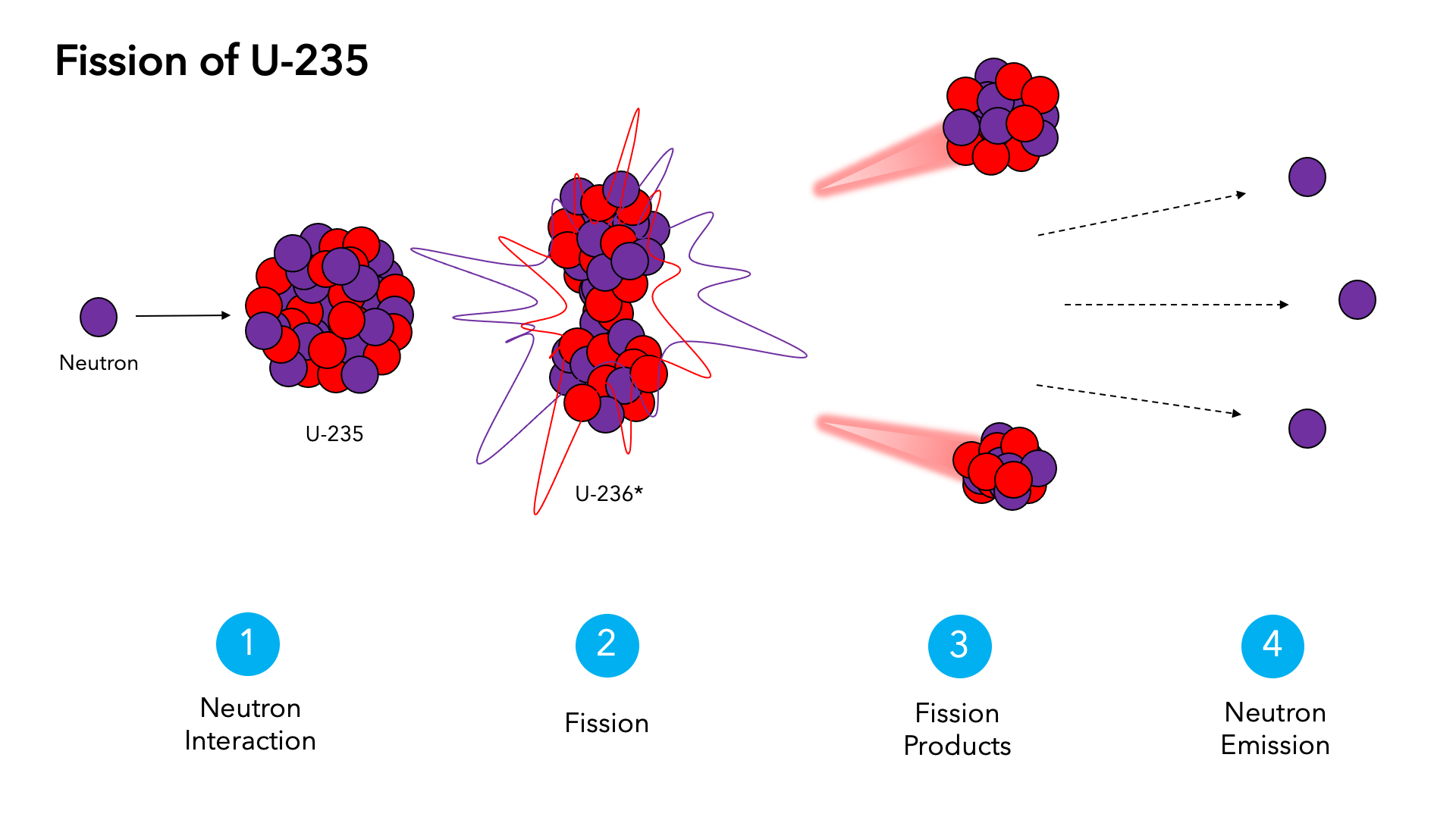
Steps of Nuclear Fission
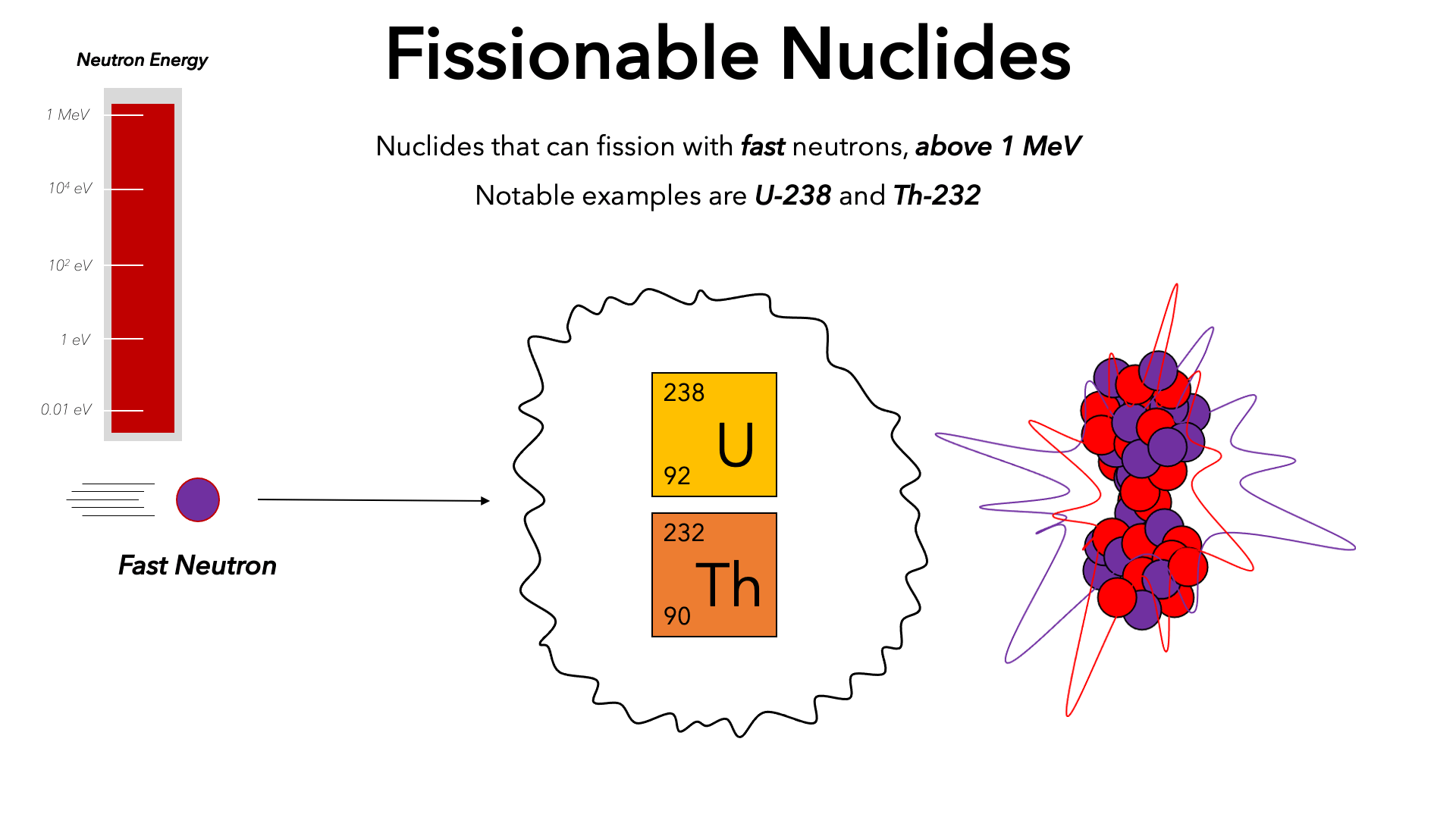
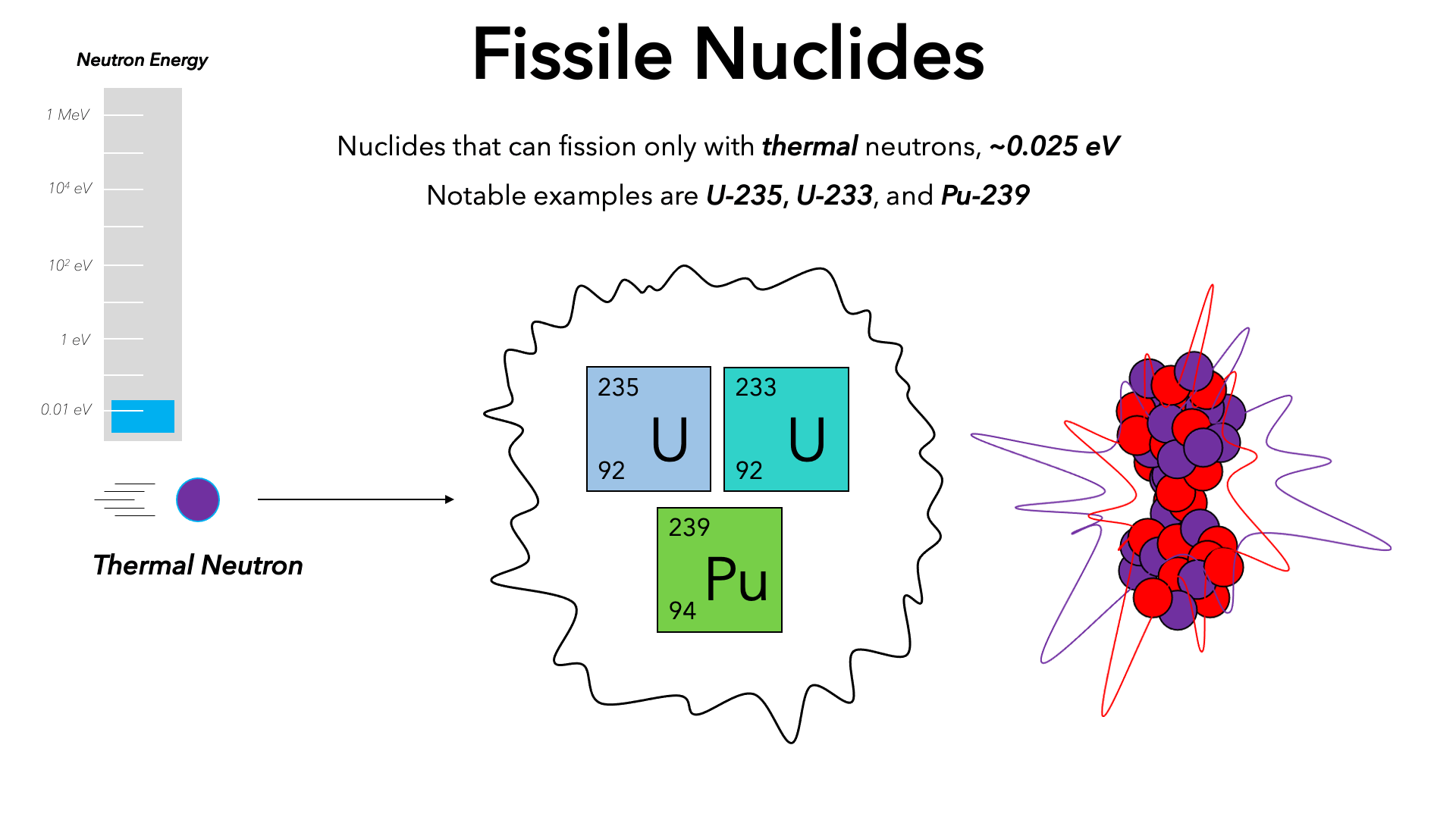
Whether a neutron interaction will occur depends on a neutron’s incident energy. High energy neutrons are called fast neutrons and have energies above 1 MeV. Low-energy neutrons are called thermal neutrons and have energies of approximately 0.025 eV.
In other words, fast neutrons are 100 million times more energetic than thermal neutrons. These energies define whether an interaction is probable to occur; this probability is called a cross-section (link here).
There are several types of neutron interaction, but 3 are most relevant to nuclear fission. These interactions are defined by what the target nuclide is:
Fissionable Nuclide: a nuclide that can fission from either high or low-energy incident neutrons.
Fissile Nuclide: a subset of fissionable nuclide that can only fission with low-energy incident neutrons. All fissile nuclides are fissionable, but not all fissionable nuclides are fissile. This is a subtle, but important difference.
In most commercial reactors, Uranium-235 must be enriched from its natural mined content (0.73%) to between 3% and 5%. This enrichment is enough to sustain a chain reaction.
Fertile Nuclide: a nuclide that can readily absorb incident neutrons, and through radioactive decay can become a fissile nuclide
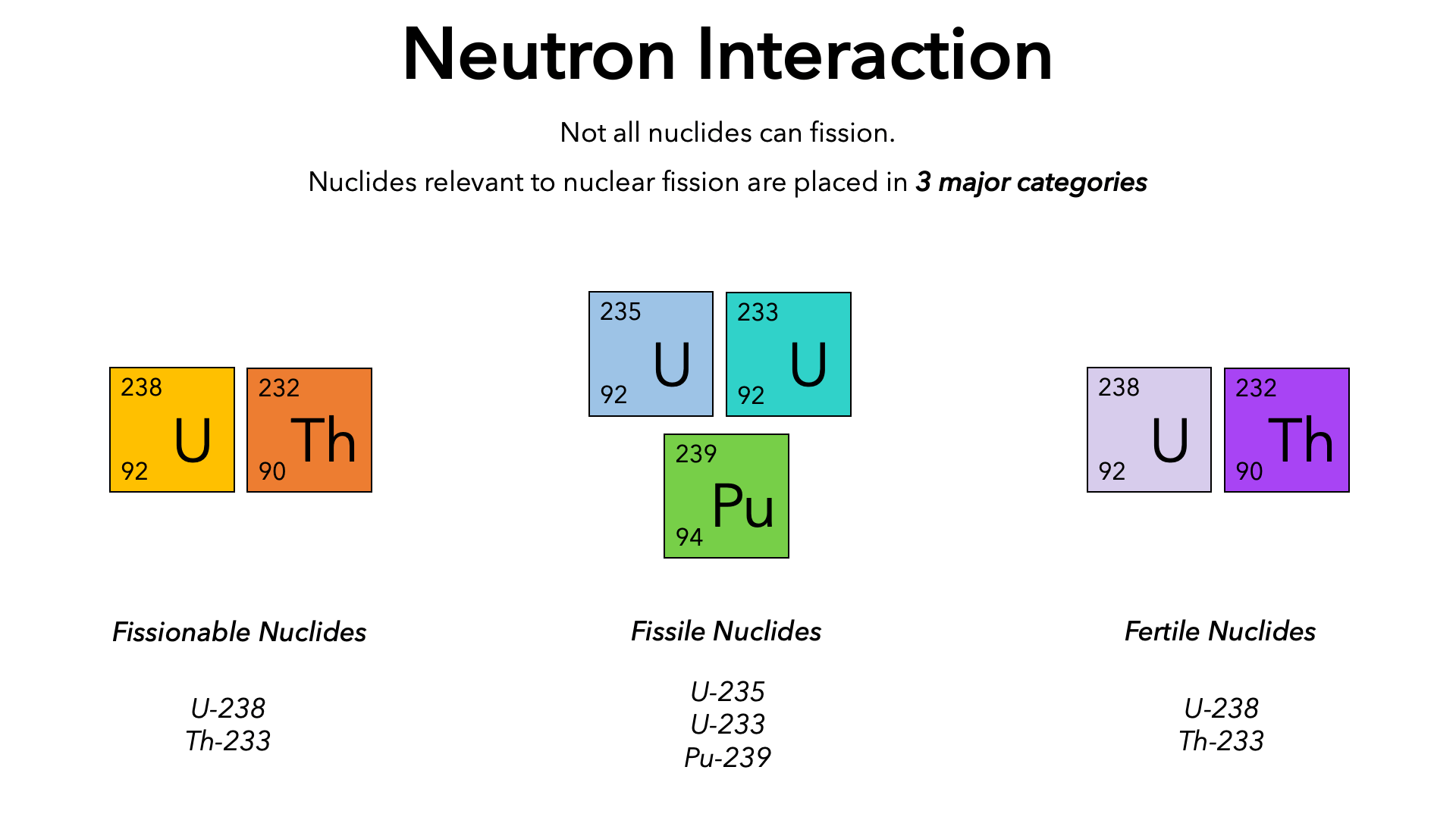
Types of nuclear material relevant to neutron interactions.
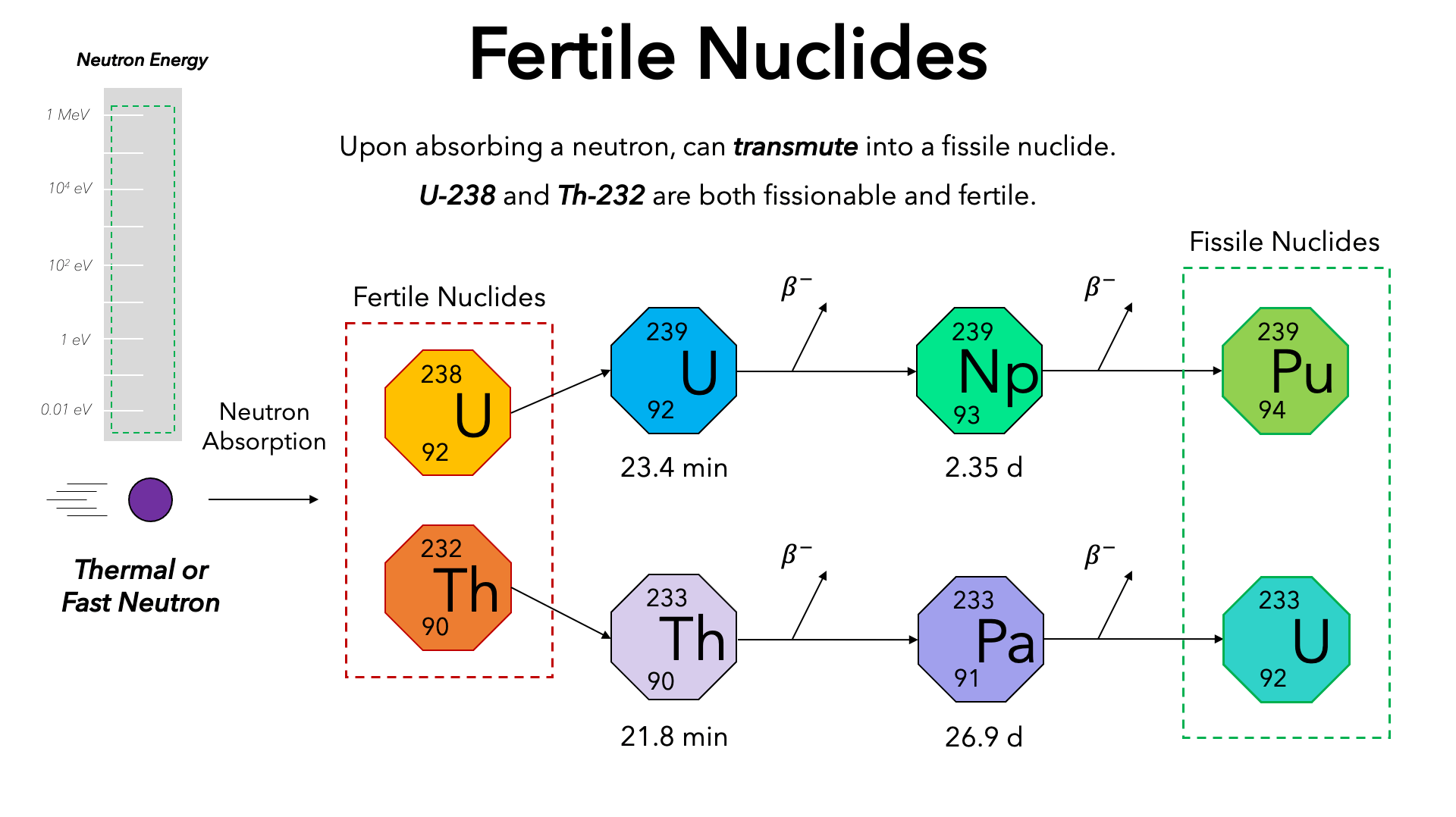
Decay chains of U-238 and Th-232 upon absorbing a neutron
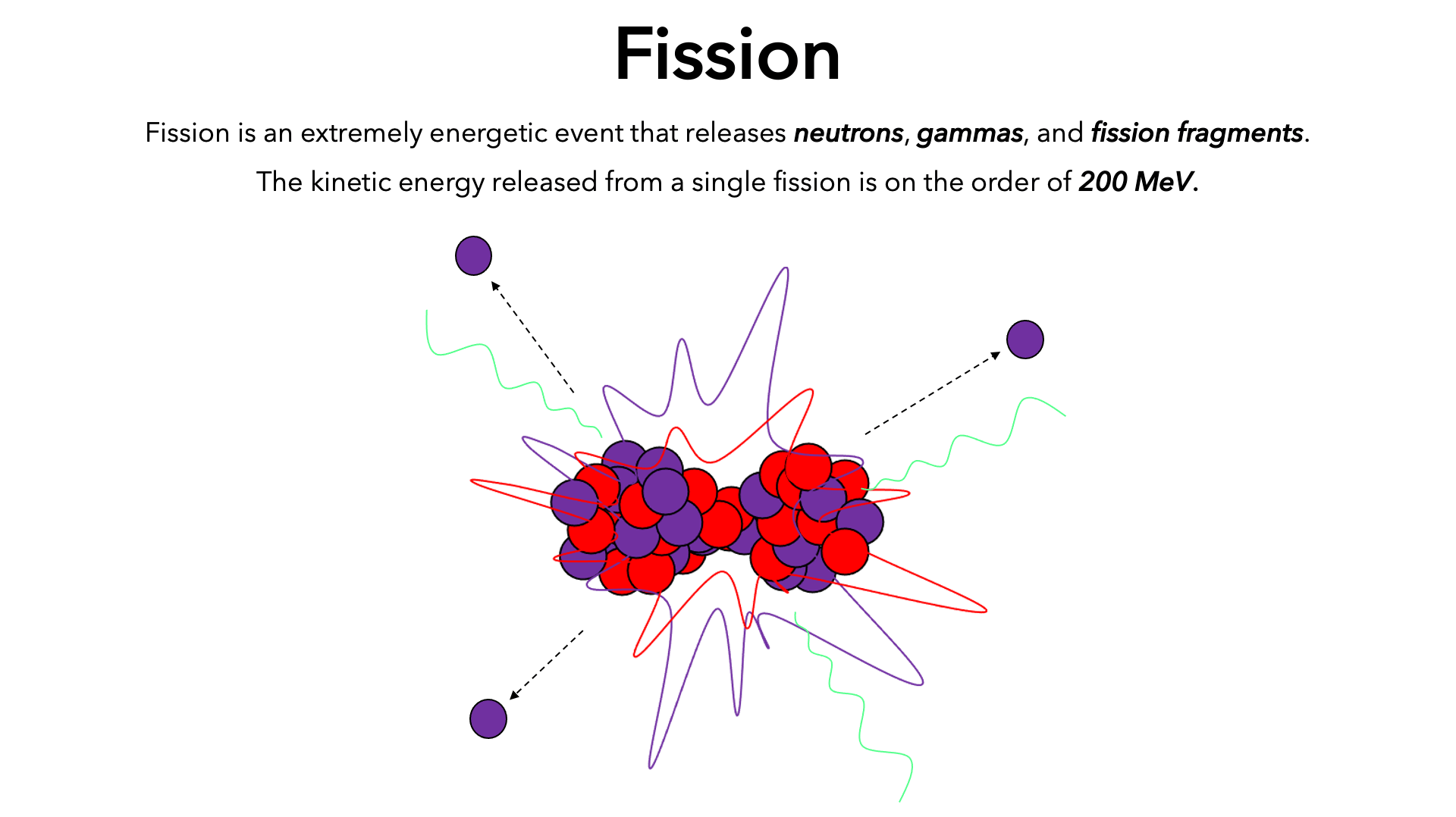
It is hard to comprehend the amount of energy fission releases. In short, there is no event, other than fusion, that can create such an immense amount of energy at the atomic scale. Multiply this by how many fissile atoms exist in a fuel material, and the picture becomes clearer...
Consider a tootsie pop, a small piece of candy that is usually a nice treat. In this case, it would not be so nice since we are assuming it is made entirely out of U-235.
To visualize fission’s energy density, how much power could a tootsie-pop sized fuel element release, and would it be useful to humans at a large scale? The answer may surprise you.
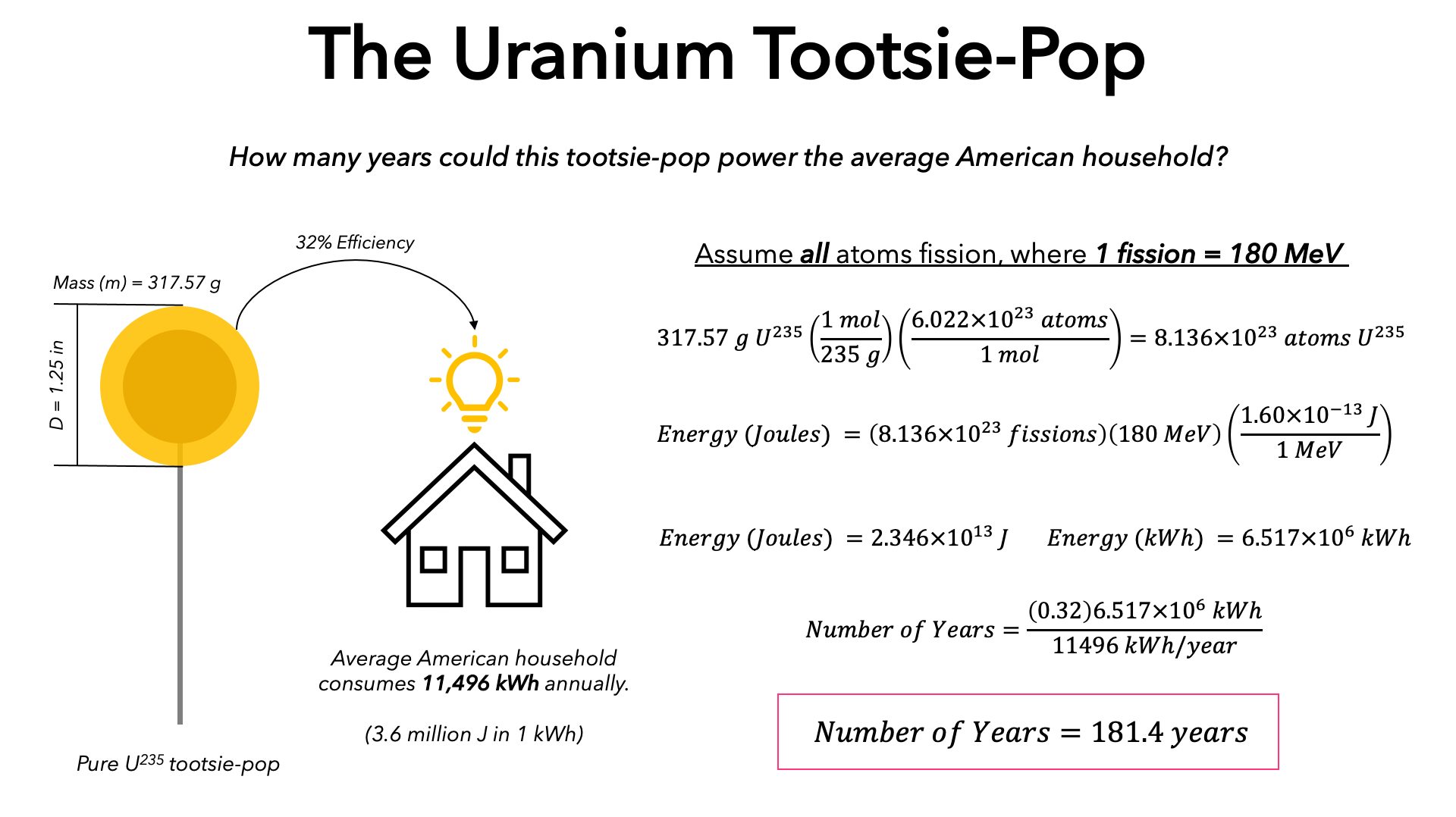
The Tootsie-Pop problem, adapted from Nuclear Operations and Safety, taught by Dr. Thomas Congedo at the University of Pittsburgh
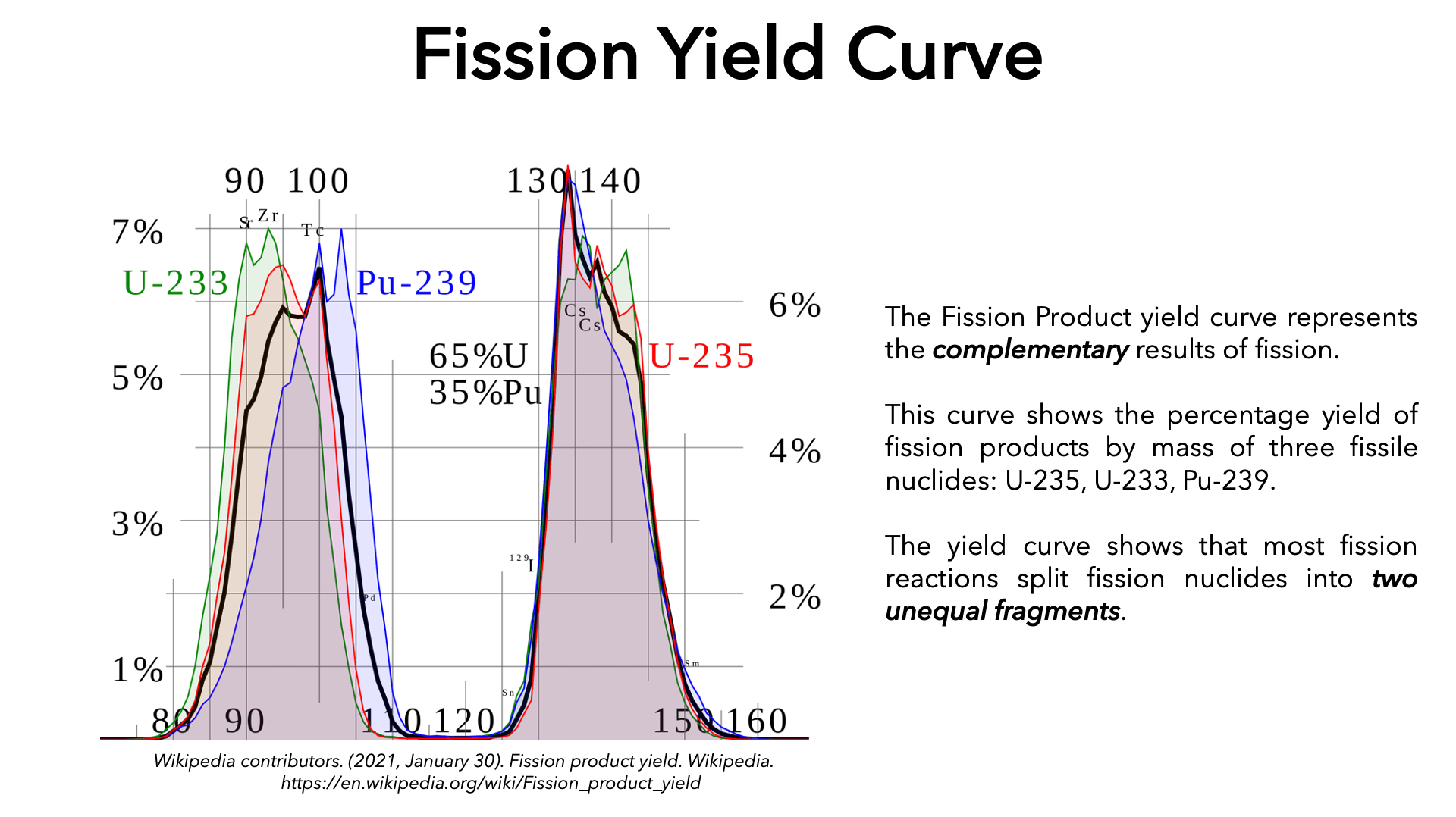
Fission products are the highly radioactive fragments that separate from a fissioned nuclide. Depending on the fissioning nuclide, the composition of these fission products vary. There is no guarantee what will result, so long as the sum of their masses and the neutrons released from fission add up to the mass of the original nuclide. A considerable portion of spent nuclear fuel is fission products.
Due to their radioactivity, they can experience several radioactive decays. These decay chains can last anywhere from minutes, to years.
In the nuclear industry, it is essential to keep these materials away from workers and the public at large.
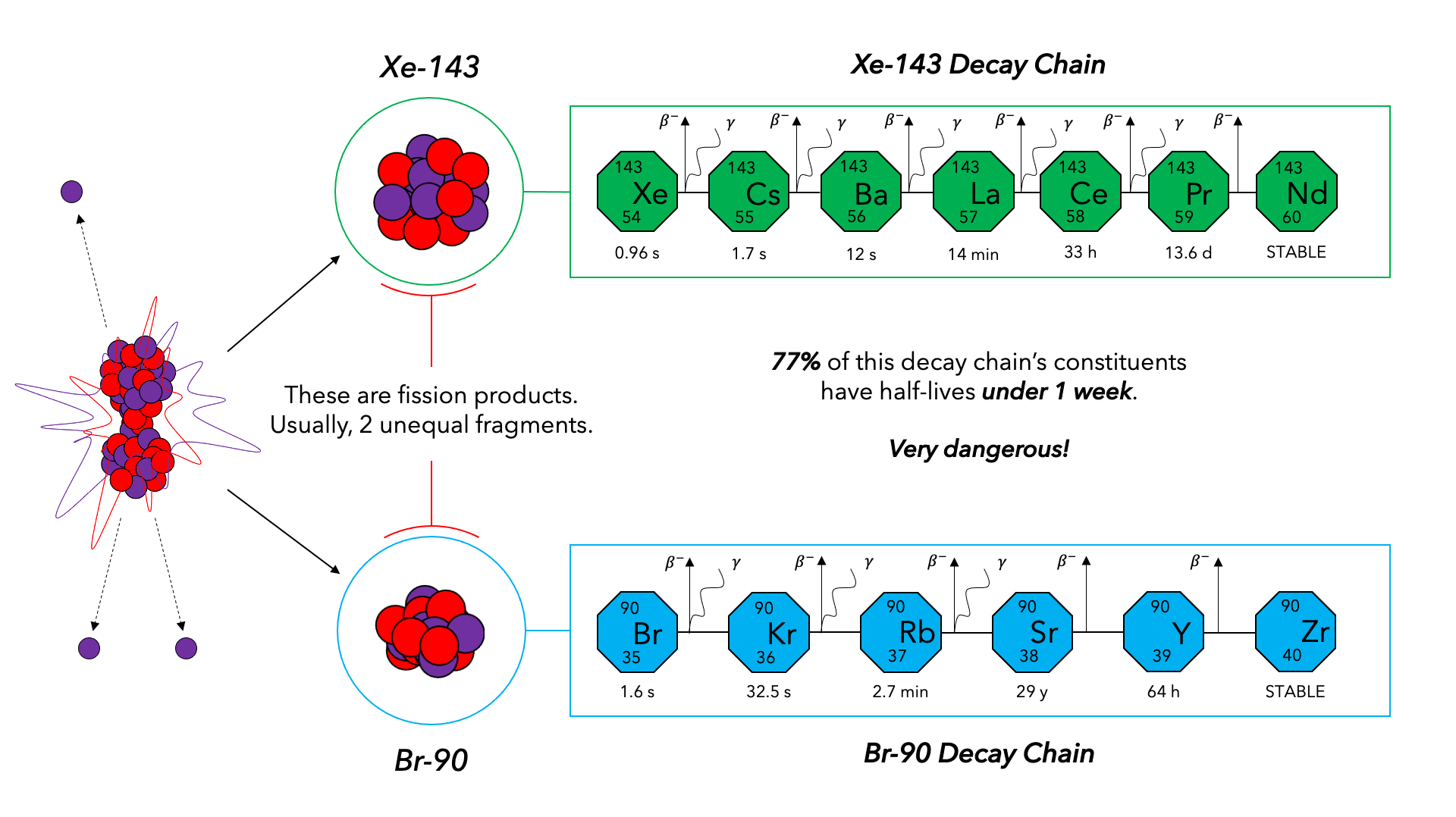
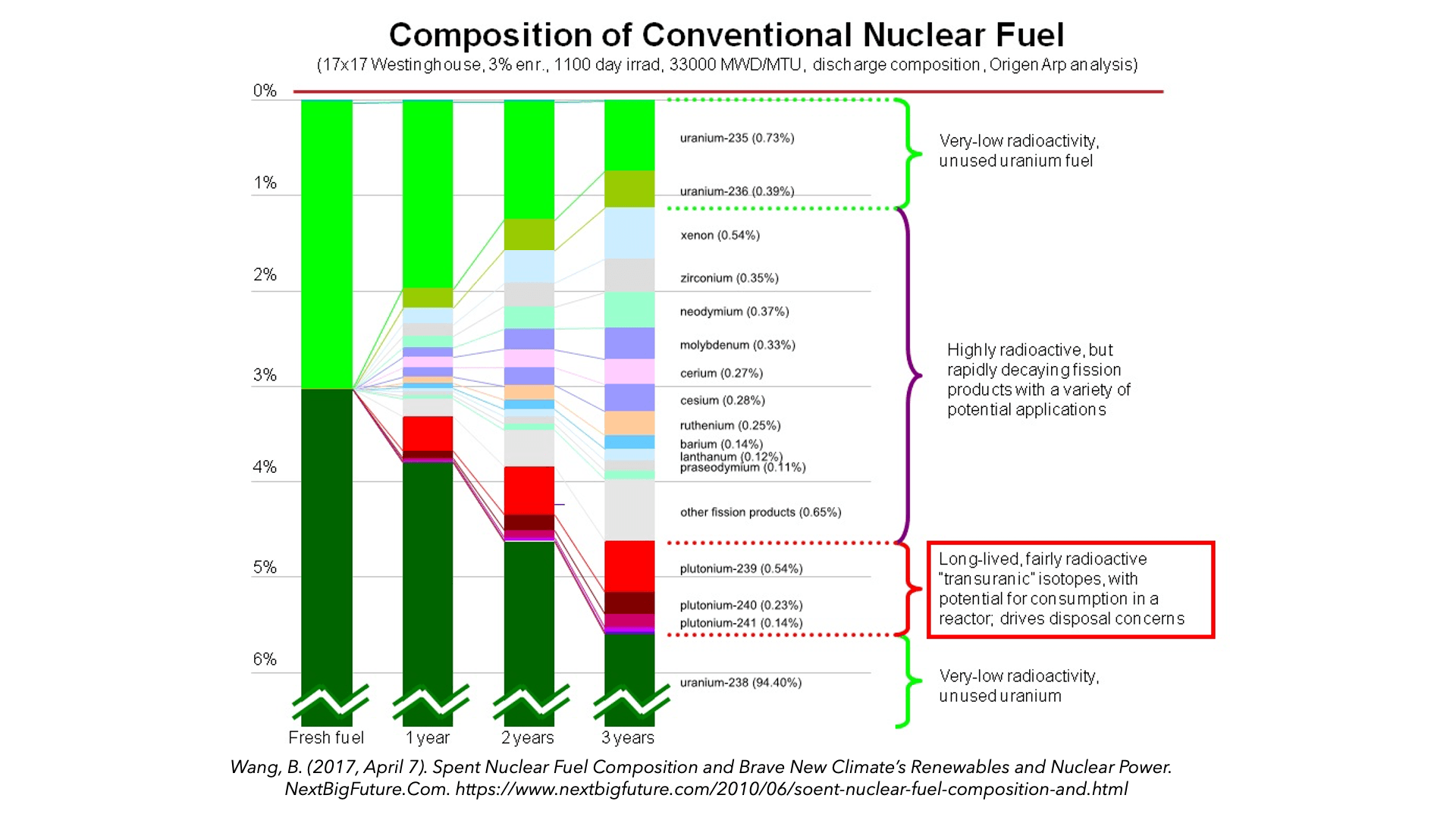
Composition of a Westinghouse 17x17 fuel rod assembly. Chart shows the buildup of fission products and consumption of uranium over time
Explanation by T. Gibbons (Neutron emission in progress)
