In the early 1800s, John Dalton proposed his atomic theory of matter. Dalton's theory assumed that the atom was the smallest unit of matter and was indivisible. However, the discovery of cathode rays and radioactivity revealed subatomic particles. The discovery of subatomic particles began the search for the atom's structure. It wasn't until the early 1900s that we discovered a more modern view of the atom.
The Gold Foil Experiment
In 1910, Ernest Rutherford performed his famous Gold Foil Experiment. At the time, the atom's main theory was the plum pudding model. The plum pudding model stated that an atom was a sphere of positive charge. The positively charged sphere had electrons embedded in it. The plum pudding model explained the atom's neutral charge. However, Rutherford's experiment would disprove the plum pudding model.
Rutherford launched alpha particles (Helium nuclei) at a sheet of very thin gold foil. He then recorded the alpha particles' deflection angles. In the plum pudding model, the atom has a neutral charge. Based on the plum pudding model, Rutherford predicted there would be no repulsive forces. His hypothesis was that he would detect very small deflection angles. Many of the alpha particles did have minimal deflection angles. However, he discovered that some of the alpha particles had very large deflection angles. His discovery led him to postulate the nuclear model of the atom.
The Nuclear Model
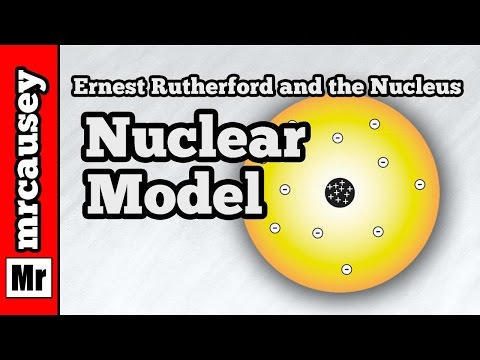
Rutherford concluded that an atom's nucleus must be positively charged. A positively charged nucleus explained the large deflection angles. When the alpha particles hit the nucleus, they experienced a repulsive force.
He also realized that an atom must have a lot of empty space. Empty space explained why many of the alpha particles had small deflection angles. The alpha particles that did not hit the nucleus passed through the foil unhindered.
His experiment did not provide any answers about the behavior of electrons. Hantaro Nagaoka had proposed that electrons are rings that orbit around the nucleus. He was inspired by the rings of Saturn. At the time, Rutherford believed that his experiments helped confirm Nagaoka's proposal. Later, Rutherford and Neils Bohr would introduce the Bohr model of the atom. The Bohr model has the electrons orbit around the nucleus like a solar system.
Rutherford also didn't know about neutrons. So, he was only able to make broad generalizations about trends. Rutherford's experiments allowed him to calculate the nuclear charge. He quickly recognized that the nuclear charge was about half the atomic mass. But, at the time, the atomic weights were approximate. He never connected the charge to the atomic number. Thankfully, other scientists quickly connected the two ideas. So, we soon realized that charge related to an element's position on the periodic table.
Today we call Rutherford's model the nuclear model of the atom. The nuclear model was the first step toward our modern understanding of the atom. In the 1930s, the discovery of the neutron completed our picture of the nucleus. Later, quantum mechanics would help us explain electron orbitals. Rutherford's work laid the foundation.