Illustrated · 1 min
+5 contributors





Nucleotide Structure
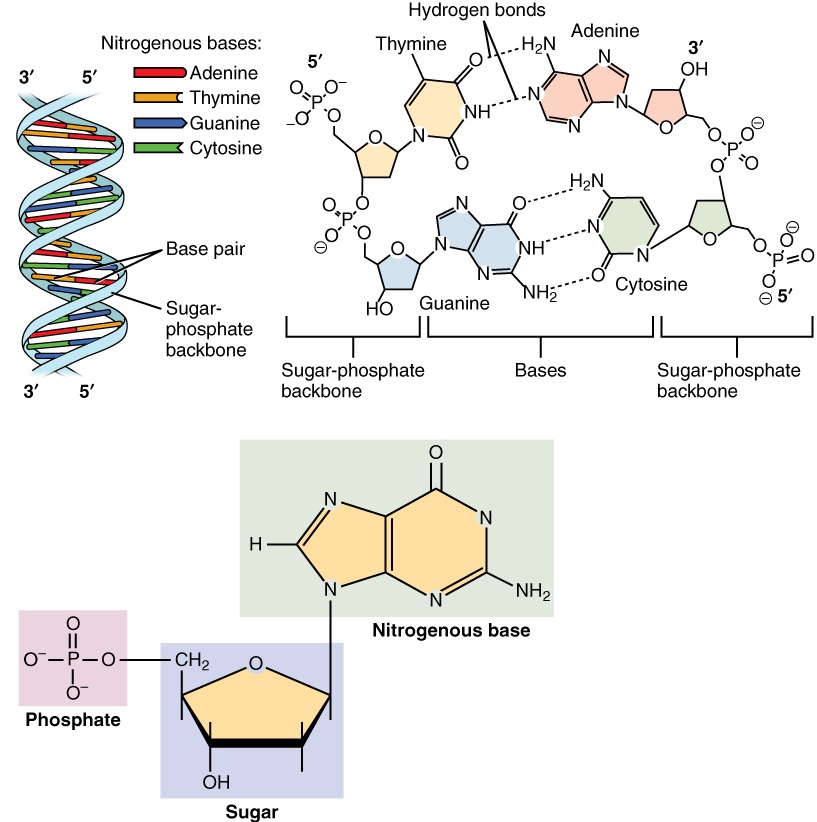
Nucleic acids are made up of basic building blocks called nucleotides. Each one has three parts.
1: A 5-carbon sugar molecule (the big pentagon)
2: A phosphate group (the part with a phosphorous atom)
- RNA and DNA: the phosphate group binds to another nucleotide's carbon ring, forming the backbone of the molecule
- ATP: there are three phosphates in the phosphate group that store energy
3: A nitrogenous base (the nitrogenous base always has a nitrogen)
- DNA: the nitrogenous bases are adenine, guanine, cytosine, and thymine
- RNA: the nitrogenous bases are adenine, guanine, cytosine, and uracil
- ATP: the nitrogenous base is always adenine

Image source: By cacycle CC BY-SA 3.0, via Wikimedia Commons
This is an ATP molecule. It is different from DNA and RNA because it has three phosphate groups instead of one. The two additional phosphate groups are what allow ATP molecules to store so much energy. The nitrogenous base is the group emerging from the carbon ring that has five nitrogen atoms attached to it. This particular nitrogenous base is adenine.