Nucleotide — Overview & Structure

Before this, knowWhat Are Nucleic Acids? — Structure & Function

Illustrated · 1 min

Nucleotide Structure

Nucleic acids are made up of basic building blocks called nucleotides. Each one has three parts.

1: A 5-carbon sugar molecule (the big pentagon)

  • DNA: deoxyribose
  • RNA: ribose
  • ATP: ribose

2: A phosphate group (the part with a phosphorous atom)

  • RNA and DNA: the phosphate group binds to another nucleotide's carbon ring, forming the backbone of the molecule
  • ATP: there are three phosphates in the phosphate group that store energy

3: A nitrogenous base (the nitrogenous base always has a nitrogen)

  • DNA: the nitrogenous bases are adenine, guanine, cytosine, and thymine
  • RNA: the nitrogenous bases are adenine, guanine, cytosine, and uracil
  • ATP: the nitrogenous base is always adenine
ATP has three phosphate groups, a sugar, and a nitrogenous base.

Image source: By cacycle CC BY-SA 3.0, via Wikimedia Commons

This is an ATP molecule. It is different from DNA and RNA because it has three phosphate groups instead of one. The two additional phosphate groups are what allow ATP molecules to store so much energy. The nitrogenous base is the group emerging from the carbon ring that has five nitrogen atoms attached to it. This particular nitrogenous base is adenine.

Illustrated · 1 min

Building Blocks of Nucleic Acids

Nucleic acids are polymers made from building blocks called nucleotides.

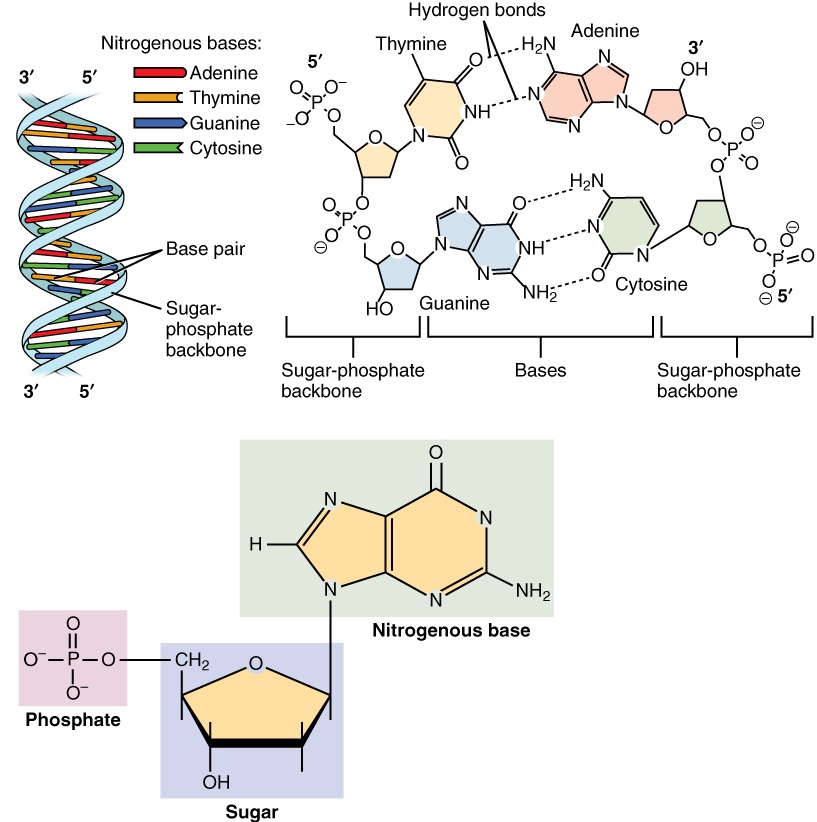
Nucleotides are made up of a nitrogen group (called a nitrogenous base), a phosphorus group, and a 5-carbon ring. These monomers join together by covalent bonds to form nucleic acids.

Chemical structure of nitrogenous bases

Structure of DNA bases

Image source: By OpenStax CC BY 4.0, via Wikimedia Commons

Nucleotide monomers and the unique nitrogenous bases create the framework for all the genetic information in a living organism. These bases form chemical bonds with their complementary base pairs in DNA (deoxyribonucleic acid) to form double-stranded molecules that are necessary for encoding an organism's genetic information.

Nucleotides are important in gathering and transferring chemical energy. An example that we'll learn more about later is adenosine triphosphate (ATP). It is often called the "molecular unit of currency".

Vocabulary Review:\color{#8925AE}{\text{Vocabulary Review:}}

Monomer\color{#8925AE}{\text{Monomer}} : Any molecule that can react with other molecules of the same or different makeup to form a chain, or polymer

Polymer\color{#8925AE}{\text{Polymer}} : A chain of monomers made of a specific type of compound

Macromolecule\color{#8925AE}{\text{Macromolecule}} : A polymer that has a large (macro) molecular mass. There are four main types in organisms: carbohydrates, proteins, lipids, and nucleic acids

Nucleotides\color{#8925AE}{\text{Nucleotides}} : The monomers of nucleic acids. Made up of a nitrogen group, a phosphorus group, and a 5-carbon ring

Nucleic Acid\color{#8925AE}{\text{Nucleic Acid}} : Complex polymer that stores information in a cell in the form of a code. DNA and RNA

Video

(Video) DNA, Nucleotides, and Dehydration Synthesis

by Johnny Clore

This video dives into what makes up a nucleotide. In other words, what makes up the monomers that make up nucleic acids. Plus, you'll learn how these monomers come together to form long chains of polymers.

Type a concept, like “slope” or “photosynthesis”.

↑ ↓ to choose · Enter to openSearch explanations and problems

