Video · + 2 min read

+4 contributors




(Video) The Number Line
by Eddie Woo

Here's an excellent video by Eddie Woo where he explains the concept of number lines, how to construct them, and how to use them. As you'll see, one of the main uses of number lines is to compare numbers. Given two numbers, which is bigger, and which is smaller? Let's find out.
How to Make a Number Line
Making a number line is very simple. First we draw a long horizontal line.

Next, we make a small dash to mark the middle.

This will be our zero mark. We can write the number above or below the line to indicate this.

Now let's add some more equally spaced ticks to the right of the . These will increase in size from to to etc. We can remember this by thinking that every time we move to the Right, we Raise the unit.

Now how far do we continue incrementing by one? How long can you go to the right before the integers stop? Well, the answer is forever! They go to infinity. So instead of making ticks forever we put an arrow at the end to indicate that it continues in that direction.

Now what about the left hand side? Well that is the negative numbers. Number that have a negative symbol in front of them, i.e. . They work the same way but instead of getting bigger, as you go to the left you get smaller. We can remember this by thinking that when we move to the Left, we Lower the unit. Let's add in ticks and mark down some.

Just like with the right hand side, the numbers can continue getting smaller forever. There's an infinite number of negative numbers. So we again denote this with an arrow.

Positive and Negative
Number lines are broken up into two parts. To the right of the zero is the positive numbers.

Similarly, to the left of the zero is the negative numbers.

Sadly, zero is all alone by itself. It is neither positive nor negative. Bummer. Still include it though!
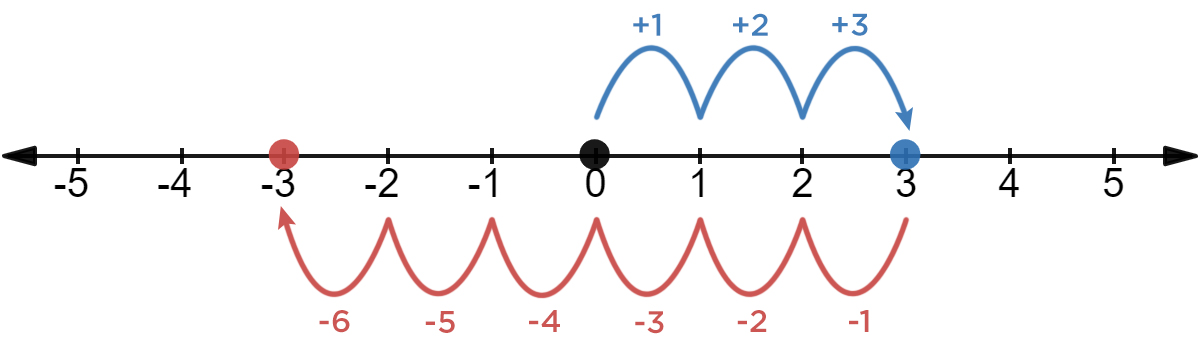
We can put points on number lines. These are filled in circles or dots ON the line to show information. If we wanted to convey the number , we just put a dot on the line at .

Images in this explanation courtesy of Alex Federspiel