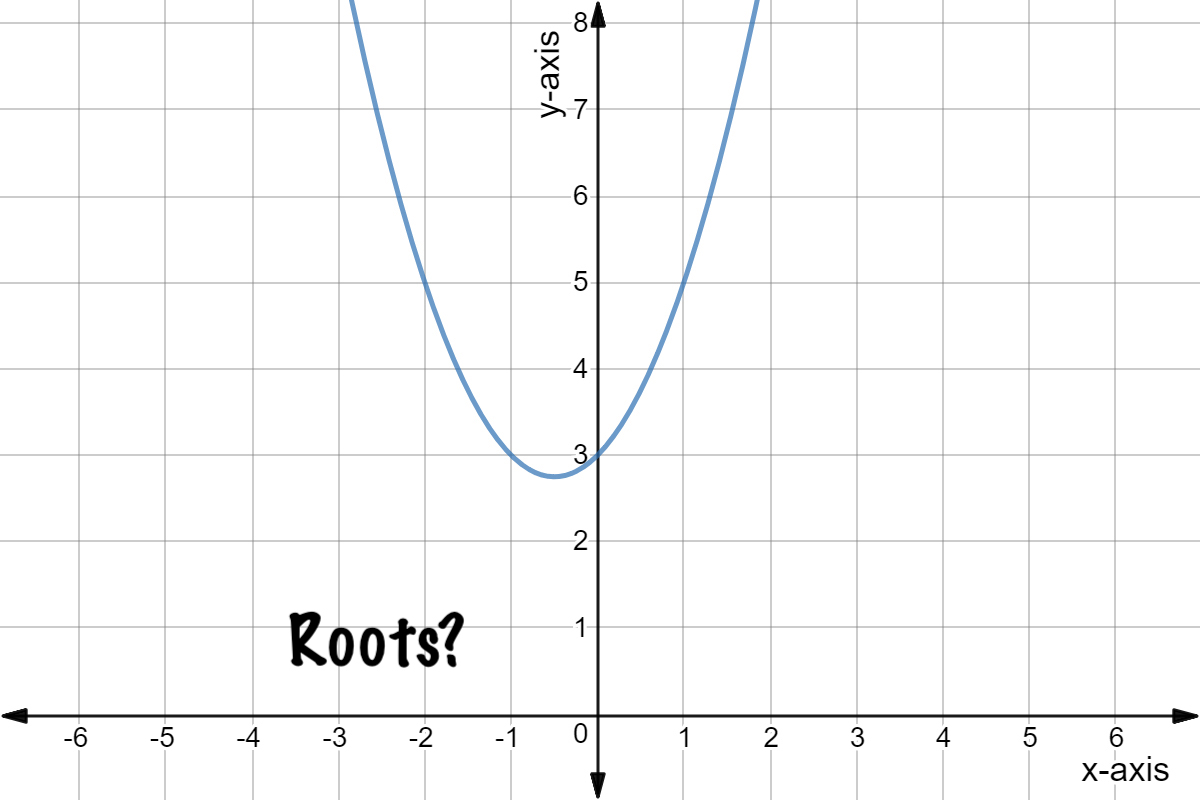
Number of Roots of a Quadratic

Interactive · 2 questions

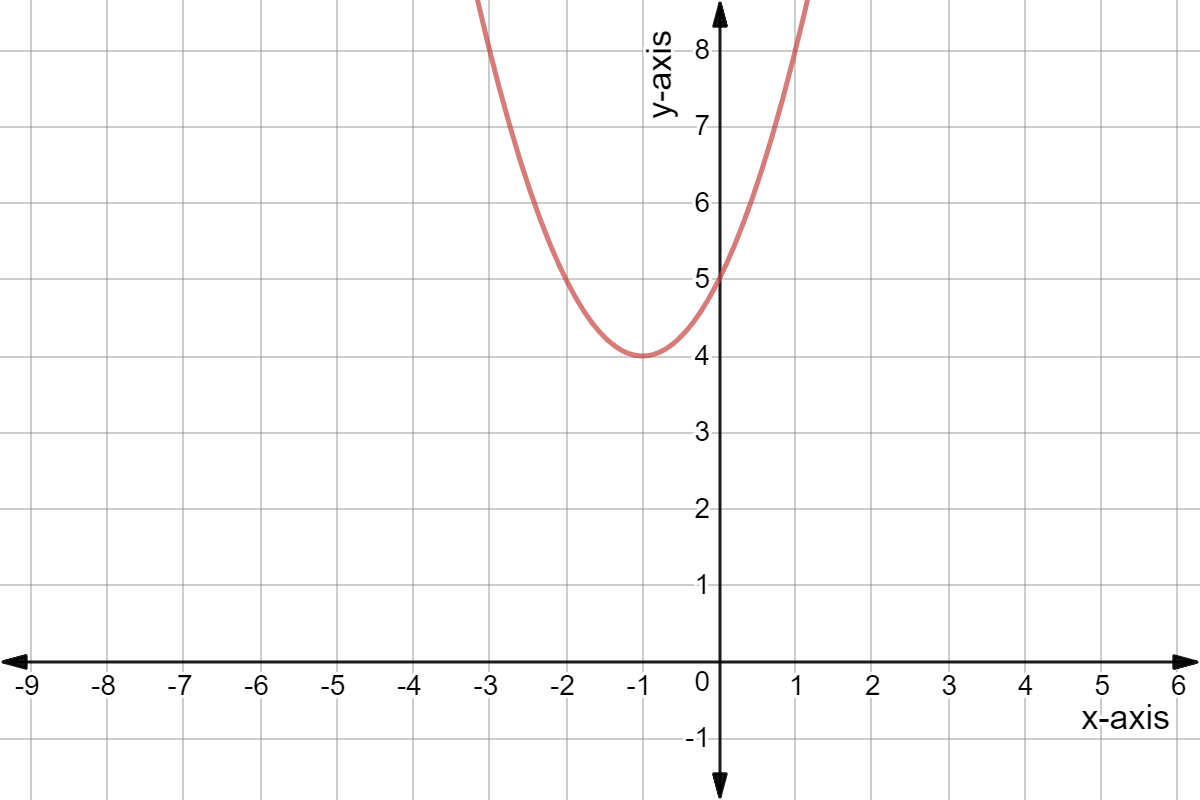
The easiest way to think about a quadratic equation with no real solutions is to first visualize the graph.

First, look at this graph:
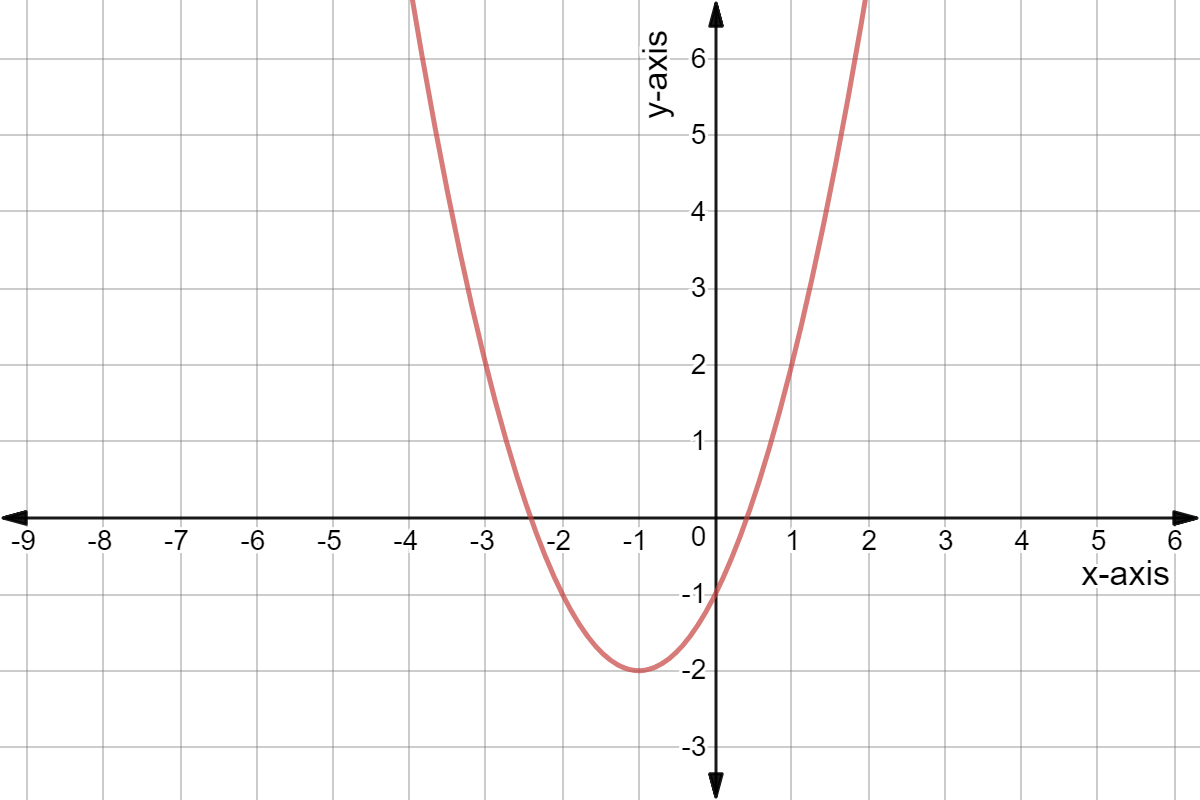
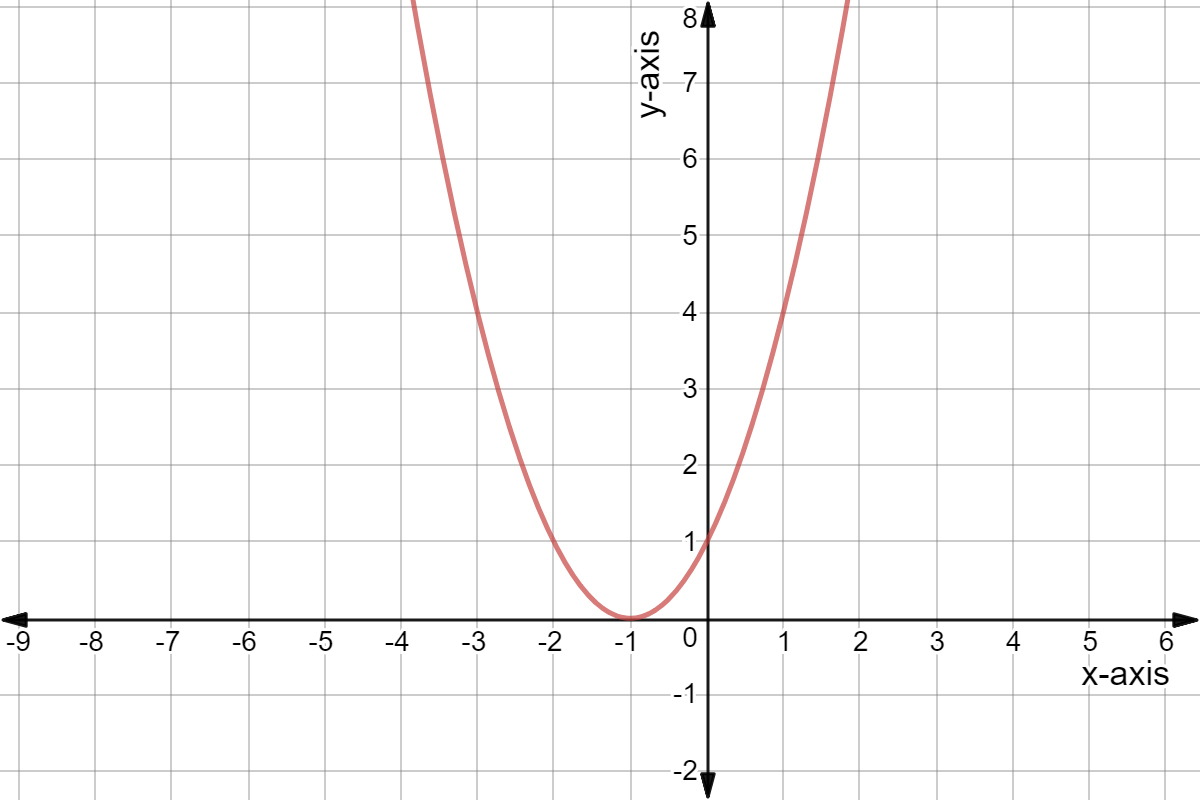
Quadratic graph of y = x^2 + 2x - 1.

Made using Desmos

What kind of roots do you think this quadratic equation has?

Choose one answer

Interactive · 1 question

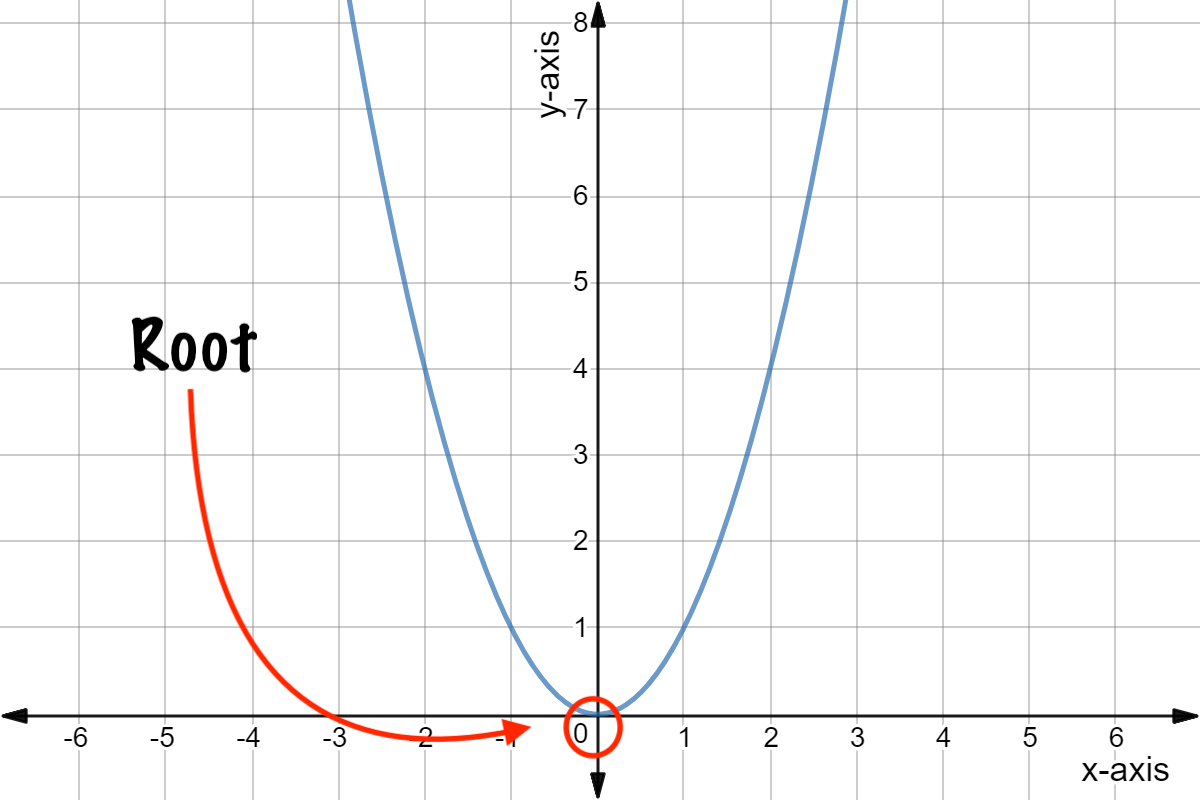
When the discriminant (b2−4ac)(b^2 - 4ac) is positive, square roots of positive numbers are always real, so the solution(s) will be real. However, there can be one solution or two solutions, depending on whether or not the discriminant is equal to 0. In the Quadratic Formula, there's a ++ or −- between the −b-b and the discriminant, so if the square root of the discriminant is 0, the ++ or −- won't do anything, and there will only be one answer. This also means that if the discriminant is equal to 0, the graph of that quadratic function's vertex is on the x - axis.

Above there are 2 quadratic equations' graphs: a green one and a blue one. Their equations are: y=x2/4y = x^2/4 and y=x2−4y = x^2 - 4. The functions' solutions are labeled SS, XX and SS.

Can you figure out which equation goes with which graph from how many solutions they have?

Choose one answer

Read · 1 min

The nature of the roots of a quadratic equation can be determined by taking the discriminant of the equation.

By nature, it is meant as whether the roots are real distinct, real equal or non-real numbers.

The discriminant of the quadratic equation ax2+bx+c=0ax^2 + bx + c = 0 is Δ=b2−4ac\Delta = b^2 - 4ac where Δ\Delta refers to the discriminant.

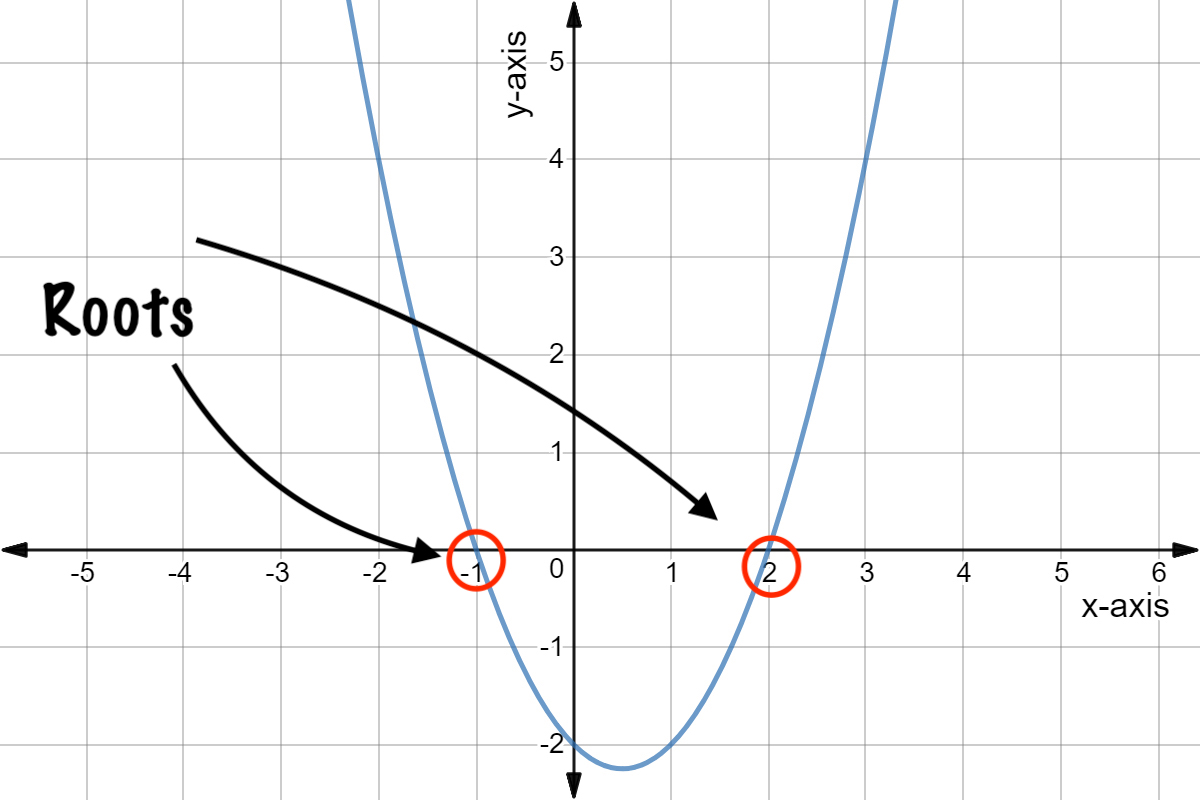
  • If Δ>0\Delta > 0, the equation has real distinct roots.
  • If Δ=0\Delta = 0, the equation has real equal roots.
  • If Δ<0\Delta < 0, the equation has non-real roots, i.e. No real roots.

Video · + 1 min read

(Video) Using the Discriminant to Predict the Types of Solutions to a Quadratic Equation

by Patrick JMT

In this video, PatrickJMT states that we will be learning how to predict the types of solutions to a quadratic equation using the discriminant.

Summary\large{\text{Summary}}

He states that the discriminant is the term under the square root of the quadratic equation, so b2−4acb^2 - 4ac

If b2−4acb^2 - 4ac is positive, then you are going to have two real solutions. If its zero, you are going to have exactly one real solution. If its negative, you are going to have two imaginary solutions, which means there will be no real solutions.

He then gives us a quadratic equation to look at: 3x2−2x+2=03x^2 - 2x + 2 = 0. We want to know the nature of the roots, which means how many real solutions do we have? When breaking the equation down into terms of aa, bb and cc, we see that the aa term is 33, bb is −2-2, and cc is 22.

Since we have these values, we can plug them into the discriminant to get (−2)2−4(3)(2)(-2)^2 - 4(3)(2). Performing the arithmetic, we get a discriminant of −20-20. Clearly, this is a negative number, so looking at our rules from before, we see that we are going to have no real solutions to the problem.

This video is a great example of using the discriminant to predict what solutions our quadratic equation will have before we even apply the quadratic formula.

Interactive · 4 questions

Consider a quadratic ax2+bx+cax^2+bx+c.

We should knock off the easiest part of this question first. The yy-intercept occurs when x=0x=0. Plugging x=0x=0 into your generic quadratic should give you the only yy-intercept, which is cc.

But the number of xx-intercepts is a trickier matter. This happens when y=0y=0, and therefore when ax2+bx+c=0ax^2+bx+c=0. We know need to figure out the number of solutions.

What would you say is the number of solutions, if I forced you to just guess a random (integral) answer?

Choose one answer

Interactive · 1 question

When do Quadratic Equations have real solutions?

Recall that a quadratic equation, written in the form ax2+bx+cax^2 +bx + c, has the solutions −b±b2−4ac2a\frac{-b \pm \sqrt{b^2 - 4ac}}{2a}.

What could cause this quadratic formula to be undefined?

Choose all correct answers

Video · + 1 min read

(Video) Factoring and the Quadratic Formula

by PatrickJMT

Patrick JMT has a great video explaining why there are quadratics with no real solutions and what to do about them.

Summary\large{\text{Summary}}

Not all quadratic equations have solutions. At this point in the video, Patrick JMT is giving an example of when a quadratic equation does not have a solution. He gives the example x2+1=0x^2 + 1 = 0.

He notes that when you plug in x=0x=0 into the equation, you get a final answer of 1=01 = 0. Likewise, if you plug any positive or negative number in for xx, the final answer will never be 00.

Graphing this equation, the graphed line will never touch or even reach the xx-axis, which is a strong indication to no solutions for the equation. Rewriting the equation to read 1x2+0x+11x^2 + 0x +1 helps when trying to find the determinant of the equation. a=1a = 1, b=0b = 0, and c=1c = 1. You would find that b2–4acb^2 – 4ac is equal to 02–4(1)(1)0^2 – 4(1)(1), which is −4-4.

This is a big problem, because this determinant is the value that is under the square root in our quadratic equation. Therefore, since the determinant is <0<0, there are no real solutions to this equation.

Video · + 1 min read

(Video) The Discriminant and Quadratic Graphs

by HEGARTYMATHS

Here's a video by HEGARTYMATHS showing how the discriminant relates to the number of xx-intercepts the graph will have.

Summary\large{\text{Summary}}

The discriminant is part of the quadratic formula. Its the part inside the radical symbol, b2−4acb^2-4ac. The discriminant can be used to quickly tell how many real solutions a quadratic function will have. This also means how many xx-intercepts it has. There are three different cases to look at:

  1. Case 1: b2−4ac>0b^2-4ac>0 - Here the discriminant is positive. Because of this the quadratic formula will come out with two different answers. So for this case we have two real solutions and the graph will have two xx intercepts.
  2. Case 2: b2−4ac=0b^2-4ac=0 - Here the discriminant is zero. Because of this the quadratic formula will come out with one answer. So for this case we have one real solution and the graph will have one xx intercept; it's vertex.
  3. Case 3: b2−4ac<0b^2-4ac<0 - Here the discriminant is negative. Since we can't take the square root of a negative number, we can tell that the quadratic function has no real solutions and no xx intercepts. Later, when you learn about complex numbers, you'll learn that there are two imaginary solutions.

Test Yourself: How many xx intercepts does x2+4x−11x^2+4x-11 have?

Choose one answer

Type a concept, like “slope” or “photosynthesis”.

↑ ↓ to choose · Enter to openSearch explanations and problems