Oblique Asymptotes of Rational Functions

Before this, knowVertical Asymptotes of Rational FunctionsHorizontal Asymptotes of Rational Functions

Illustrated · 1 min

Oblique Asymptotes

Remember the previous lesson on horizontal asymptotes. In a rational function, when the numerator degree is one higher than the denominator degree, there is an oblique asymptote (no horizontal asymptote).

To find the oblique asymptote, divide the numerator by the denominator.

For example:

f(x)=x2+7x+3f(x) = \frac{x^2+7}{x+3}

To find the oblique asymptote:

$x^2+7\divx+3$ = $x-3$

Image Source: By Trisha

The remainder is not a part of the oblique asymptote, so you can ignore it.

Therefore, the oblique asymptote is: y=x−3y=x-3.

Here is what the overall graph looks like. The rational function is graphed in a solid purple line, while the oblique asymptote is graphed in a dashed green line.

Graph of rational function in purple, with oblique asymptote graphed in a dashed green line.

Made using Desmos

Video

(Video) How to find SLANT ASYMPTOTES (KristaKingMath)

by Krista King

Watch this video by Krista King to learn how to solve for the oblique/slant asymptote.

When the degree of the numerator of a rational function is 1 degree higher than the degree of the denominator, there is an oblique asymptote.

To solve for the oblique asymptote, use polynomial long division to divide the numerator by the denominator.

Try the example problem Krista does in the video!

Find the oblique (slant) asymptote for f(x)=x2+x−1x−1f(x) = \frac{x^2+x-1}{x-1}. Hint: Use polynomial long division!

Choose one answer

Illustrated · 1 min

Oblique Asymptotes of Rational Functions

In this lesson, we are going to learn about oblique asymptotes. These are invisible lines that a graph of a rational function gets closer to, but never actually touches, as you go far out to the left or right.

In the previous lessons, we learned about vertical and horizontal asymptotes. Oblique asymptotes are different: they are slanted lines (instead of straight up/down or straight across).

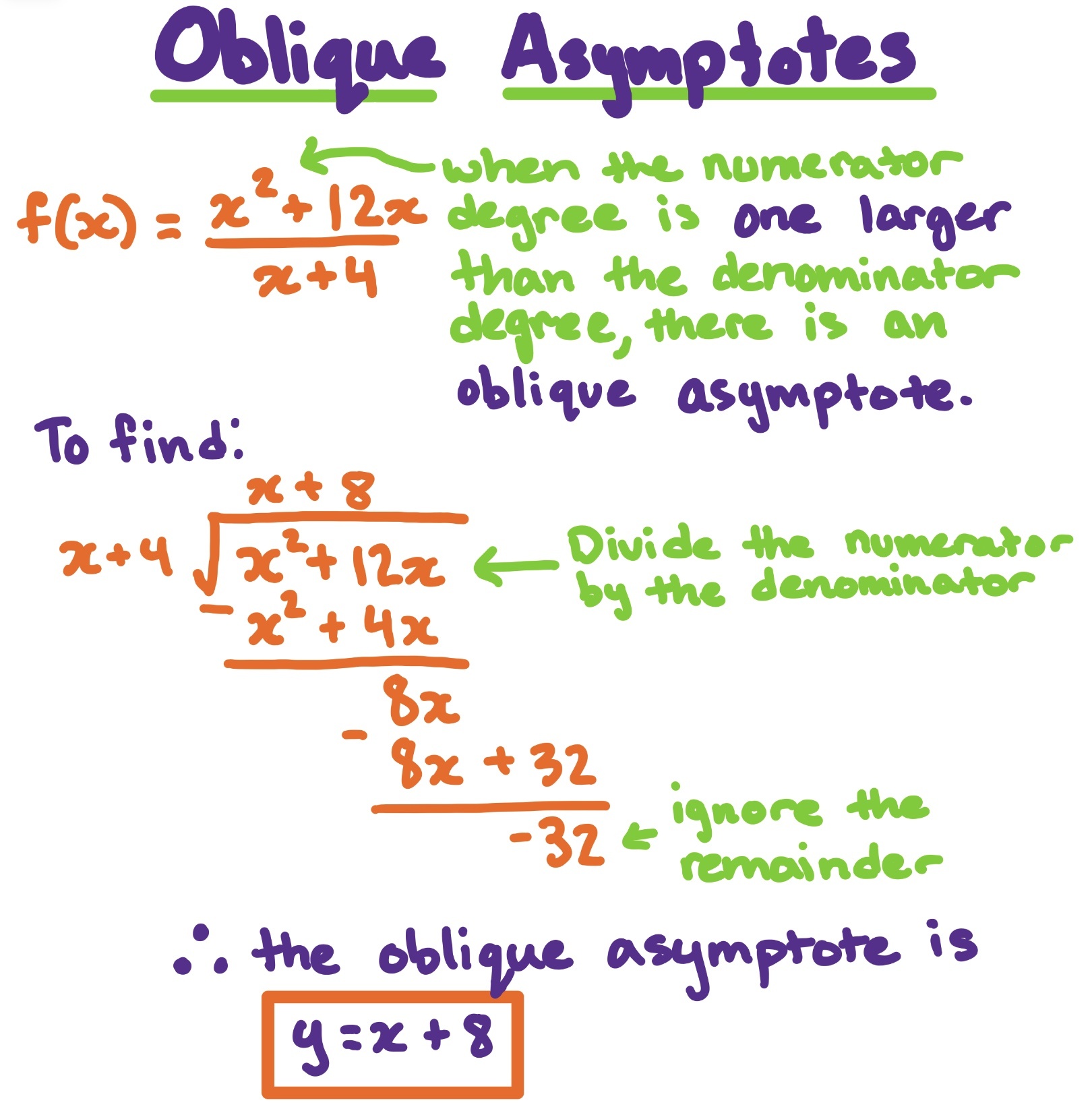
Oblique Asymptotes
f(x)=frac{x^2+12x}/{x+4}
<-- when the numerator degree is one larger than the denominator degree, there is an oblique asymptote. 

To find:
Do polynomial long division to divide the numerator by the denominator. 
$x^2+12x\divx+4$

Therefore, the oblique asymptote is $y=x+8$.

Image source: by Trisha

We see oblique asymptotes when the numerator has a higher degree than the denominator by exactly one. For example, if the top is a degree 22 polynomial, and the bottom is a degree 11 polynomial, we may have an oblique asymptote.

To find the oblique asymptote, we divide the numerator by the denominator using long division or synthetic division. The result (ignoring the remainder) is the equation of the slanted line.

####Example

Given the function: f(x)=x2+2x+3x+1f(x)=\frac{x^2+2x+3}{x+1}

When we divide, we get x+1x+1 as the quotient. That means that the oblique asymptote is the line y=x+1y=x+1.

As xx gets really big or really small, the graph of the function will get closer and closer to this line.

Oblique asymptotes help us to better understand the end behavior of graphs. They tell us how the function behaves when xx is very large or very small.

Type a concept, like “slope” or “photosynthesis”.

↑ ↓ to choose · Enter to openSearch explanations and problems