Read · 3 min

Julio wants to know how many dog-walkers in the park don't pick up their dog's poop. He sits on a park bench for hours and counts the number of people whose dogs poop, and the number of people who don't pick up the poop. In the hours, people's dogs poop, and of them don't pick up the poop.
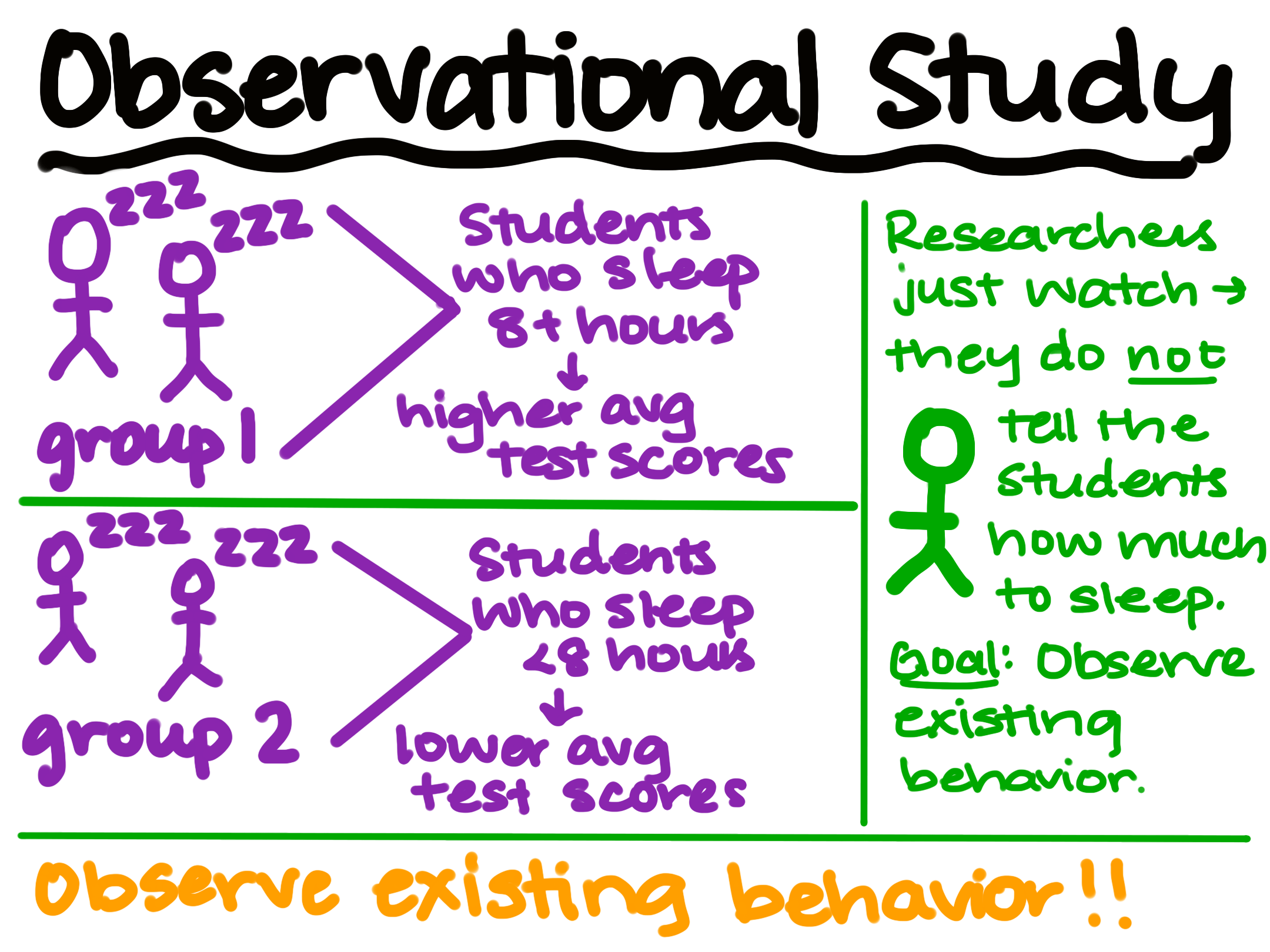
This is an example of an observational study.
Observational Study
An observational study is a type of research study where researchers collect information about a sample or population without manipulating any variables. That means that the researcher does not control the independent variable. In observational studies, the researcher is simply observing. In contrast, with experimental research, you will find more controlled trials.
A key subset of observational research is naturalistic research. Naturalistic research is observational research but in the environment that an act normally occurs. In our park and dog poop example, that is naturalistic research, since the research is sitting on a park bench observing behavior in a park, where people normally walk their dogs. Observational research can also happen in a lab setting, where researchers set up a scenario and watch what people do. Because people don't normally go to a lab and do things, that is not an example of naturalistic research.
We must also understand the difference between covert and overt observational research. Covert observational research is when the participant does not know they are being studied or the research is "disguised" in the participant group. For example, if a researcher doesn't tell a participant that they are the researcher, and they start talking to the participant to observe some kind of behavior, that is covert research. Overt observational research is when the participant knows they are being watched. For example, the researcher may be sitting in a chair in the back of the room, watching the participant.
Pros of Observational Research
Many times in research, it is unethical to manipulate certain variables. Suppose we are trying to understand how a natural pollutant affects the body. It would be unethical to expose certain groups of people to the pollutant in order to see its effects on the body. This is where observational research comes in! We can examine how the pollutants are affecting people naturally, without intervention. Another example is cancer research. We can't give cancer to people, but we can conduct research on people who already have cancer.
Observational research is also much cheaper than some other forms of research since you are not controlling variables in an experimental setting. In a similar vein, observational studies are less time-consuming since you don't need to set up variables and controls.
Cons of Observational Research
Because we are not controlling the independent variable in observational research, we are not able to protect against confounding or third variables. For example, if we look back at our first example, maybe there was something distinct about the group of people who didn't pick up their dog's poop, like they didn't have a bag with them.
In a similar vein, because we are not controlling the variables, we are also not controlling the participants involved in the research. Due to the naturalistic nature of observational studies, we can only research those who fit the criteria naturally. So, if we think back to our cancer example, we cannot control which people have cancer already, which may impact our research.
Biases and Errors
There are some biases and errors that we must keep in mind when we are doing observational research.
- Selection bias: the study is not able to select a sample of participants that are representative of the greater population
With observational research, we can only look at participants who are already have some pre-existing condition or factor, so we can't manipulate either the variables or the sample.
- The Hawthorne Effect: when participants change the way they behave because they they're being observed
This can show up as trying to be more ethical when making decisions because participants know they're being watched or even adhering to more gender or racial stereotypes.
- Observer bias: when a researcher's preconceptions or assumptions influence data collection