Read · 4 min
We learned that atoms want to have a full valence electron shell. Atoms can achieve a full valance shell in two ways. Ionic bonds form when atoms donate and take electrons to form ions. Covalent bonds form when atoms share electrons. In most cases, an atom has a full valence shell when it has eight valence electrons. This is the octet rule. The octet rule is a helpful principle for periods one through three of the periodic table. For elements in periods one through three, we are looking at the [s and p]((https://www.expii.com/t/shapes-of-atomic-orbitals-overview-examples-8323) orbitals. The s orbital holds two electrons. The p orbitals hold a total of six electrons. Filling the s and p orbitals gives us a full octet. Unfortunately, we cannot always follow the octet rule. We have to learn the exceptions.
Exceptions to the Octet Rule
- For the transition metals, we have to consider the d-orbitals.
- For the lanthanides and actinides, we have to consider the f-orbitals.
- Some molecules have an odd number of electrons.
- Some molecules have an atom with a full valence shell that is less than eight.
- Some molecules have an atom that has more than eight valence electrons.
Exceptions 1 and 2: The Transition Metals, Lanthanides, and Actinides
The transition metals have d orbitals. The d-orbitals take part in bond formation. So, for the transition metals, we alter the octet rule to the eighteen electron rule. A transition metal needs eighteen electrons to fill the s, p, and d orbitals. We apply the eighteen electron rule to covalent bonds. In covalent bonds, the transition metal shares electrons until it has eighteen electrons. Unfortunately, the eighteen electron rule is not universal. Many stable transition metal compounds have less than eighteen electrons.
When the transition metals ionic bond they use the s-orbital electrons first. Next, the transition metal uses the d-orbital electrons. Because of the d-orbitals, the octet rule does not work. The transition metals can form many different stable ions. We call the stable ions, oxidation states. The best way to determine the oxidation state is to write out the electron configuration. Knowing which oxidation states are stable is difficult. You need an advanced understanding of physical chemistry and thermodynamics. The easiest way to know an element's common oxidation states is to look it up.
The lanthanides and actinides have f-orbitals. There is considerable debate about if, when, and how f-orbitals bond. There are no general rules for f-orbitals. The f-orbitals can hold fourteen total electrons. So, the lanthanides and actinides do not obey the octet rule.
Exception 3: Molecules with Odd Numbers of Electrons
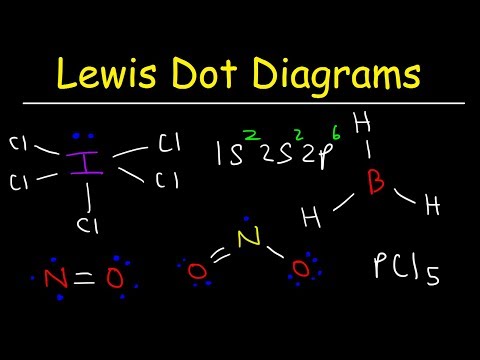
The octet rule says that every atom in a molecule should have eight valence electrons. There should always be an even number of electrons. Yet, some molecules have an odd number of electrons. One of the most common examples is nitric oxide (NO). Nitrogen has five valence electrons and oxygen has six. Nitric oxide has a total of eleven electrons. Nitric oxide is a free radical. A free radical is a molecule that has an unpaired electron. When you draw the lewis dot diagram for nitric oxide, you have one dot on the nitrogen. Free radicals are unstable and undergo spontaneous reactions. They want to bond with other free radicals. When two free radicals bond, their unpaired electrons become paired.
Exception 4: Full Valence of less than Eight
The elements in group three of the periodic table have three valence electrons. Group three contains the metalloid boron (B) and the metals aluminum (Al), gallium (Gl), indium (In), and thallium (Tl). The group three elements often form covalent bonds. But, when the group three elements bond, they end up with only six total valence electrons. Molecules with less than eight electrons are hypovalent. However, the molecules made from the group three elements are reactive. They will react with molecules that donate unpaired electrons. We call these molecules ligands. For example, boron trifluoride () will react with ammonia (). The ammonia will donate its electron pair to the boron atom. After reacting, boron does end up obeying the octet rule.
Exception 5: More than Eight Valence Electrons
Molecules with more than eight valance electrons are hypervalent. The central atom for hypervalent molecules can be a nonmetal, metalloid, halogen, or noble gas. But, they have to be in group three or higher. Why? They need access to d-orbitals. An example is Sulfur Hexafluoride (SF6). Sulfur's valence electrons are in the 3s and 3p orbitals. But, the third energy level has access to the 3d orbitals. So, it can exceed the octet rule.
As a side note, molecules like sulfur hexafluoride are complicated. Recent studies have shown that the sulfur-fluoride bonds are both ionic and covalent. Some of the fluorines are covalently bonded to sulfur. Other fluorines are ionically bonded to sulfur. The complex bonding in some hypervalent molecules is not something you need to understand. For general chemistry, you only need to know that hypervalent molecules do not obey the octet rule.