Interactive · 2 questions
+2 contributors


One-to-One Functions
In this lesson, we will understand the concept of one-to-one functions, which is also known as injective functions. Only one-to-one functions can have an inverse found algebraically.
Let and be sets such that there exists a function such that . The function is injective (one-to-one) if for all elements in domain , implies that .
In other words, every element in the domain is mapped to exactly one element in the codomain - no more, no less! In addition, no two elements in the domain can be mapped to the same element in the codomain.
We can call an injective function an injection.
Let's take a look at an example of an injective function. Let's pretend the function maps dog owners to their dogs. The number of elements in the input group is three unique elements and in the output group is also three.
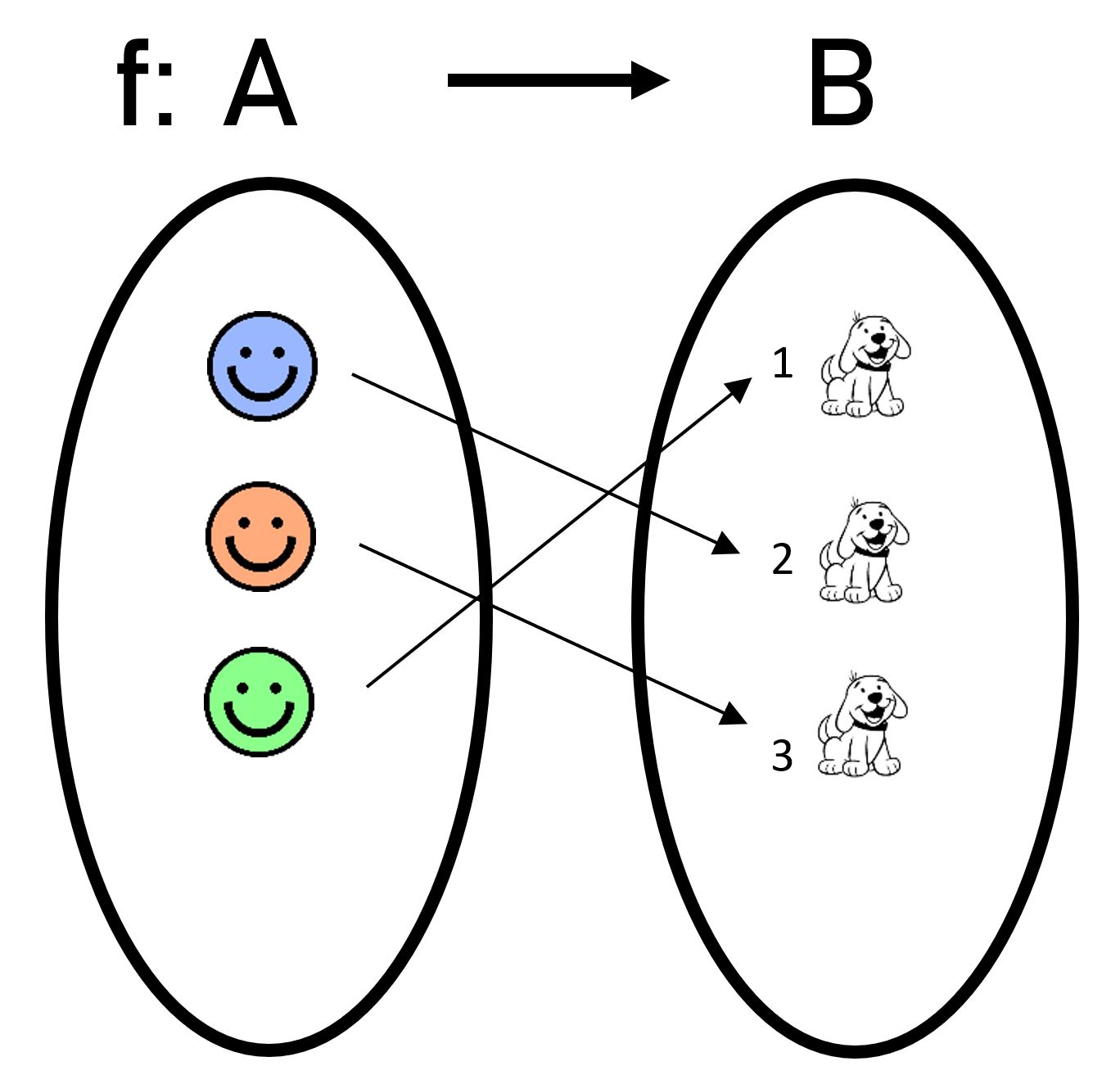
Image source: by Angela Yang
The function is injective because every owner has a dog, and no two owners have the same dog.
Now you try!
Take a look at these three different versions of function .
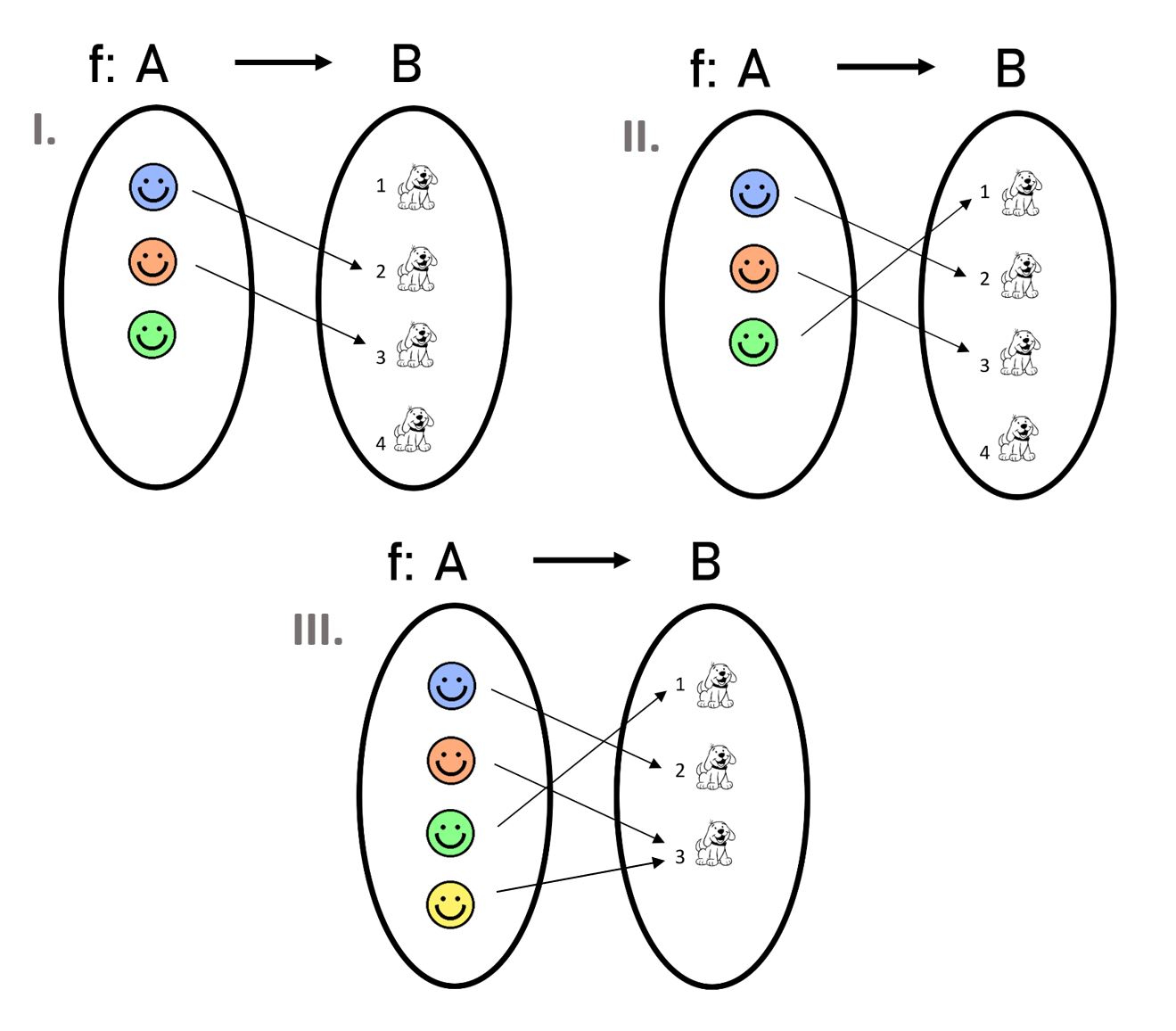
Image source: by Angela Yang
Choose all versions of function that are injective.
Notice anything?
Hint: take a look again at the number of elements in the domain and the codomain .
We can refer to the number of elements in a set as its size. If is an injective function, then the size of must always be less than the size of .
Why is this true?
Keeping in mind our analogy above, every dog owner must have exactly one dog, right? Then, at the very least, the size of will be equal to the size of . However, for a function to be injective we only require that every element in the domain is mapped to an element in . That being said, there can be elements in that are not mapped to. In other words, it is possible to have dogs without owners.
You will later learn about surjective functions, which guarantee that every dog has an owner! A function can also be called bijective if it is **both **surjective and injective.
Injection Review: Test your knowledge!
Which of the following is **false **about injective functions?
Even More About Injections: Inverses
If we know that a function is injective, we can find its inverse.
If function lets us find dogs by inputting owners, then we can find an inverse function such that we can find owners by inputting dogs. In simpler terms, we can find a function that will map dogs to their owners.
Remember that the inverse of a function is a reflection over the line .