Illustrated · 1 min

So far, we have learned about different functions, such as piecewise, step, and one-to-one functions, but now let's learn about onto functions!

##Onto Functions

Onto functions, also known as surjective functions, are when every possible output corresponds to an input value of real numbers It sounds very similar to one-to-one functions, but the key difference is that in one-to-one functions, every input must correspond to only one output. Onto functions are more particular in that every output or yy value must have an input or xx value.

Let's look at an example onto function.
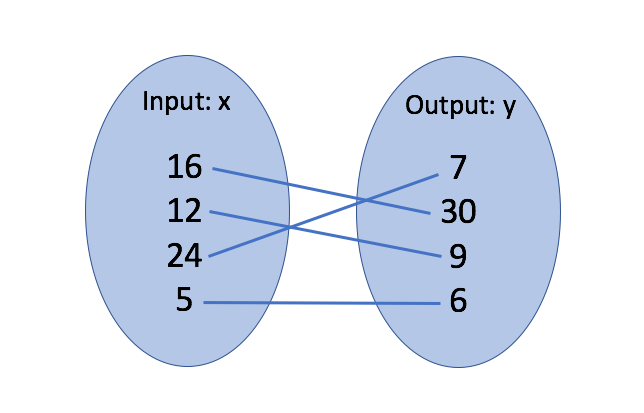
Function map:

Input x: 16, 12, 24, 5
Output y: 7, 30, 9, 6

16 to 30
12 to 9
24 to 7
5 to 6

Image source: by Trisha Rahman

In this function map, we can see every yy value connects to an xx value, meaning we have an onto function.

However, if we slightly change this example, we no longer have an onto function:
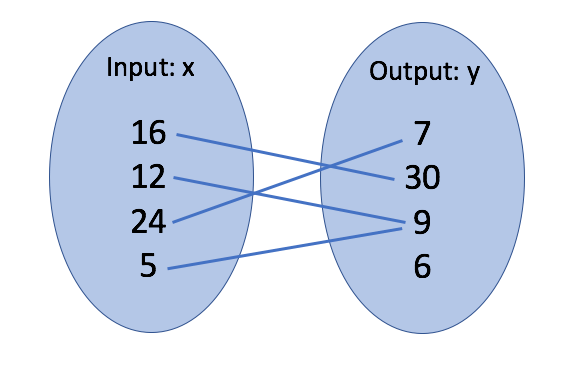
Function map:

Input x: 16, 12, 24, 5
Output y: 7, 30, 9, 6

16 to 30
12 to 9
24 to 7
5 to 9

Image source: by Trisha Rahman

In this function map, the output 66 does not have a corresponding input (the horizontal line changed), so we know this is not an onto function.

Video

Proving a Function is an Onto Function

by The Math Sorcerer

In this video by The Math Sorcerer, you will learn how to prove a function is surjective / an onto function.

Illustrated · 1 min

Onto Functions

In our previous lesson, we learned about one-to-one functions. Now, let's talk about onto functions.

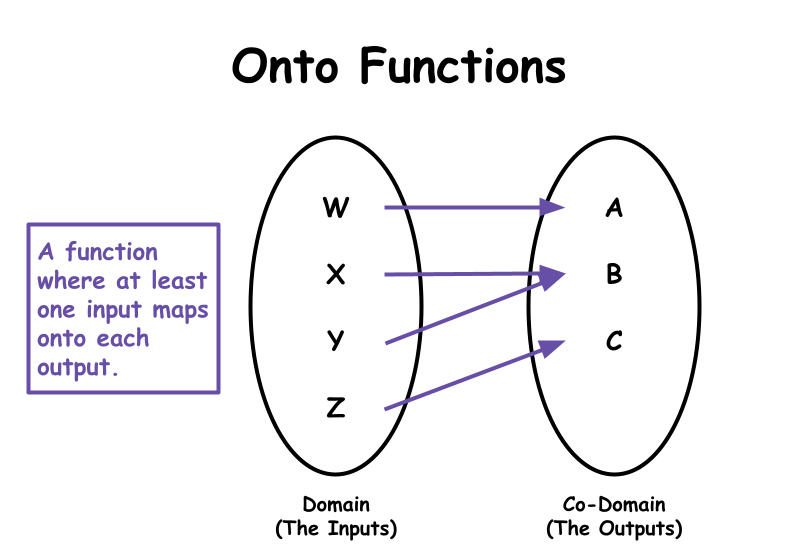
An onto function, also called a surjection, is a function where every element in the codomain (the set of all possible outputs) has at least one element from the domain (the set of inputs) that maps to it. In simpler terms, every output value in the codomain must be used by some input.

Imagine you're throwing a ball into a basket. If every basket (output) gets a ball (input), the function is onto. But if some baskets are left empty, it’s not onto.

Onto functions: A function where at least one input maps onto each output.

Image source: by Anusha Rahman

For example, consider the function f:1,2,3→a,b,cf : {1,2,3} \rightarrow {a, b, c}, where f(1)=a,f(2)=b,f(3)=cf(1) = a, f(2)=b, f(3)=c. Since every letter (output) has an input, this is an onto function.

However, if f:1,2,3→a,b,cf : {1,2,3} \rightarrow {a,b,c} with f(1)=a,f(2)=a,f(1)=a, f(2)=a, and f(3)=bf(3)=b, then it's NOT onto because the letter cc doesn't have an input that maps onto it.

For a function to be both one-to-one and onto, we call it a bijection. Bijections are special because they are both one-to-one and onto!

Type a concept, like “slope” or “photosynthesis”.

↑ ↓ to choose · Enter to openSearch explanations and problems
