Operations on Polynomial Functions

Before this, knowStandard Form of a Polynomial Function and Its Degree

Interactive · 2 questions

Adding and subtracting polynomials

It turns out that polynomials are like numbers, and we can do arithmetic with them!

Let's start with addition of polynomials. If you have two copies of the same term, you can just add them together. Let's do an example to demonstrate this!

Suppose f(x)=x2+2x+1f(x) = x^2 + 2x + 1 and g(x)=2x2+3x+4g(x) = 2x^2 + 3x + 4. Then we see that we can add the x2x^2 terms together, the xx terms together, and the constant terms together, just like numbers! Then (f+g)(x)=(1+2)x2+(2+3)x+(1+4)=3x2+5x+5.(f+g)(x) = (1 + 2)x^2 + (2+3)x + (1 + 4) = 3x^2 + 5x + 5.

Let's try another example! Suppose f(x)=x3+4x2+2x+1f(x) = x^3 + 4x^2 + 2x + 1 and g(x)=x2+3x+2g(x) = x^2 + 3x + 2. What is (f+g)(x)(f+g)(x)?

Choose one answer

Interactive · 8 questions

Polynomials are the functions we can write in terms of addition and multiplication (of real numbers and variables). For now, we'll stick to polynomials with only one variable.

Because multiplication distributes over addition, we can write polynomials in many ways. All polynomials can be written in the standard form: P(x)=anxn+⋯+a2x2+a1x+a0.P(x) = a_n x^n + \dots + a_2 x^2 + a_1 x + a_0. Here, a0,a1,…,ana_0, a_1, \dots, a_n are constants (fixed numbers not depending on xx). We call the highest power, nn, the degree of the polynomial. The expressions a0a_0, a1xa_1 x, a2x2a_2 x^2, and so on are the terms of the polynomial.

Remember: always keep track of your coefficients and variables carefully!

It's often convenient to keep polynomials reduced to standard form as we work with them. So we'll talk about how to add and multiply polynomials in standard form, and then reduce them back to standard form by combining like terms.

Adding polynomials

Adding polynomials is exactly like adding numbers with several digits, only easier. For example, to add 2x2+3x+12x^2 +3x + 1 and 5x2−7x+45x^2-7x+4: [ \begin{array}{rrrr} & 2x^2 & +3x & +1 \

  • & 5x^2 & -7x & +4 \ \hline & 7x^2 & -4x & +5 \end{array} ] Things are even easier because never don't need to "carry a one". We just add the terms with x2x^2, and also the terms with xx, and also the terms with no variable at all.

You have to be slightly careful when lining things up. Try adding together t2+4t^2 + 4 and t−1t - 1.

You should get: [ \begin{array}{rrrr} & t^2 & & +4 \

  • & & t & -1 \ \hline & t^2 & +t & +3 \end{array} ] The tt and the t2t^2 have different degrees, so they belong in separate columns.

With practice you can stop writing out the long addition table, just as with adding numbers.

Find (x3+3x+1)+(x2−4x+4)(x^3 + 3x + 1) + (x^2 -4x + 4).

Choose one answer

Video

(Video) Adding, Subtracting, Multiplying, and Simplifying Polynomials - Part 2

by PatrickJMT

Patrick JMT has a good video explaining how to subtract polynomials (complete with a few examples).

Summary

Let's walk through the first example together!

[8a4+(a−3)−a2]−[4a4+2(a+1)+a2][8a4+a−3−a2]−[4a4+2a+2+a2]8a4+a−3−a2−4a4−2a−2+a24a4−2a2−1a−5\begin{align} [8a^4 + (a-3) - a^2]-[4a^4+2(a+1)+a^2] \\ [8a^4 + a-3 - a^2]-[4a^4+2a+2+a^2] \\ 8a^4 + a-3 - a^2-4a^4-2a-2+a^2 \\ 4a^4 - 2a^2-1a-5 \end{align}

We used a combination of distribution and combining like terms to simplify these polynomials. Try the next examples with the video!

Illustrated · 1 min

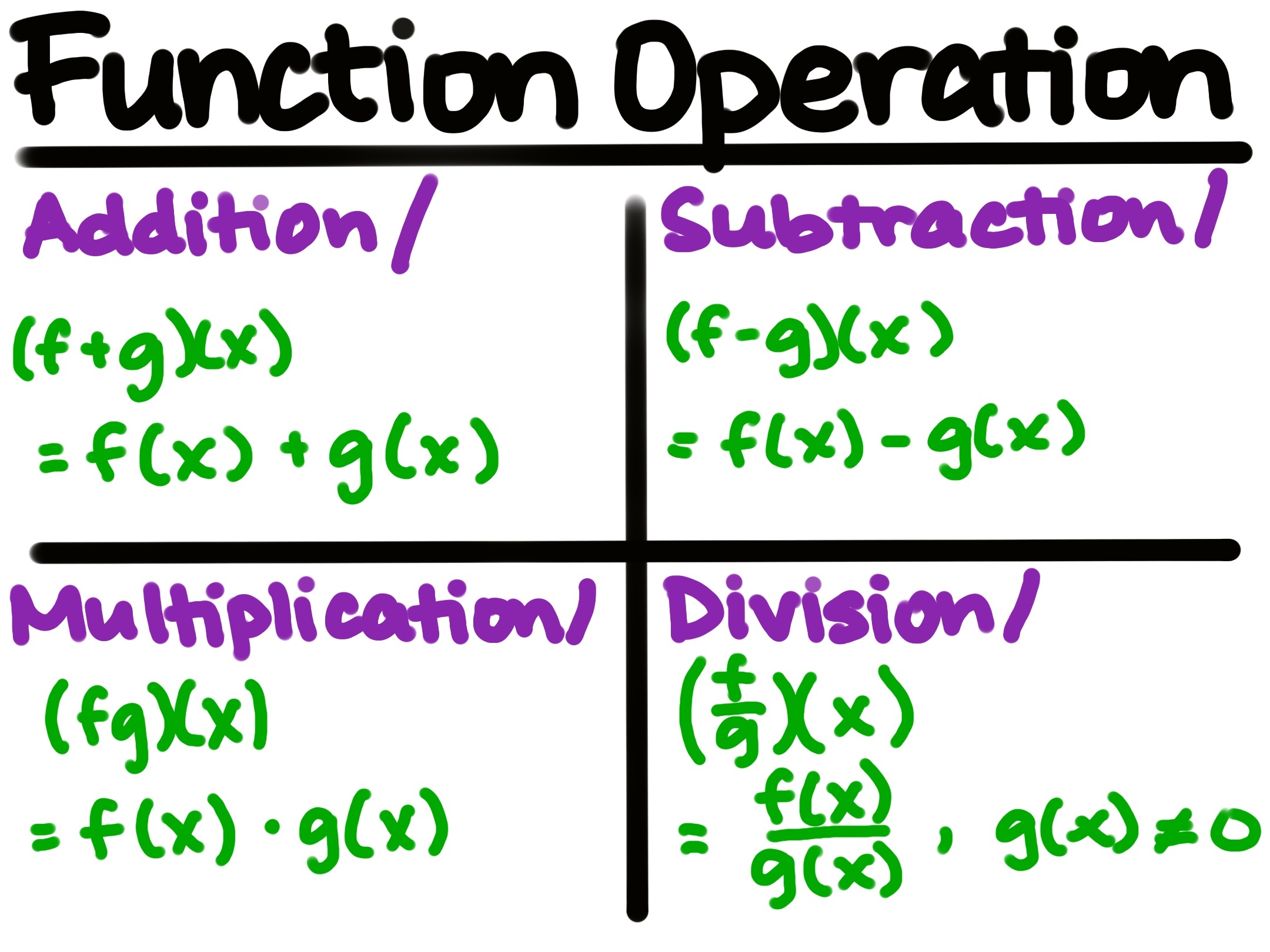
Function Operations

Just like we can add, subtract, and multiply polynomials, we can do the same with polynomial functions. A function is a rule that takes an input, does something to it, and gives back an output. If we have two functions, f(x)f(x) and g(x)g(x), we can perform operations on them just like we do with regular numbers or polynomials.

Function Operations
Addition: (f+g)(x) = f(x) + g(x)
Subtraction: (f-g)(x) = f(x) - g(x)
Multiplication: (fg)(x) = f(x) x g(x)
Division: (f/g)(x) = f(x)/g(x), g(x) cannot equal 0

Image source: by Anusha Rahman

There are four main operations.

####Addition

To add two functions, we add their corresponding outputs.

(f+g)(x)=f(x)+g(x)(f+g)(x) = f(x) + g(x)

For example, if f(x)=2x+3f(x) = 2x+3 and g(x)=x2−4g(x) = x^2 -4, then (f+g)(x)=f(x)+g(x)=(2x+3)+(x2−4)=x2+2x−1(f+g)(x) = f(x) + g(x) = (2x+3) + (x^2 -4) = x^2+2x-1.

####Subtraction

To subtract functions, subtract their outputs.

(f−g)(x)=f(x)−g(x)(f-g)(x) = f(x) - g(x)

Using the same functions from the previous example, (f−g)(x)=f(x)−g(x)=(2x+3)−(x2−4)=−x2+2x+7(f-g)(x) = f(x) - g(x) = (2x+3) - (x^2 -4) = -x^2+2x+7.

#####Multiplication

When multiplying functions, you multiply their outputs.

(fg)(x)=f(x)⋅g(x)(fg)(x) = f(x) \cdot g(x)

If we continue using the previous example, we get (f⋅g)(x)=f(x)⋅g(x)=(2x+3)(x−4)=2x3−8x+3x2−12(f \cdot g)(x) = f(x) \cdot g(x) = (2x+3)(x^-4) = 2x^3 - 8x + 3x^2 -12.

#####Division

We can also divide functions, but the result will be a rational function (a fraction of two polynomials).

(fg)(x)=f(x)g(x)=2x+3x2−4(\frac{f}{g})(x) = \frac{f(x)}{g(x)} = \frac{2x+3}{x^2-4}

However, this function might not be defined for certain values of xx (like when g(x)=0g(x)=0).

In the next lesson, you will learn how to find the degree of a polynomial.

Type a concept, like “slope” or “photosynthesis”.

↑ ↓ to choose · Enter to openSearch explanations and problems