Interactive · 1 question

+2 contributors


Organic and Inorganic Molecules
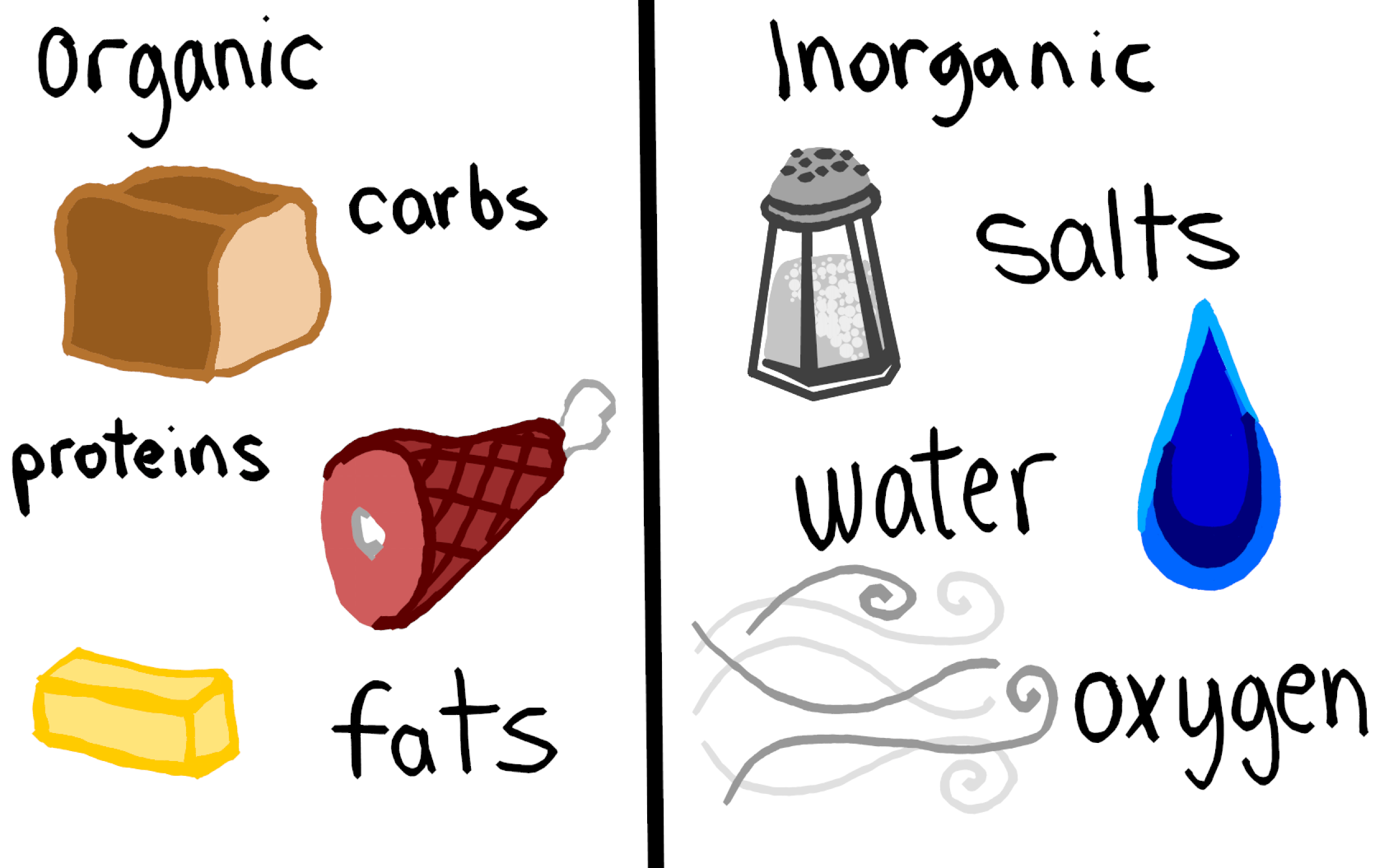
Organic molecules are the focus of an entire branch of chemistry called organic chemistry. Similarly, inorganic chemistry is the study of inorganic compounds. But what's the difference between them?
- Contain a carbon skeleton (carbons bonded to other carbons)
- Have only covalent bonds
- Typically are quite large
- Contain only carbon, hydrogen, oxygen, sulfur, nitrogen, and phosphorus.
- Do not usually have carbon
- Can contain many different elements
- Often contain charged ions (ionic bonds), like salts, metals, and minerals

Image source: By Tem5psu CC BY-SA 3.0, via Wikimedia Commons
The R group, also called the functional group, attached to an organic molecule lets us categorize and know the difference between molecules. The R group is a group of atoms that gives specific properties to molecules.

Image source: By Jü [Public domain], via Wikimedia Commons
Some R groups are polar like alcohol, some are non-polar, some are huge ring structures, and others are charged. Some examples include carboxylic acids, amino acids, and hydrocarbons.

Image source: By すじにくシチュー CC0, via Wikimedia Commons
Examine the molecule above. What type of molecule is it?
: The sixth element on the periodic table. It is the backbone of life.
: Any molecule made of carbon and hydrogen. Nitrogen, phosphorus, and oxygen are commonly found in them.
: Any molecule that does not have both carbon and hydrogen.