Organic vs. Inorganic Molecules — Definition & Overview

Interactive · 1 question

Organic and Inorganic Molecules

Organic molecules are the focus of an entire branch of chemistry called organic chemistry. Similarly, inorganic chemistry is the study of inorganic compounds. But what's the difference between them?

Organic molecules:\color{green}{\text{Organic molecules:}}

  • Contain a carbon skeleton (carbons bonded to other carbons)
  • Have only covalent bonds
  • Typically are quite large
  • Contain only carbon, hydrogen, oxygen, sulfur, nitrogen, and phosphorus.

Inorganic molecules:\color{green}{\text{Inorganic molecules:}}

  • Do not usually have carbon
  • Can contain many different elements
  • Often contain charged ions (ionic bonds), like salts, metals, and minerals
Organic molecules contain a carbon backbone. Inorganic molecules can contain carbon, but lack the carbon-to-carbon bonds of the carbon backbone.

Image source: By Tem5psu CC BY-SA 3.0, via Wikimedia Commons

The R group, also called the functional group, attached to an organic molecule lets us categorize and know the difference between molecules. The R group is a group of atoms that gives specific properties to molecules.

Four organic molecule that have an R group.

Image source: By Jü [Public domain], via Wikimedia Commons

Some R groups are polar like alcohol, some are non-polar, some are huge ring structures, and others are charged. Some examples include carboxylic acids, amino acids, and hydrocarbons.


A cyclohexane molecule with six carbon atoms and twelve hydrogen atoms.

Image source: By すじにくシチュー CC0, via Wikimedia Commons

Examine the molecule above. What type of molecule is it?

Choose one answer

Illustrated · 1 min

What Is Organic?

In chemistry and biology, the word organic has nothing to do with that expensive section of the grocery store. Put that definition for "organic" out of your mind for now.

When we talk about organic and inorganic molecules in science, we are talking about molecules that either have or lack carbon atoms in their structure.

Organic molecules are carbon-based and have a carbon backbone. Inorganic molecules are not carbon-based.

Image source: By Hannah Bonville

Let's look at some examples:

Organic Molecules:

Organic molecules contain carbon

These are all organic molecules. They have carbon (highlighted in pink) as the backbone of their structure. \\ Image source: By Hannah Bonville

Inorganic Molecules:

Inorganic molecules do not contain carbon

These are all inorganic molecules. There's no carbon in sight. \\ Image source: By Hannah Bonville

Sometimes people assume that because inorganic molecules don't have carbon in them, they aren't that important to life.

That's definitely not the case. Some incredibly important inorganic molecules and compounds include the oxygen you breathe (O2O_2) and the water you drink (H2OH_2O).

Here's a chart with some important organic and inorganic molecules:

Common organic molecules include proteins, carbohydrates, lipids, and nucleic acids. Common inorganic molecules include water, oxygen gas, nitrogen gas, and salt.

Image source: By Hannah Bonville

As you can see from the table above, organic molecules make up all of the four macromolecules that we need for life. Nucleic acids like DNA and RNA are especially important because they carry our genetic code.

Key Vocabulary:

  1. Organic
  2. Inorganic
  3. Carbon

Illustrated · 1 min

What Is the Difference Between Organic and Inorganic Molecules?

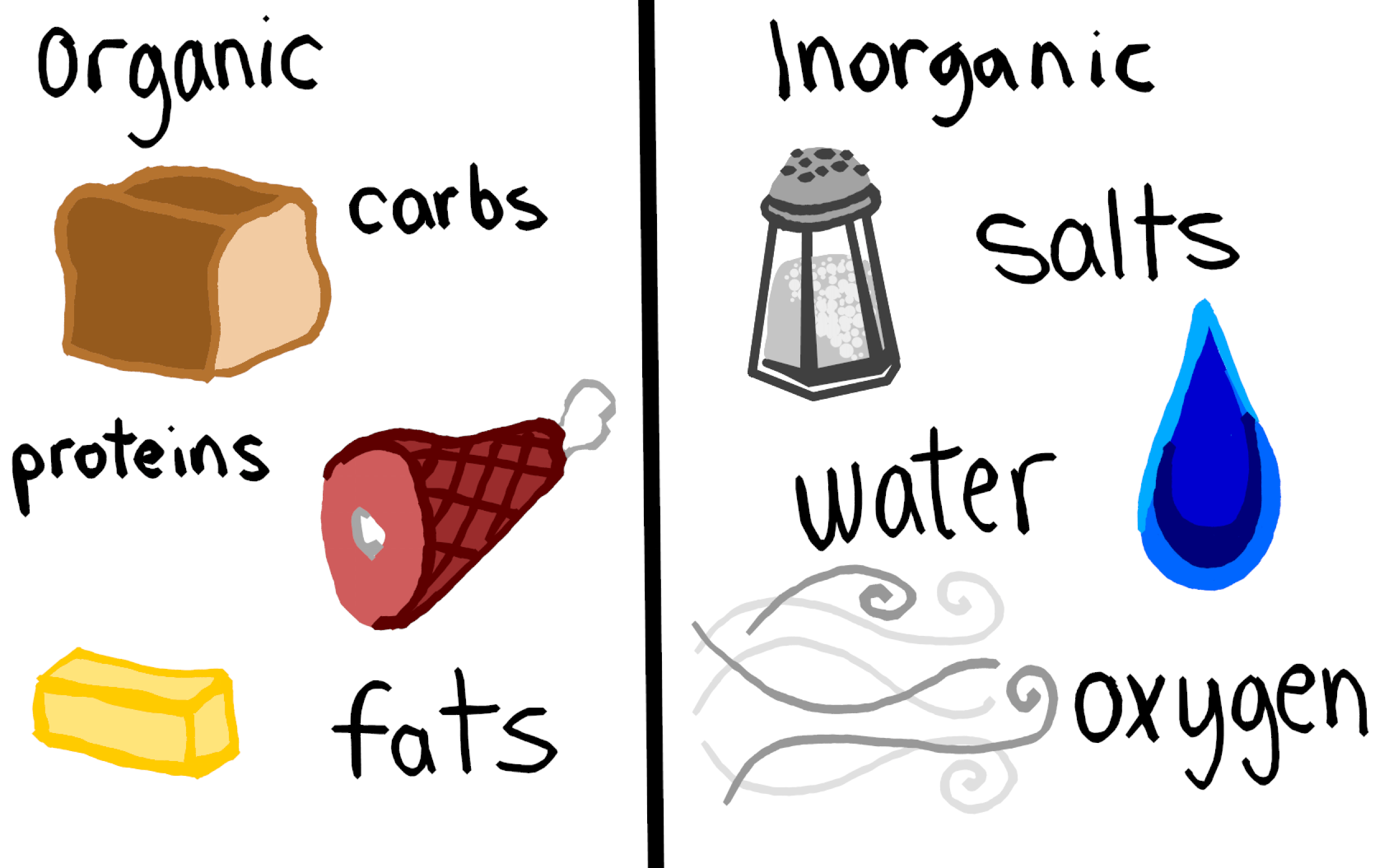
The image has two categories: organic and inorganic. In organic, there are carbohydrates (bread), proteins (ham), and fats (butter). In inorganic, there are salts (salt shaker), water (a raindrop), and oxygen (wind).

Image source: By Sarah Morgan

If you looked at the contents of a kitchen, which parts would be organic and which parts would be inorganic?

Organic molecules have carbon-hydrogen bonds. These types of molecules are created by living organisms. Organic molecules can include things like carbohydrates, proteins, and fats. While organic molecules can have non-carbon atoms contained inside them, like oxygen, nitrogen, or even iron, they are mostly made of carbon and hydrogen chains. Because of this, they are made almost entirely of covalent bonds.

Inorganic molecules do not contain carbon-hydrogen bonds. While carbon can still appear in inorganic molecules, such as in carbon dioxide, it lacks the additional hydrogens that make it organic. Inorganic molecules often have ionic bonds between metals and nonmetals, such as in table salt, which is made of sodium and chlorine. However, they can still have covalent bonds, such as in water molecules or oxygen gas.

The image shows organic and inorganic molecules. The organic side has a four-carbon molecule. Organic molecules contain carbon and hydrogen. They also use covalent bonds. On the inorganic side, there is NaCl, or salt. Inorganic molecules can have ionic or covalent bonds. They do not contain -CH groups.

Image source: By Sarah Morgan

Interactive · 1 question

What Does Organic Really Mean?

Image of a supermarket

Image source: By Webkid~commonswiki assumed (based on copyright claims) CC BY-SA 3.0, via Wikimedia Commons

Ah, the grocery store. Aisles and aisles of every food you could think of. If I asked you to show me where the organic food was, you'd probably direct me to a specific aisle of fancy, pricey produce and snacks. But what if I told you that, chemically speaking, essentially all food is organic?

While grocery stores usually use the word "organic" in its alternate, non-scientific meaning, in biology, organic molecules are a category of molecules that make up the basis of all living things, and therefore also the food we eat.

In order for a substance to be classified as organic, it must:

1) Be carbon based. In our lesson about carbon, we discussed how its properties allow it to form chains and rings, creating complicated and diverse molecules. In general, the word organic simply means based on one of those carbon structures, but there are a few more rules.

2) Contain covalent bonds. In order for carbon-based structures to form those complex molecules, the bonds between the carbons and hydrogens must be covalent. As a rule, every organic compound contains at least one (usually many more) covalent C−HC-H bond. A few examples of compounds that contain carbon but are not organic are carbon dioxide, CO2CO_{2}, which contains no C−HC-H bond, and variants of the ion cyanide, CN−CN^{-}, including HCNHCN, where the C−HC-H bond is ionic.

3) Be molecular. Most compounds we've discussed so far are made up of molecules. However, some substances, called crystals, do not form molecules. Instead, each atom is able to form bonds on each side with atoms that are able to form more bonds. This allows the same atomic structure to continue on forever. Though diamond and graphite are made out of carbon, they are not organic because they are crystals, so they do not contain molecules.

Phew, that was a lot of words. But in short, you can remember that any molecule that contains CC covalently bonded to at least one HH is organic.

All of life is made up of organic compounds. They are what we eat to get energy and gain mass. So why did I say that only most things in the grocery store are organic?

In short, anything that contains calories, the unit we use to measure the energy supply in food, is organic in the chemical meaning, whether or not it's labeled with that word at the grocery store. But there are many inorganic compounds that are necessary for life that we eat in our food as well.

For example, water (H2OH_{2}O) is inorganic. This is pretty obvious, as it fails step one of checking for organic compounds: it doesn't contain any carbon.

Additionally, many minerals, or types of ionic crystalline structures, are necessary for helping with the many chemical reactions that happen in our body. Salt is a classic example, but there are others that you might frequently find in a daily multivitamin, such as iron and magnesium.

Which part of your meal does not contain any organic molecules?

Choose one answer

Read · 1 min

Summary of Organic Molecules

Organic molecules must contain two or more carbon atoms. They form the majority of the material in any organism. Organic molecules are usually high in energy and can be combusted to produce heat and carbon dioxide.

Polymers of organic molecules are called macromolecules. Organic macromolecules are grouped into four categories: carbohydrates, lipids, proteins, and nucleic acids.

Inorganic molecules are any molecules that do not contain a carbon backbone. They are things like the air we breath, the metals used in manufacturing, and the salts we use.

Video

(Video) Organic and Inorganic Molecules

by Logos Academy with Dr. Leonel Oyarzun

Are organic molecules free-range? Do atoms hold hands and dance to form molecules? Will the ability to act, sing, dance, and play the violin with your toes get you a good job? In this video, Dr. Leonel Oyarzun answers all these questions and more about the differences between organic and inorganic molecules.

Video

(Video) Organic vs. Inorganic Molecules

by Nick Wasmer

Organic compounds are anything that contain a carbon backbone. But why does organic chemistry revolve around the element carbon? What other elements are commonly found in organic compounds? Watch this video to find out.

Type a concept, like “slope” or “photosynthesis”.

↑ ↓ to choose · Enter to openSearch explanations and problems