Illustrated · 1 min
By Gabi Slizewska

+1 contributors
Contributors

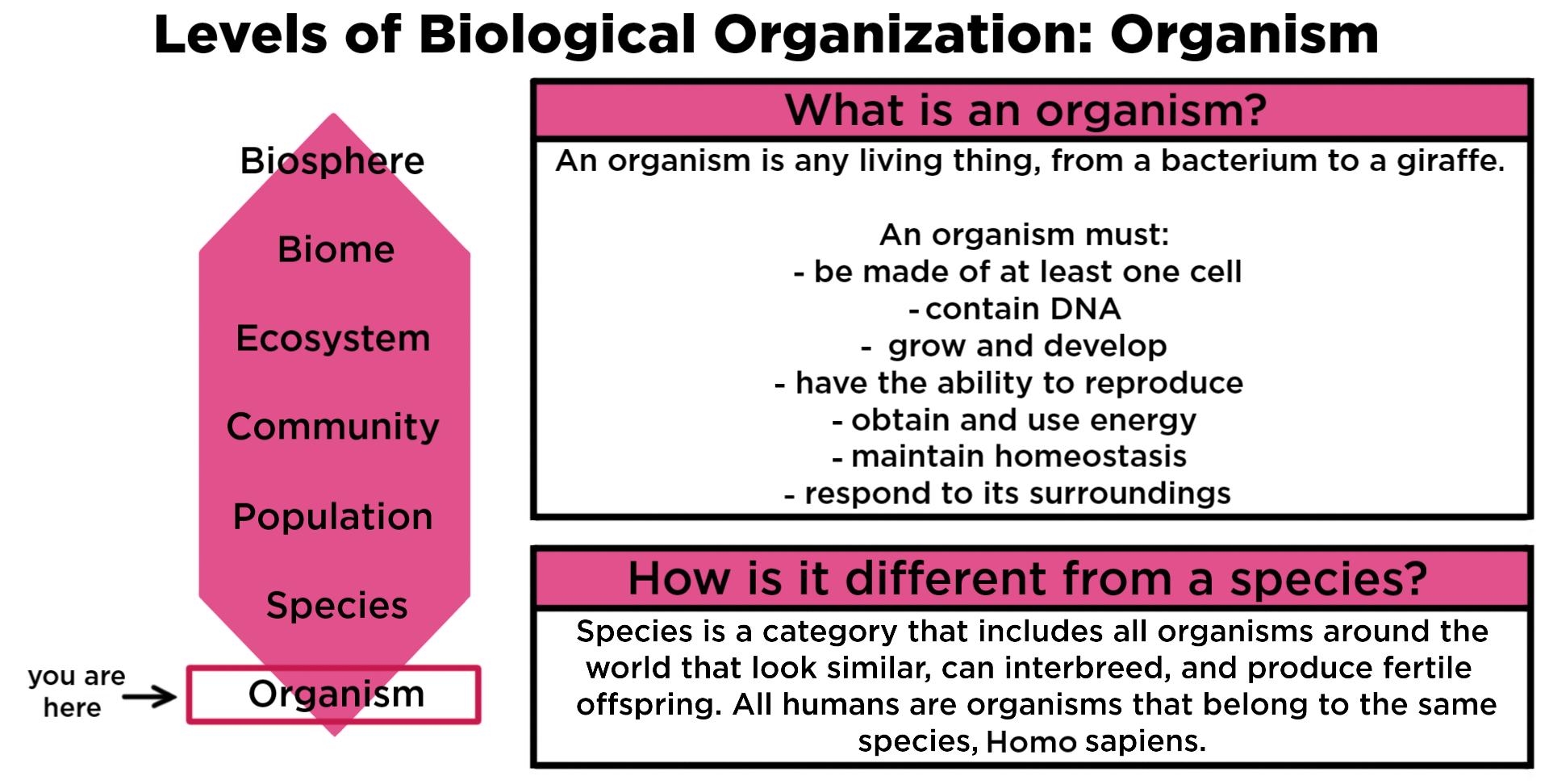
Image source: By Gabi Slizewska

Before this, knowSpecies (Ecology) — Definition & Examples
Illustrated · 1 min
Image source: By Gabi Slizewska
Illustrated · 1 min
An organism is the simplest level of organization in ecology. Essentially, an organism is an individual. Every organism must have the eight characteristics of life.
You are an organism. The tree that helped make the air you're breathing is an organism. The single-celled critter camping out in your stomach is an organism.
Finally, the adorable pups in the picture below are organisms. Ferocious ones, too.

Image source: By Daniel Stockman CC BY-SA 2.0, via flickr.com
: The study of organisms and their environment
: The biosphere is the global ecological system. It includes all life and ecosystems
: A large group of ecosystems that are characterized by soil and climate types
: The interactions between a biological community and its environment
: A group of interacting populations
: A group of individuals of the same species living in a particular geographical area
: A group of organisms that can breed and create fertile offspring
: A living individual
: A species' ecological role in its community
Video
by AishiPotato

What do a whale and a bee have in common? They're both organisms, but what does that mean? This video will tell you.

Image source: By Valeri Natole
Illustrated · 1 min
An organism is one living person, animal, bacteria, or thing. As long as that something is alive, it's an organism. As a result, we are organisms and any living thing around us is an organism.

Image source: By mvdsande CC0, via pixabay.com
Multicellular
Multicellular organisms are made of a bunch of cells. Those cells make up tissues, which make up organs, which make up organ systems. Organ systems work together to create a functioning organism.
Unicellular
Single-celled, or unicellular, organisms are made up of just one cell.

Image source: by Valeri Natole

Image source: by Valeri Natole
Organisms are the very basis of biotic interactions in the biosphere. Every ecological level bigger than Organism includes more than one interacting organism.
Illustrated · 2 min
Ecology focuses on relationships between organisms, populations, species, communities, ecosystems, biomes, and the entire biosphere. All of these ecological levels interact and intersect to create the natural world we know and are part of. Since an organism is one individual living creature, organism ecology is the study of the smallest interacting units on the Earth.
There's also population ecology, species ecology, community ecology, and so on beyond studying the individual organism!

Image source: by Valeri Natole using: Kawaii Earth Clipart By Mvolz CC BY-SA 4.0, via Wikimedia Commons
What's an Organism?
An organism is a living thing - it's that simple! But delving a little deeper, we can ask: what IS a living thing?
A living thing has to have eight features:
If a thing has all of these features, it is a living thing.
An Organism's Environment
An individual organism's environment includes everything around it that isn't it. If you look at the image above, you might think an organism's environment has a complex organization because of the many layers ecologists look at in that environment. But don't fear! You can simply think of populations, communities, and species as the biotic parts of an organism's environment and of the ecosystem as including both biotic and abiotic parts. Biomes are broad habitats, like deserts, temperate forests, or the oceans. Different ecosystems exist in different biomes. And the biosphere? Well, that's just the whole Earth!
Organism Ecology and Natural Selection
Natural selection is how evolution happens. Even though evolution happens at the species level, natural selection happens at the organism level!
No two organisms are alike. That means there's a certain amount of variability in a group of organisms, and some might be better suited to their environment than others. The better-suited critters live longer, get stronger, and make offspring that are similar to them. Meanwhile, the not-so-fit critters die off. Natural selection has occurred, choosing the best organisms to succeed in the environment. Over time the species will all look more and more like the survivors. That's evolution.
Ecologists look at the history of an organisms' species, its niche construction, and other factors contributing to the natural selection process.



