
Illustrated · 1 min
By Gabi Slizewska

+1 contributors
Contributors


Image source: By Gabi Slizewska
Illustrated · 1 min
Image source: By Gabi Slizewska
Interactive · 2 questions
Osmoregulation is how living things balance the water content inside of their bodies. This means, in simpler terms, trying to balance water loss with water intake to keep the body hydrated properly. Every single cell in an organism's body is constantly osmoregulating to keep perfectly hydrated.

Image source: By LadyofHats [Public domain], via Wikimedia Commons
Osmosis is the movement of solvent particles from an area with lower solute concentration to an area with higher solute concentration. With osmoregulation, the solvent we're talking about is water, life's most famous and important solvent.
When particle concentration becomes higher on one side of a membrane that water can move through, the water will shift from one fluid compartment to the one with the higher concentration of particles. The goal of osmosis is to even out particle concentrations by adding solvent where there are more dissolved particles.

Image source: By Hans Hillewaert CC BY-SA 4.0, via Wikimedia Commons
Living things regulate osmotic pressure to keep things like blood pressure or cell wall structure in check. That's osmoregulation.
The concentration of salts inside and outside of the cells can drastically impact their hydration. Remember that water flows from the area of lower solute concentration to the area of higher solute concentration. You can also think of this as water moving from areas with high concentrations (of water) to areas with low concentrations (of water). This is called "down the concentration gradient".
What is a cell's preferred environment?
Animals can be divided into two categories depending on what kind of water maintenance they use: osmoregulators or osmoconformers.
Osmoregulators are land animals. They must control their internal water levels because they lose water to evaporation and excretion. Water can't pass through protein channels, but it can pass through the cell membrane. Therefore, the cells will undergo osmosis to keep the internal concentration at appropriate levels.
The flow of water into and out of an osmoregulator is related to the salt concentration. Water flows into the cell in response to ion concentrations. So, water concentration inside of cells is indirectly controlled by ion pumps like the sodium-potassium pump. Remember how the sodium-potassium pump creates a concentration gradient? The gradient allows water to enter and leave the cell through osmosis.
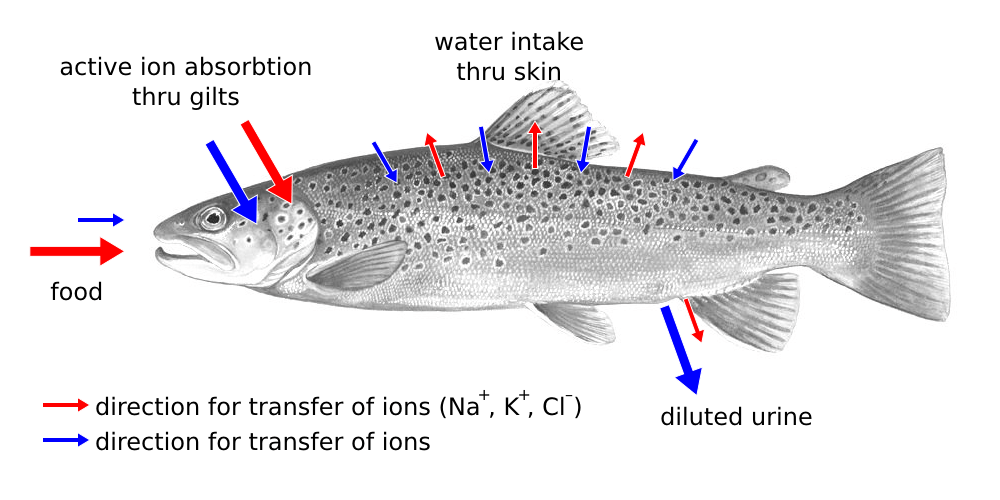
Image source: By Raver, Duane; modified by Biezl [Public domain], via Wikimedia Commons
Osmoconformers are typically animals that live in the water. They conform to the concentration of the water around them. Starfish, for example, do not osmoregulate. They lose and gain water at equal rates. If they are placed in water with too high or too low of a concentration of salt, their organelles will swell or shrink and they will die.
Humans are osmo, which .
: The ability of living things to keep a balance between things entering and leaving the cell. In other words, the organism controls its internal environment
: The process that allows organisms to maintain their internal temperature
: The process of balancing the ion content inside the body
: The process of balancing the water content inside the body
: All things in a system are perfectly balanced
Interactive · 1 question
Osmoregulation means maintaining water and electrolyte concentrations in an organism at an ideal level of hydration. This is also called maintaining osmotic balance. Cells will always aim to be in an isotonic environment, where the concentration of solute outside the cell is the same as the concentration of solute inside the cell. This is possible because cells have a semipermeable membrane. The flow of water moves down its concentration gradient into salty environments to achieve an isotonic environment.
Controlling the ion concentrations in a cell is done through control of osmotic pressure, which is the amount of water contained within a cell versus that of the surrounding water. Cells can also use diffusion and active transport of different substances to help with this.
For example, if the inside of a cell is saltier than its environment, water will flow into the cell and the cell will swell. On the other hand, if the inside of a cell is more dilute than its environment, the cell will lose excess water and shrink.
One of the best ways to learn about osmotic regulation is by looking at the kidney, one of the most important organs involved in human osmoregulation. The kidney uses many different mechanisms to achieve the perfect level of hydration inside the human body while removing unwanted waste. By deciding how much water to reabsorb back into the bloodstream, the kidney helps to keep cells inside the body in an isotonic environment so that cells will neither shrink nor swell.
After a long process of reabsorbing nutrients back into the bloodstream, the pre-urine (a waste product) passing through the kidney reaches an area called the collecting duct. In this duct, a very important step in maintaining osmoregulation takes place.
If water levels in the body are high, such as right after you’ve drunk a big glass of water, the water that is left in the pre-urine will stay there. But if water levels are low, as they are when you’re dehydrated, a hormone called ADH (antidiuretic hormone) will be released, telling your body to reabsorb more water from the pre-urine. As a result, the collecting duct will have water transport channels inserted so that more water can leave the pre-urine and go back into the bloodstream. This keeps your cells at a healthy level of hydration.
Suppose you wake up in the morning and haven’t had any water since dinner the night before. What might be happening in your kidneys?
Kidney filtration is a vital part of osmoregulation in humans. Without it, our bodies would fill with extra water and waste products. This would cause a huge disruption in homeostasis that could cause death.
Video
by Bozeman Science

Water is incredibly important to our cells. How do we keep the right concentration of water in our cells at all times? The answer is osmoregulation, which is the diffusion of water. In this video, Mr. Andersen reviews osmosis and explains how different organisms either keep their cell water concentrations at a set point or allow their cells to conform to the environment outside. Finally, he explains the cool—but complex—way that the human body osmoregulates.



