
Illustrated · 2 min

+2 contributors


The Diffusion of Water
Osmosis is the diffusion of water across a membrane.
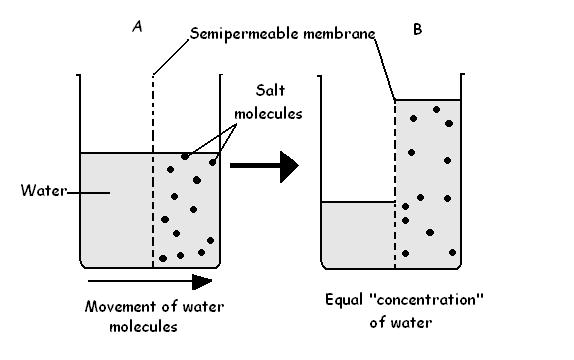
Image source: By Rlawson at English Wikibooks CC BY-SA 3.0, via Wikimedia Commons
Look at Picture A, shown above. The right-hand side of the beaker has a higher concentration of salt molecules than the left side does. This means that the concentration of water on the right-hand side is lower. Salt can't cross the membrane, but water can freely. In Picture B, the water from the left side crosses the membrane to the right side in order to make the concentration of water and salt equal on both sides. Just like in diffusion, the water moves from a region of higher concentration to one of lower concentration.
Basically, we just want the salt and water ratios to match on both sides (like three water molecules for each salt molecule on both sides). Once it matches, osmotic pressure from the salt solution side pushes back on the water, causing it to stop rushing in.
The concentration of water can be described in three ways: hypertonic, hypotonic, or isotonic.

Image source: By LadyofHats [Public domain], via Wikimedia Commons
Isotonic is a fancy way to say equilibrium; the solutions on both sides of the membrane are the same concentration.
Hypertonic means the solution outside the membrane has a higher solute concentration than the solution inside the cell. This causes animal cells to shrink and the vacuoles of plant cells to collapse.
Hypotonic means the concentration of solute inside the cell is higher than it is in the solution outside the cell. This causes animal cells to swell up and burst. For plant cells, the vacuoles swell and push the organelles into the cell walls.

Image source: By CNX OpenStax CC BY 4.0, via Wikimedia Commons
: A semi-permeable phospholipid bilayer
: The movement of particles from areas of high concentration to areas of low concentration
: The movement of water molecules from areas of high water concentration to areas of low water concentration
: The movement of particles from areas of high concentration to areas of low concentration with the help of an enzyme
: The movement of particles across the membrane with no help from the cell



