
Illustrated · 1 min
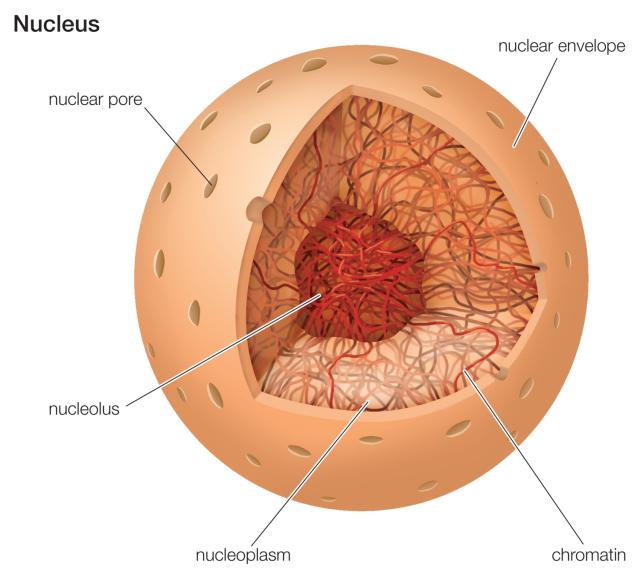
Structure of a nucleus.
All eukaryotic cells have a cell nucleus. The nucleus is the “command center” of a cell and contains all the hereditary information of the cell. The nucleus also regulates protein synthesis.
The nucleus is surrounded by a double membrane known as the nuclear envelope. The nuclear envelope is comprised of phospholipids that form a lipid bilayer. The nuclear envelope retains the contents of the nucleus and separates it from the cytoplasm of the cell. Similar to the cell membrane, the nuclear envelope regulates the flow into and out of the nucleus through nuclear pores.
The nucleus contains the hereditary information of the cell. Hereditary information is stored in the form DNA. DNA contains all the information a cell needs to grow, develop and reproduce. When a cell is not dividing, the DNA is organized into long, entangled structures called chromatin. When the cell is dividing the DNA is organized into individual chromosomes. Different organisms have different numbers of chromosomes. Humans each have 23 chromosome pairs.
The nucleolus is a dense structure within the nucleus that is composed of RNA and proteins. The nucleolus helps synthesize ribosomes.
The nucleus regulates the synthesis of proteins within the cell through the use of messenger RNA (mRNA). Messenger RNA is transcribed DNA that is produced in the nucleus and serves as a template for protein production. Ribosomes, another type of organelle, use mRNA and tRNA to synthesize proteins.