
Interactive · 4 questions
To understand the levels of protein structure, we must first understand amino acids.
Amino acids are organic compounds that have an amine group and a carboxyl group bound to a carbon that is designated the alpha carbon. The alpha carbon is also bound to a hydrogen and a variable group refered to as the R group. The alpha carbon is is a chiral carbon in all amino acids except glycine because the variable group in glycine is a single hydrogen atom. The amino acid proline is technically an imino acid because its R group cyclizes with the amine group.
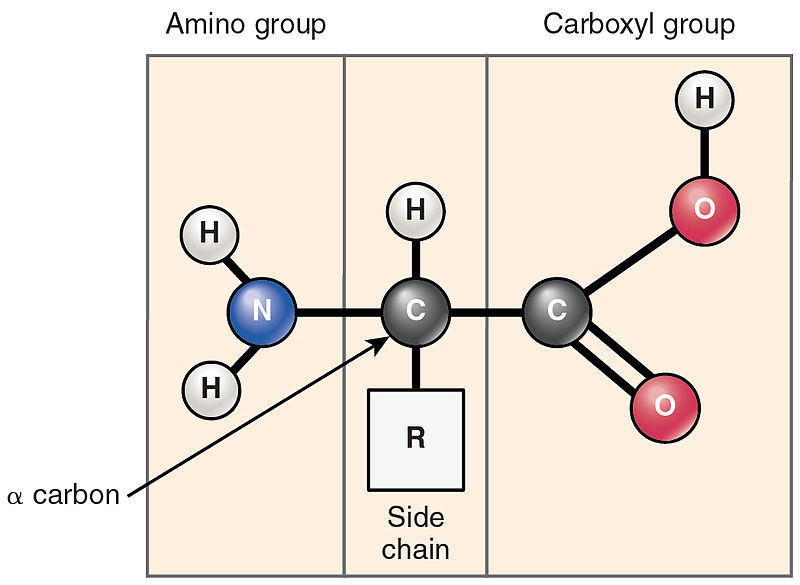
Structure of an Amino Acid
Normally, we study only the proteogenic amino acids, or the ones that make up proteins. Non-proteinogenic amino acids are also important in cells.
The 20 normal proteinogenic amino acids are shown below. They are grouped by properties and the 1 and 3 letter code for the amino acid are shown in the parentheses to the right. The properties of these specific amino acids will be important in understanding the levels of protein structure.
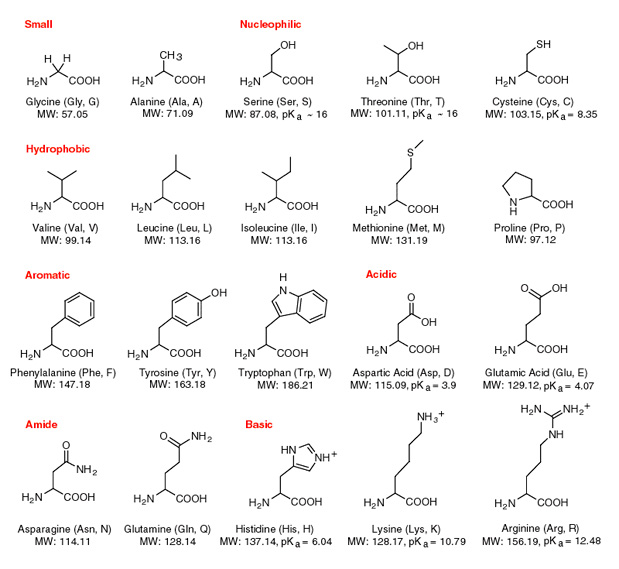
The 20 Proteinogenic Amino Acids
Taking a look at the table above, what is the one letter name of Asparagine?
If you found the amino acid asparagine on the fourth row, you can see the letter N next to the name. N is the one letter code for asparagine.
Amino acids will join together in peptide bonds to form polypeptide chains. The peptide bonds are shown as grey lines in the image below.
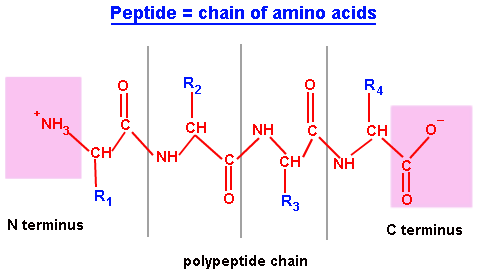
A Polypeptide Chain
We are now ready to take a look at protein structure. There are four distinct levels of protein structure: primary, secondary, tertiary, and quarternary.
Primary structure is simply the linear sequence of amino acids in a polypeptide. of unfolded chain of amino acids that have been produced by a ribosome. We normally list it as the sequence of amino acids from the free amine group end (N-terminus) to the free carboxyl group (C-terminus). One example of primary structure is the sequence This can also be written as
How many different order-dependent two amino acid peptide chains exist?
You have 20 choices for the first amino acid and 20 for the second amino acid so you have possible dipeptides (2 amino acid polypeptide chain).
Knowing this, the next question should be pretty easy.
How many different order-dependent tripeptides (3 amino acid polypeptide chains) exist?
so you have 8000 possible tripeptides. As you can see, the possible number of proteins, which have on average 480 amino acids, is very high. If you assume all proteins are of average length (which they're not), there are 20^480 possible proteins. That's a lot!
Let's take a look at secondary structure. One very smart biochemist/physicist, G. N. Ramachandran decided to try to figure out what conformations the bonds between two adjacent amino acids could occupy without creating steric clash. To avoid going into too much detail, the basis of it will not be explained. It is shown below.
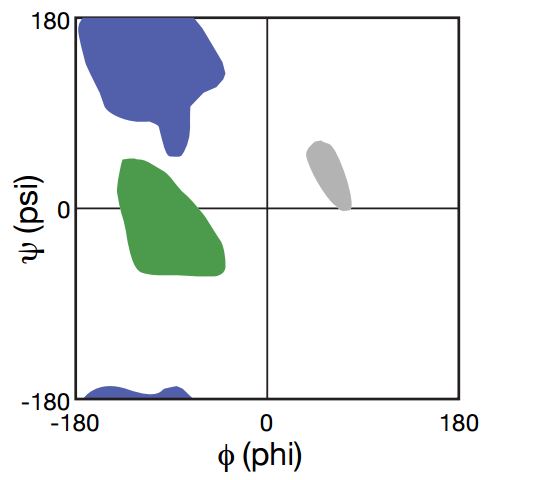
Ramachandran Plot
Phi and Psi are various bond angles in a specific two amino acid linkage.
If the plot of the bond angles in a sequence of amino acids fall in the green region, the structure formed is referred to as an Alpha Helix. As the name implies, an alpha helix is a helical structure. Amino acids commenly found in Alpha Helices are Methionine, Alanine, Leucine, Glutamic Acid, and Lysine or MALEK. This protein, bovine rodhopsin has 7 alpha helices shown as cartoon ribbons in red. Real alpha helices are more complex.
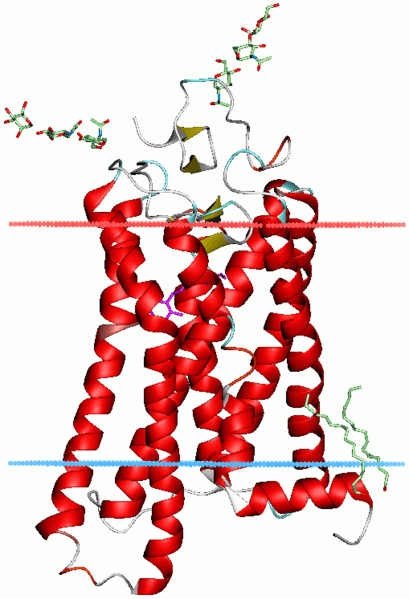
Bovine Rhodopsin with Alpha Helices
If the plot of the bond angles in a sequence of amino acids fall in the blue region, the structure created is referred to as a Beta Pleated Sheet. The protein below, a sucrose porin, has a large beta sheet that twists to form a barrel.
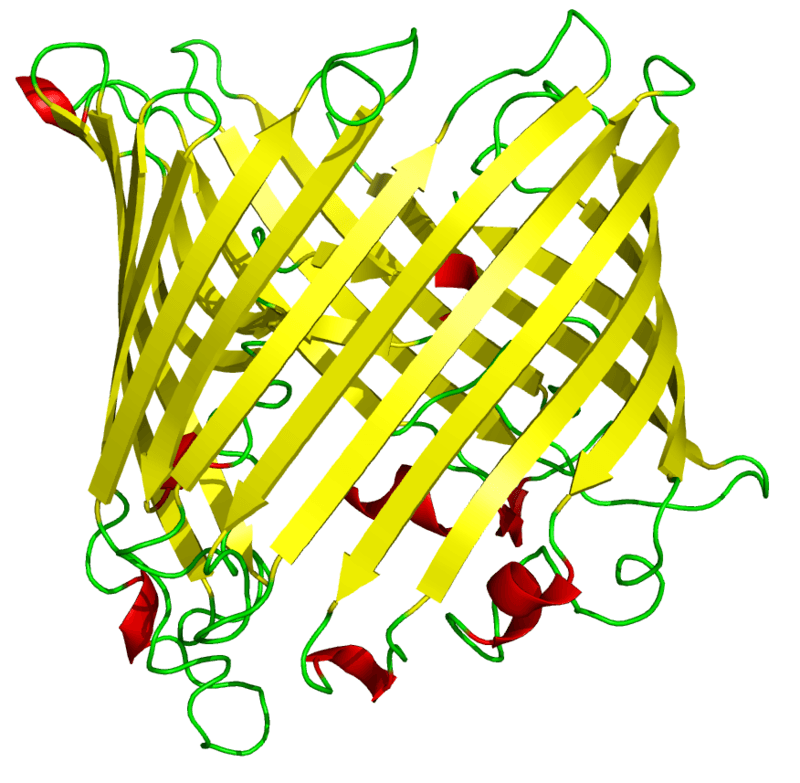
Sucrose Porin with a Beta Barrel
Both beta sheets and alpha helices were first conceptualized by the Nobel prize winning biochemist Linus Pauling by folding a sheet of paper while sick in bed. These structures are also stabilized by an extensive number of hydrogen bonds.
Other structures can form but are uncommmon. Linkers/Loops, segments of proteins that connect alpha helices and beta sheets, can have any of the bond angles shown in the Ramachandran plot.
Which of the following structures makes up most of the multiple subunit protein complex shown below?
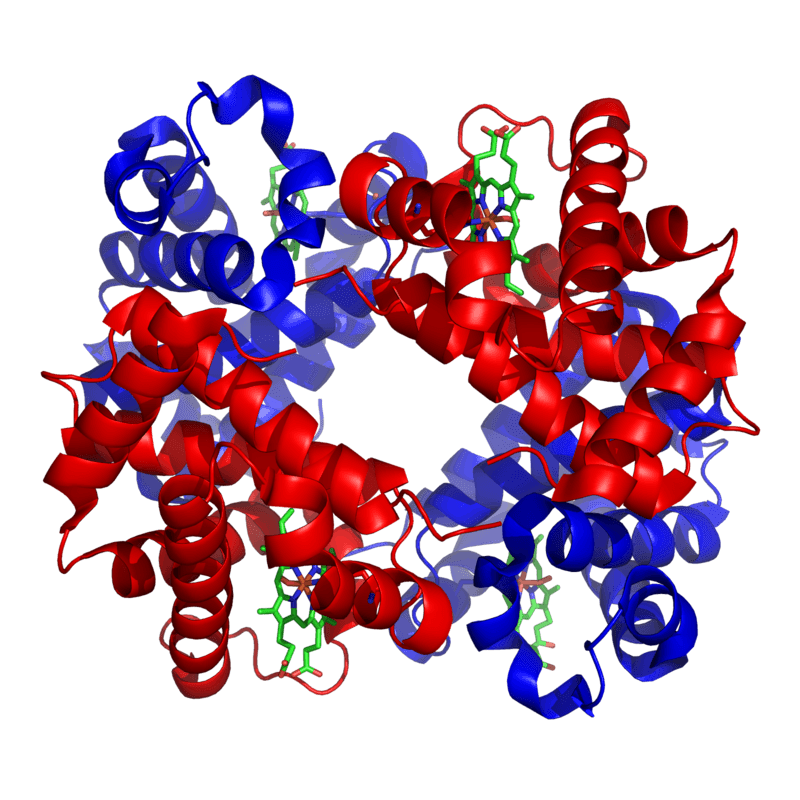
The protein complex above, Hemoglobin, is primarily made up of alpha helices.
Tertiary structure is simply the final 3d shape of the protein that is stabilized by not only the secondary structure but also by Van der Waals interactions, disulfide bonds, hydrogen bonds, and hydrophobic interactions. In other words, it is the specific arrangement of the secondary structure in a single polypeptide chain.
Quarternary structure is just the tertiary structure applied to multiple polypeptide chains that form a protein complex. For example, the hemoglobin complex above.