Interactive · 2 questions

+3 contributors



Properties of Water

Image source: By Rick Doble CC BY-SA 4.0, via Wikimedia Commons
Water is the most abundant compound on Earth's surface. It exists in three forms: solid, liquid, and gas.
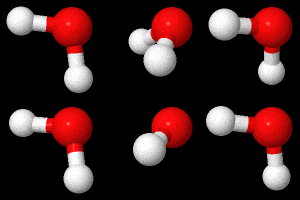
Image source: By Darekk2 CC BY-SA 4.0, via Wikimedia Commons
Water is a polar molecule, which means that it has poles, like a magnet and the Earth. It has a partial positive charge () on the hydrogen atoms and a partial negative charge () on the oxygen atom. The partial charges on a water molecule are similar to a bar magnet, where oppositely charged poles repel each other but opposite poles attract.

Look at where the partial charges are on this water molecule.
Image source: By Drago Karlo CC BY-SA 4.0, via Wikimedia Commons
What is the part of the water molecule with a partial negative charge?
Water has many unique properties that are a result of its polarity. Hydrogen bonding is when the positively charged hydrogen atoms are attracted to the negatively charged oxygen of another water molecule. The poles make water molecules really like sticking to each other.
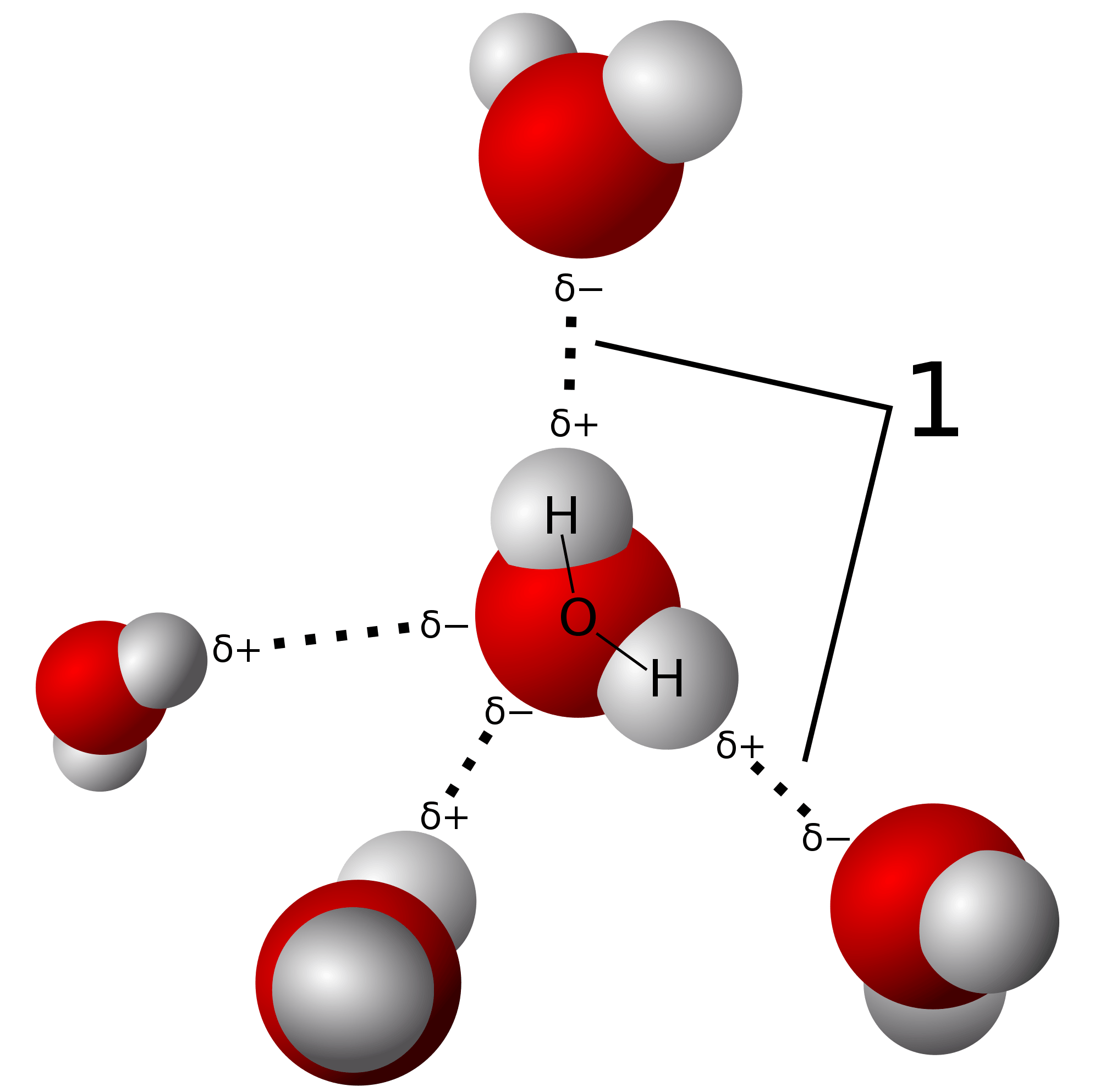
Hydrogen bonding between water molecules.
Image source: By Qwerter, sevela.p, Michal Maňas, Magasjukur2 CC BY-SA 3.0, via Wikimedia Commons
A useful mental picture of this is a pile of magnets. The positive and negative poles are attracted to each other.

Image source: By K. Aainsqatsi at English Wikipedia [Public domain], via Wikimedia Commons
Hydrogen bonding happens between what types of partial charges?
: Partial positive and negative charges caused by some atoms wanting electrons more than other atoms in a molecule
: Positively charged hydrogens of one molecule are attracted to the negative charge on another molecule
: The intermolecular (between-molecules) attraction between molecules of the same type
: The intermolecular attraction between different types of molecules
: The attraction between different molecules on the surface of a liquid
: The amount of heat energy needed to increase the temperature of a specific amount of a substance to a specific temperature. The lower the specific heat, the easier it is to heat a substance up