Interactive · 1 question
We all know from algebra what a parabola is. It's the graph of a quadratic function (a polynomial of degree ). However, it is more than just a mathematical graph in the world of physics. It turns out that when an object is given an initial velocity at any particular direction, if it's not on the ground, it follows the trajectory of a parabola!
When an object is in the air, what non-negligible forces are acting on the object?
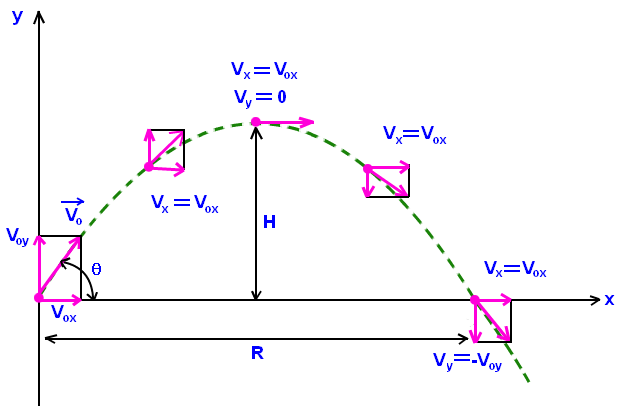
Let us try to discover the path of the trajectory ourselves. Let us say we are on flat ground and a soccer ball is kicked up at angle with respect to the ground, with velocity . Let the point of impact be the origin on the coordinate plane. Then, since there is no horizontal acceleration, the -position of the ball is given by
Now, remember your kinematics! If we let upwards be the positive direction, we find that if the acceleration of gravity is , we get
From here, it is easy to substitute and solve to see that the -equation is a parabola, unless air resistance is present to spoil it! In future sections, you can read more about the properties of these parabolic trajectories, which are given the name projectile motion.