Illustrated · 2 min

+2 contributors


Introduction
In this next lesson in the topic of parametric equations, we will talk about parametrization.
###
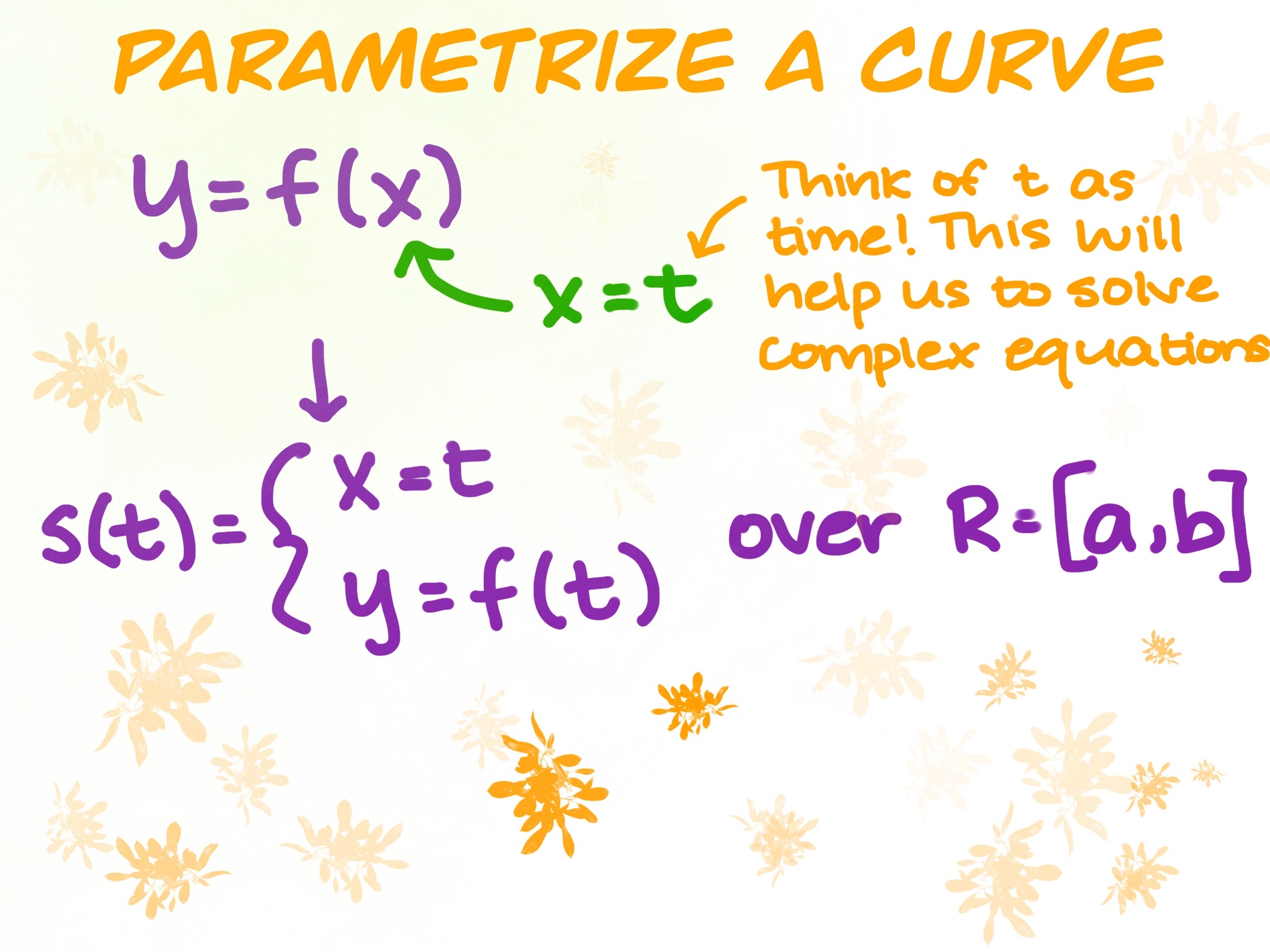
is the process of finding the pair of parametric equations that describe a function.
Okay, let's say we have a function, To determine the two parametric equations that define this function, we first have to make our independent variable, in this case , a of another independent variable, conventionally . This essentially makes equal to a function. So doing that we have, or more accurately, Next, we also have to alter how we define our dependent variable . Since, and is now a function of , , therefore, is now: In this case, since is equal to for any given point, we can just say = and from this conclusion we can also say that
Let's look at more difficult example below:
![Here we have a [quadratic function]() which we are trying to parametrize.
So we first start by setting our independent variable, in this case again $x$, equal to a function of the variable $t$. $f(t)$ is not just equal to $t$ as it was in our first example, in this case $f(t)$ is equal to $t + 2$. So in this case when we make $x$ a function of $t$ we get $x(t) = t +2$](https://d20khd7ddkh5ls.cloudfront.net/img_3246_1_3.jpg)
image source: Mia Evans
Here we have a quadratic function which we are trying to parametrize. So we first start by setting our independent variable, in this case again , equal to a function of the variable . is not just equal to as it was in our first example, in this case is equal to . So in this case when we make a function of we get
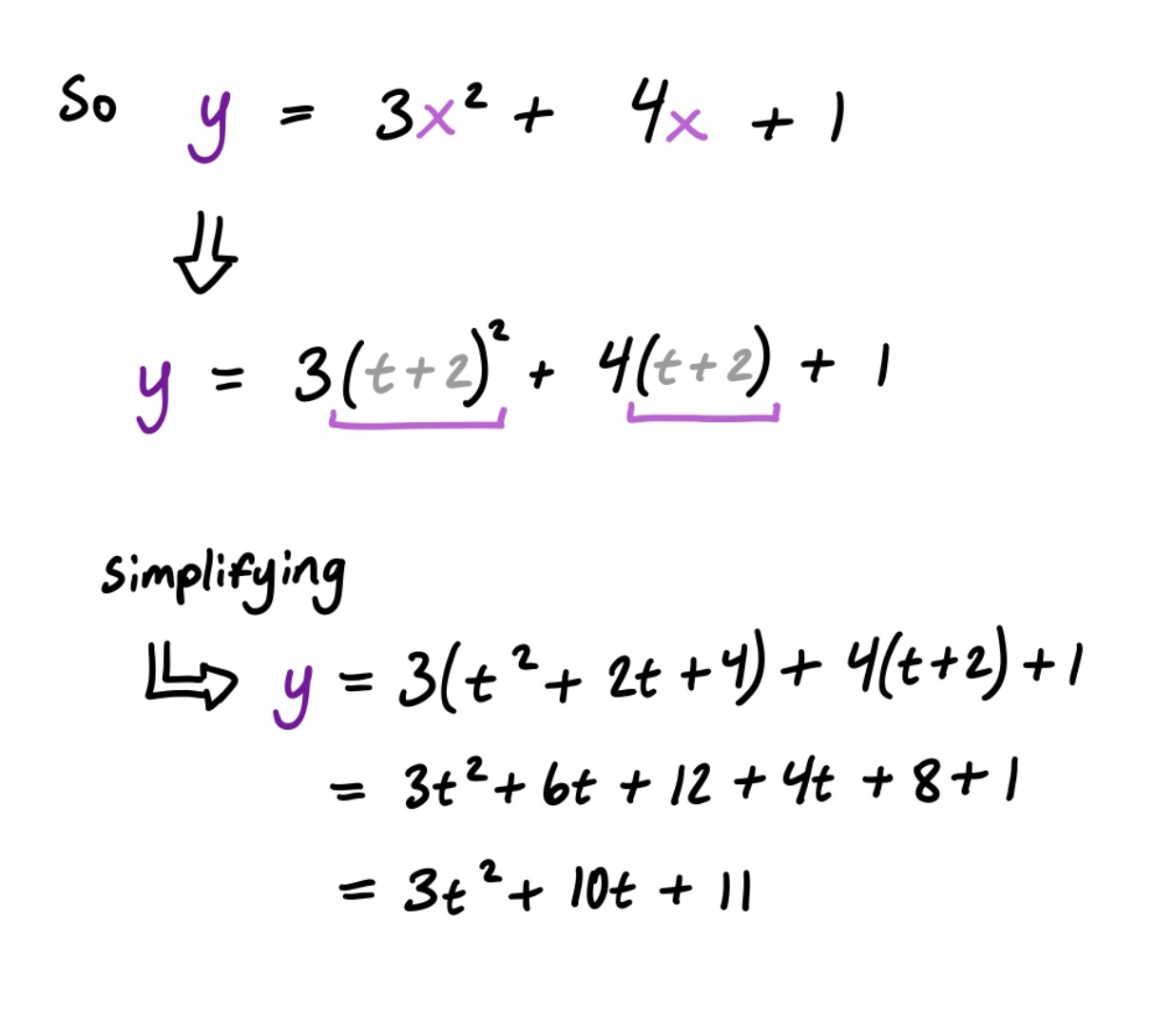
image source: Mia Evans
Since we have adjusted out dependent variable , e now have to adjust our dependent variable . We do this by replacing all the variables we see with what is now equal to: After doing this, we can expand out the equation to simplify.
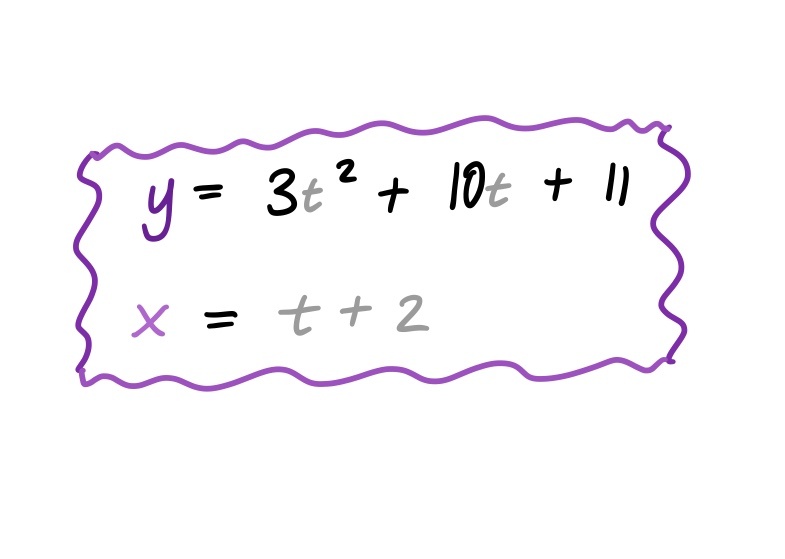
image source: Mia Evans
At the end, this is what our function, originally , becomes when it is represented by parametric equations!
(We could also write these equations as: since and are now functions of ).
You can test if this answer is correct by checking with a point. If the point is on the curve, then it is correct!
Looking Further
We can take this concept a step further when dealing in three dimensions (or other dimensional spaces)! All you have to do is additionally consider the variable.