
Illustrated · 1 min
By Sylvia Freeman

+1 contributors
Contributors


Image source: By Sylvia Freeman
Illustrated · 1 min
Image source: By Sylvia Freeman
Illustrated · 1 min
Imagine that you are renting a one-bedroom apartment and another person tries to live with you.
A mutualistic roommate would help you pay rent.
A commensal roommate would not pay rent but wouldn't ever leave their room or eat your snacks, either.
A parasitic roommate would steal your rent money.

Image source: By Sarah Morgan
In a parasitic relationship, one organism benefits at the expense of another. For example, mosquitoes drink human blood, which causes humans to get itchy and can even get them sick.
Read · 2 min
Parasitism is a symbiotic relationship between two species where one of them benefits (the parasite) and the other is harmed or even killed (the host). We can represent this type of relationship as .
In this relationship, the parasite lives on or inside of the host's body and steals some or all of its nutrients. The parasite doesn't want to outright kill the host since then its free buffet will end. Instead, the parasite will slowly steal the nutrients it needs and will leave enough for the host to survive. This allows the relationship to keep going.
Parasites are disturbingly common. Think of fleas and ticks, leeches, lice, and that sort of nightmare fuel. Malaria is caused by parasites, as are scabies (adult chicken pox) and sleeping sickness.
Host organisms often have defenses against parasites such as tears, skin, and the immune system. If a tick tries to bite you but can't get through the skin, it won't be able to mooch off of you.
The word "parasite" might make you think of little organisms you can't even see, but parasites can be more than that. For example, some birds will lay their eggs in other birds' nests. When the eggs hatch, the parent birds do not recognize that it is not their own offspring. They will feed and care for the mystery chicks as well as their own. This has a negative effect on the parents because they have to hunt for food more often. When birds trick other birds into raising their young, it is called brood parasitism.
: A close, long-term relationship between two species
: How organisms compete for resources like food and water
: The relationship between a predator and its prey
: A relationship between two organisms that helps both of them
: A relationship where one organism benefits and nothing really happens to the other organism
: A relationship where one organism benefits and the other organism is harmed
Illustrated · 2 min
Imagine you’re at school finishing up a test. You notice the kid sitting next to you keeps peeking at your paper. You studied hard to ace this test, and now he’s going to get the same grade as you without any work. While you watch him watching you work, your teacher looks up. Next thing you know, you’re both in trouble. That pesky cheater is just like a parasite.
So, what’s a parasite exactly? Parasites benefit from harming host organisms without killing the host organism. This parasite-host relationship is called parasitic symbiosis.

Image source: By Valeri Natole
Parasitism in Plants
Parasitic plants have a special adaptation, called a haustorium, to steal nutrients from their host plants. A haustorium is a specialized root that connects to the host plant’s internal systems and siphons off valuable nutrients. In this relationship, the parasite plant gets nutrients without doing a whole lot of its own work, while the host plant loses hard-earned food.
An example of a parasitic plant is Amorphophallus titanum, a gigantic red flower that's also called the "corpse flower".

Image source: By Rhododendrites CC BY-SA 4.0, via Wikimedia Commons
Sexual Parasitism
Sexual reproduction: Two parents pass on genes to offspring, increasing the fitness of both parents. Right? Not always.
Sexual parasites use the other parent for their reproduction hardware but don’t allow that second parent to pass on any of its genetic material. This can be a complicated process to understand—it goes against our previous knowledge of sexual reproduction. Some examples of sexual parasites are Amazon mollies and deep-sea anglerfish.

Image source: By R. Mintern [Public domain], via Wikimedia Commons
Worms, Worms, Worms
Trichomoniasis. Chagas disease. Toxoplasmosis. Physaloptera. What do these gross-sounding conditions have in common? They’re all caused by parasitic worms. Worms can sneak into hosts’ bodies in a variety of ways, including ingestion (the host accidentally eats a food contaminated by the worm) or touch (the host touches a surface where the worm is and then touches their eyes, nose, or mouth). Like a lot of other parasites, worms are sneaky because they’re invisible to the naked human eye.
Sounds scary, right? It’s a good thing we and other animals have an immune system—and scientists working on fighting parasites.
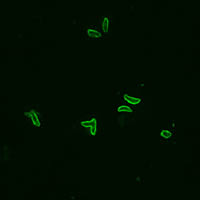
Image source: By Unknown author [Public domain], via Wikimedia Commons

Image source: By Valeri Natole
In mutualism, both species involved benefit.
In commensalism, one species benefits while the other stays unaffected.
Parasitism and predator-prey relationships are more similar to one another. In both, one organism benefits while the other is harmed. The difference is that in parasitism, the benefitting organism doesn’t kill the host. In predator-prey symbiosis, the predator species kills and eats organisms from the prey species.
Fictional parasites and extreme depictions of parasitic invasions show up everywhere in pop culture, from the xenomorphs in Alien to the Yeerks in the Animorphs series. The word "parasite" has even come to have human-centric meanings, like in the title of the 2019 film Parasite.
Video
by Jaap de Roode on TED-Ed
In this relationship, the organism which benefits is called a parasite. Parasites live on or inside another organism called the host. Parasites use their host to obtain all or part of the nutrients they need. They often make their host weaker but don't typically kill it.




