Partial Fraction Decomposition

Before this, knowRational Equations and InequalitiesRational Functions and Graphs

Interactive · 6 questions

Partial fractions (in a "special case")

Partial fractions is a way of taking a rational function (a function of the form p(x)/q(x)p(x)/q(x), where p,qp, q are both polynomials) and "splitting it up" into fractions. An example is 3x−2x2−4=1x−2+2x+2\frac{3x-2}{x^2-4} = \frac{1}{x-2} + \frac{2}{x+2}

Let's find a way to do this. Let's first do it when the denominator is a quadratic, and use the function 3x+1x2−x−6\frac{3x+1}{x^2-x-6} as an example.

In the spirit of the example above, let's try to write 3x+1x2−x−6=cx−a+dx−b\frac{3x+1}{x^2-x-6} = \frac{c}{x-a} + \frac{d}{x-b}

What should a,ba, b equal (given that a<ba < b for the sake of ordering them in your answer below)?

Spot the idea in disguise

In a contest problem, this idea hides inside a situation you have not seen before. Learning to spot it is the real skill. These are real problems from the AMC 12, the national math competitions for middle and high school students, each with a worked solution on LIVE by Po-Shen Loh.

Video · + 1 min read

(Videos) Partial Fraction Decomposition

by PatrickJMT

Here are some videos by patrickJMT showing you how to do partial fraction decomposition.

Partial Fraction Decomposition is the process of taking a simplified fraction and breaking it into smaller fractions.

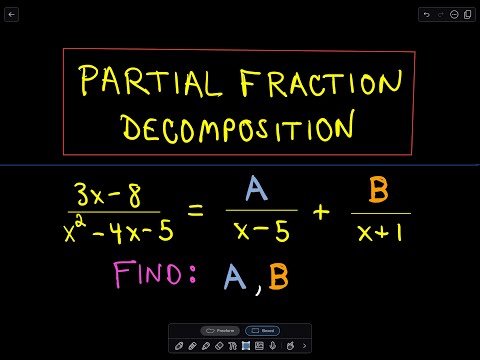
The first example he looks at is: 3x−8x2−4x−5\frac{3x-8}{x^2-4x-5} Before starting the problem there's two things to check:

  1. The degree of the numerator always needs to be smaller than the degree of the denominator.
  2. Does the denominator factor.

Our denominator can factor so let's go ahead and do that. 3x−8x2−4x−5=3x−8(x−5)(x+1)\frac{3x-8}{x^2-4x-5}=\frac{3x-8}{(x-5)(x+1)} Notice that we have two distinct linear factors. What we try to do is break our rational function into two separate fractions. Where each denominator is one of the factors. =Ax−5+Bx+1=\frac{A}{x-5}+\frac{B}{x+1} Our job is to figure out the constants AA and BB. There are multiple ways to solve these. Personally, I like the way Patrick goes about it. You take whatever is on the bottom of our starting fraction and multiply it to both sides.

The result, after canceling, is: 3x−8=A(x+1)+B(x−5)3x-8=A(x+1)+B(x-5) Because our factors are linear, there is a shortcut we can do at this step in order to quickly figure out our AA and BB values.

The first step is to look at the first term on the right, A(x+1)A(x+1), and ask what value of xx can we put in that will cancel that term out? If we pick x=−1x=-1 then the inside becomes 00 which removes the term. So now we plug in x=−1x=-1 into our equation. 3(−1)−8=A(−1+1)+B(−1−5)−11=−6B−11−6=BB=116\begin{align} 3(-1)-8&=A(-1+1)+B(-1-5)\\ -11&=-6B\\ \frac{-11}{-6}&=B \end{align}\\ \boxed{B=\frac{11}{6}}

Next we do the same thing for the second term on the right. Here, x=5x=5 removes the term so let's plug that in. 3(5)−8=A(5+1)+B(5−5)7=6A76=AA=76\begin{align} 3(5)-8&=A(5+1)+B(5-5)\\ 7&=6A\\ \frac{7}{6}&=A \end{align}\\ \boxed{A=\frac{7}{6}}

So now we can write our partial decomposition as =76x+1+116x−5=\boxed{\frac{\frac76}{x+1}+\frac{\frac{11}6}{x-5}}

Video · + 1 min read

(Videos) Partial Fraction Decomposition with Nonlinear Factors

by PatrrickJMT

Here's a video by patrickJMT showing you how to take the partial decomposition when there's nonlinear factors.

The first problem he looks at is 2x2+4x−5x2(x+3)\frac{2x^2+4x-5}{x^2(x+3)} Patrick rewrites the xx being in parentheses then squared 2x2+4x−5(x)2(x+3)\frac{2x^2+4x-5}{(x)^2(x+3)} The reason he does this is because it's important to think about it being two factors of xx. Not just a factor of x2x^2. So now we break it down into the following fractions. =Ax+B(x)2+Cx+3=\frac{A}{x}+\frac{B}{(x)^2}+\frac{C}{x+3}

If we had x3x^3 instead of x2x^2 we would have to make a fraction for xx, x2x^2, and x3x^3.

Now we multiply both sides by the denominator of our original fraction. x2(x+3)2x2+4x−5x2(x+3)=(Ax+Bx2+Cx+3)x2(x+3)\color{#8925AE}{x^2(x+3)}\frac{2x^2+4x-5}{x^2(x+3)}=\left(\frac{A}{x}+\frac{B}{x^2}+\frac{C}{x+3}\right)\color{#8925AE}{x^2(x+3)} Multiplying and canceling factors we get 2x2+4x−5=A(x)(x+3)+B(x+3)+C(x2)2x^2+4x-5=A(x)(x+3)+B(x+3)+C(x^2)

Since our factors are not linear we can't use the shortcut from before. Instead we do a process called equating coefficients. Our first step is to multiply everything out. 2x2+4x−5=Ax2+3Ax+Bx+3B+Cx22x^2+4x-5=Ax^2+3Ax+Bx+3B+Cx^2 Next we group together our like terms. 2x2+4x−5=(A+C)x2+(3A+B)x+3B2x^2+4x-5=(A+C)x^2+(3A+B)x+3B So now we set the coefficients of each term equal to each other. (1)        2=A+C(2)        4=3A+B(3)   −5=3B\begin{align} (1)\ \ \ \ \ \ \ \ 2&=A+C\\ (2)\ \ \ \ \ \ \ \ 4&=3A+B\\ (3)\ \ \ -5&=3B \end{align} Now we solve this system to find the values for AA, BB, and CC.

If we look at equation (3) we can easily find the value of BB. −5=3B−53=BB=−53-5=3B\\ \frac{-5}3=B\\ \boxed{B=-\frac53} With BB we can find AA in equation (2). 4=3A+B4=3A−534+53=3A173=3A179=AA=1794=3A+B\\ 4=3A-\frac53\\ 4+\frac53=3A\\ \frac{17}3=3A\\ \frac{17}9=A\\ \boxed{A=\frac{17}9} Finally, with AA we can find CC in equation (1). 2=A+C2=179+C2−179=C19=CC=192=A+C\\ 2=\frac{17}9+C\\ 2-\frac{17}9=C\\ \frac19=C\\ \boxed{C=\frac19}

So the partial decomposition becomes =179x+−53x2+19x+3=\boxed{\frac{\frac{17}9}{x}+\frac{-\frac53}{x^2}+\frac{\frac19}{x+3}}

Illustrated · 1 min

Partial Fraction Decomposition

Now that we are getting into more complicated math and rational equations, it is important to learn about partial fraction decomposition in order to deal with the large and complex fractions. It may be helpful to review rational expressions, complex numbers, systems of rational equations, and polynomial long division before diving into this lesson.

Partial Fraction Decomposition
1. Factor denominator, replace the numerators with variables
2. Set equal to original fraction, eliminate denominators
3. Get rid of the fractions and solve

Image source: by Anusha Rahman

Partial fraction decomposition allows you to break down large fractions into smaller, more manageable pieces. More importantly, it allows you to solve for variables within the fractions.

The first step is to factor the denominator and replace the numerators with variables. Typically, you will have unknown constants and linear terms in the numerator.

The second step is to set this equal to the original fraction and eliminate the denominators. This will involve a partial fraction expansion, resulting in a system of linear or quadratic equations.

Lastly, the third step is to get rid of the fractions and solve. This is the simplest, most straightforward step.

Looking Further

Many problems in Finite Telescoping Sums and Products begin by using partial fraction decomposition. Breaking each term into simpler fractions makes the cancellation easier to see.

Type a concept, like “slope” or “photosynthesis”.

↑ ↓ to choose · Enter to openSearch explanations and problems